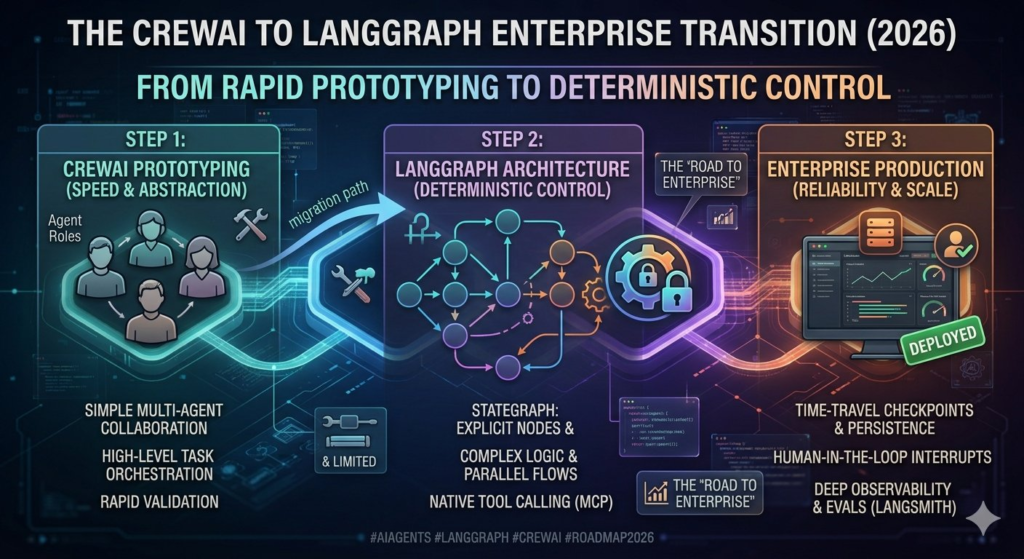
Introduction
The AI agent revolution is accelerating.
Over the last two years, frameworks such as CrewAI, LangGraph, AutoGen, OpenAI Agents SDK, and Semantic Kernel have transformed how developers build intelligent applications.
Among these frameworks, CrewAI became extremely popular because it made multi-agent development simple. Developers could create specialized agents such as researchers, writers, analysts, and reviewers with just a few lines of code.
However, as organizations move from prototypes to production systems, a growing number of engineering teams are discovering a critical reality:
Building a demo agent is easy. Running enterprise AI systems reliably is much harder.
This shift is one reason why many enterprises are increasingly evaluating LangGraph as their preferred framework for production-grade AI agents.
In this article, we’ll explore why LangGraph is gaining momentum, where CrewAI shines, and which framework is best suited for modern enterprise AI development.
Understanding CrewAI
CrewAI was designed around a simple idea:
Create a team of AI agents that collaborate to complete a task.
For example:
Research Agent
      ↓
Writer Agent
      ↓
Editor Agent
      ↓
Final Output
This approach feels natural because it mimics how human teams work.
A research agent gathers information.
A writer agent creates content.
An editor agent improves quality.
The framework automatically coordinates much of this interaction.
This simplicity is the primary reason CrewAI became popular among developers building:
- Content generation systems
- Research assistants
- Marketing automation tools
- Knowledge workers
- Rapid AI prototypes
For proof-of-concept projects, CrewAI can dramatically reduce development time.
The Problem: Enterprise AI Is Different
Most enterprise applications require far more than collaborative agents.
Organizations often need:
- Approval workflows
- Audit logs
- Security controls
- State persistence
- Error recovery
- Human oversight
- Regulatory compliance
- Workflow monitoring
- Deterministic execution
These requirements expose limitations that may not appear during early prototyping.
As complexity grows, organizations need more control over how workflows execute.
This is where LangGraph begins to stand out.
What Makes LangGraph Different?
LangGraph approaches AI systems from a workflow perspective rather than an agent-team perspective.
Instead of focusing primarily on roles and tasks, LangGraph focuses on:
- State
- Nodes
- Edges
- Routing
- Persistence
- Checkpoints
A simple LangGraph workflow looks like:
User
 ↓
Classify
 ↓
Retrieve
 ↓
Generate
 ↓
Review
 ↓
Answer
Each step is explicitly defined.
Every transition is visible.
Every state change can be tracked.
This level of control becomes increasingly valuable in production environments.
Reason 1: Better State Management
One of the biggest challenges in AI systems is managing information across multiple steps.
Consider a customer support workflow.
The system may need to remember:
- Customer identity
- Previous interactions
- Account status
- Order history
- Escalation details
In LangGraph, state is a first-class concept.
Every workflow step reads and updates a shared state.
Example:
State
 ↓
Node
 ↓
Updated State
 ↓
Next Node
This makes workflows easier to understand and debug.
In contrast, many CrewAI workflows rely more heavily on agent interactions and task passing, which can become harder to track as systems grow.
Reason 2: Superior Workflow Control
Enterprise systems rarely follow a straight line.
A real workflow might look like:
Customer Request
        ↓
   Classify Intent
        ↓
 ┌──────┴──────┐
 ↓             ↓
Order       Refund
Query        Request
 ↓             ↓
API         Approval
 ↓             ↓
Answer      Payment
LangGraph was designed specifically for this type of branching logic.
Developers can explicitly define:
- Conditional routing
- Loops
- Retries
- Failure handling
- Escalation paths
This level of control is essential in industries such as banking, healthcare, insurance, and government.
Reason 3: Easier Debugging
Debugging is one of the most overlooked aspects of AI development.
A prototype may work perfectly.
But what happens when:
- An API fails?
- The model hallucinates?
- A tool returns incorrect data?
- A database becomes unavailable?
Without visibility, finding the root cause can be difficult.
LangGraph makes debugging easier because developers can inspect:
- Current state
- Previous state
- Workflow path
- Node outputs
- Routing decisions
When systems become mission-critical, observability becomes a major advantage.
Reason 4: Human-in-the-Loop Workflows
Many organizations do not want AI making final decisions independently.
Consider:
AI Creates Refund
       ↓
Manager Review
       ↓
Approve / Reject
       ↓
Continue Workflow
This pattern is common in:
- Banking
- Healthcare
- Finance
- Legal services
- Enterprise operations
LangGraph supports workflow interruption and approval checkpoints, making it easier to introduce human oversight.
This is increasingly important as AI regulations continue evolving worldwide.
Reason 5: Better Support for Long-Running Agents
Modern AI systems often run for hours or days.
Examples include:
- Research agents
- Supply-chain monitoring
- Incident management
- Financial analysis
- Business intelligence
These workflows require:
- Persistence
- Checkpointing
- Recovery
If a process fails halfway through, organizations don’t want to restart everything.
LangGraph was built with these requirements in mind.
This makes it attractive for large-scale enterprise deployments.
Reason 6: Multi-Agent Systems at Scale
CrewAI made multi-agent development popular.
However, many organizations eventually discover that adding more agents doesn’t automatically create better systems.
A common architecture today looks like:
Supervisor
      ↓
 ┌────┼────┐
 ↓    ↓    ↓
Research
Analysis
Validation
      ↓
   Result
As the number of agents grows, teams need:
- Visibility
- State tracking
- Monitoring
- Error handling
LangGraph provides a structured approach for managing these increasingly complex systems.
Reason 7: Enterprise Governance and Compliance
Enterprise AI projects often operate under strict regulations.
Requirements may include:
- Audit trails
- Decision history
- Workflow records
- User approvals
- Access controls
Organizations need to answer questions such as:
- Why did the AI make this decision?
- Which data was used?
- Who approved the action?
- What happened before the failure?
Graph-based workflows make these questions easier to answer.
This is particularly important in regulated industries.
When CrewAI Is Still the Better Choice
Despite these advantages, CrewAI remains an excellent framework.
It is often the fastest way to build:
Content Teams
Researcher
 ↓
Writer
 ↓
Editor
Marketing Automation
SEO Agent
 ↓
Content Agent
 ↓
Social Agent
Research Systems
Search
 ↓
Analyze
 ↓
Summarize
For startups, freelancers, and rapid prototypes, CrewAI can be highly productive.
When You Should Choose LangGraph
Choose LangGraph if your project requires:
✅ Workflow control
✅ State management
✅ Persistence
✅ RAG systems
✅ Human approvals
✅ Enterprise governance
✅ Long-running workflows
✅ Observability
✅ Recovery mechanisms
✅ Multi-step orchestration
These requirements are increasingly common in production AI systems.
LangGraph vs CrewAI: Quick Comparison
| Feature | CrewAI | LangGraph |
|---|---|---|
| Learning Curve | Easier | Moderate |
| Prototyping Speed | Excellent | Good |
| Workflow Control | Moderate | Excellent |
| State Management | Limited | Excellent |
| Human Approval | Basic | Advanced |
| Persistence | Limited | Strong |
| Enterprise Readiness | Moderate | Excellent |
| Debugging | Moderate | Excellent |
| Multi-Agent Support | Strong | Strong |
| Production Scalability | Moderate | Excellent |
The Future of AI Agent Development
The AI industry is moving toward agentic systems capable of:
- Planning
- Reasoning
- Tool use
- Decision-making
- Collaboration
But enterprises are learning that intelligence alone is not enough.
Successful AI systems must also be:
- Reliable
- Observable
- Secure
- Governed
- Recoverable
This is why workflow-centric frameworks are gaining attention.
The future likely belongs to architectures that combine powerful reasoning with strong operational controls.
Final Thoughts
CrewAI deserves enormous credit for making multi-agent development accessible.
For prototypes, content automation, research assistants, and startup experimentation, it remains one of the most productive frameworks available.
However, enterprise AI requirements are evolving rapidly.
Organizations increasingly need:
- Explicit workflows
- Persistent state
- Human oversight
- Recovery mechanisms
- Governance controls
These needs are pushing many teams toward LangGraph and other workflow-oriented architectures.
The question is no longer:
“Can AI agents collaborate?”
The real question is:
“Can AI agents operate reliably in production at scale?”
For many enterprises in 2026, LangGraph is emerging as the framework better suited to answering that challenge.
However, the ideal platform depends on your cloud strategy:
- Azure AI Search → Best overall enterprise RAG platform
- Vertex AI Search → Best for Google Cloud users
- Elastic → Best for large-scale search workloads
- Weaviate → Best open-source AI-native solution
The future belongs to organizations that can connect AI models with trusted enterprise knowledge, and the right RAG platform is the foundation of that transformation.
If you enjoyed this article, you may also like:
- 5 AI Gateways That Offer Free Tokens in 2026
- How to Build a Humanoid Robot in 2026: Costs, Timeline & Complete Blueprint
- Best AI Research Tools in 2026: ChatGPT, Claude, Gemini & Perplexity
- Best AI Resume Builders in 2026 — Free
- ChatGPT Review — Is It Worth Paying For in 2026?
- 10 Best Free AI Tools You Should Use in 2026
- Best AI Video Generators in 2026 — Free and Paid
- Best AI for Students in 2026: Top 10 Tools for Learning
- How AI Learns From Humans to Build Physical Robots
- How AI Learns From Humans to Build Physical Robots
- Why LangGraph Is So Popular in Enterprises — Pros, Cons & Real-World Use Cases in 2026
- ChatGPT vs Gemini vs Claude vs Grok 2026
- DeepSeek V4 vs Grok 4 vs Claude Opus 5 vs Nvidia Nemotron vs Gemini 2.5 Pro — The Ultimate AI Model Comparison for 2026
- AI Agent and LLM Frameworks Comparison 2026: LangChain vs LangGraph vs CrewAI vs AutoGen vs LlamaIndex vs Semantic Kernel
- Best Multi-Agent AI Platforms in 2026: CrewAI vs AutoGen vs LangGraph vs OpenAI Agents SDK vs Agno vs Semantic Kernel
- Best AI Development Platforms in 2026: OpenAI API vs Anthropic API vs Google AI Studio vs Vertex AI vs Azure AI Foundry vs AWS Bedrock vs Hugging Face
- Exploring the Latest AI Tools and Technologies
- How to Use ChatGPT for Business — A Complete Beginner Guide
- How to Write Blog Posts with AI — A Proven Step-by-Step Guide
- Best AI Coding Assistants 2026
- Ultimate Guide to the 10 Best AI Chatbots in 2026
- Claude AI Review — Best ChatGPT Alternative in 2026
- Jasper AI Review — Is It Worth $49/Month in 2026?
- How to Use AI for Social Media Marketing — Complete Guide
- AI Tools for Small Business Owners — Save 10 Hours/Week
- AI Tools for Content Creators
- Best AI Music Generators in 2026 — Create Songs in Minutes
- AI Design Tools Compared: Canva AI vs Adobe Firefly vs Midjourney
- Best AI Writing Tools 2026
- 10 Free AI Tools You Should Try in 2026
- Best AI Image Generators in 2026 — Free and Paid Compared
- Best AI Productivity Tools in 2026 — Work Smarter, Not Harder
- ChatGPT vs Claude in 2026 — Which AI Is Actually Better?
- ChatGPT vs Gemini vs Claude vs Grok (2026): Which AI Assistant Should You Actually Use?
Visit Aidacoit.com for more AI comparisons, practical AI tutorials, enterprise AI insights, and emerging technology trends