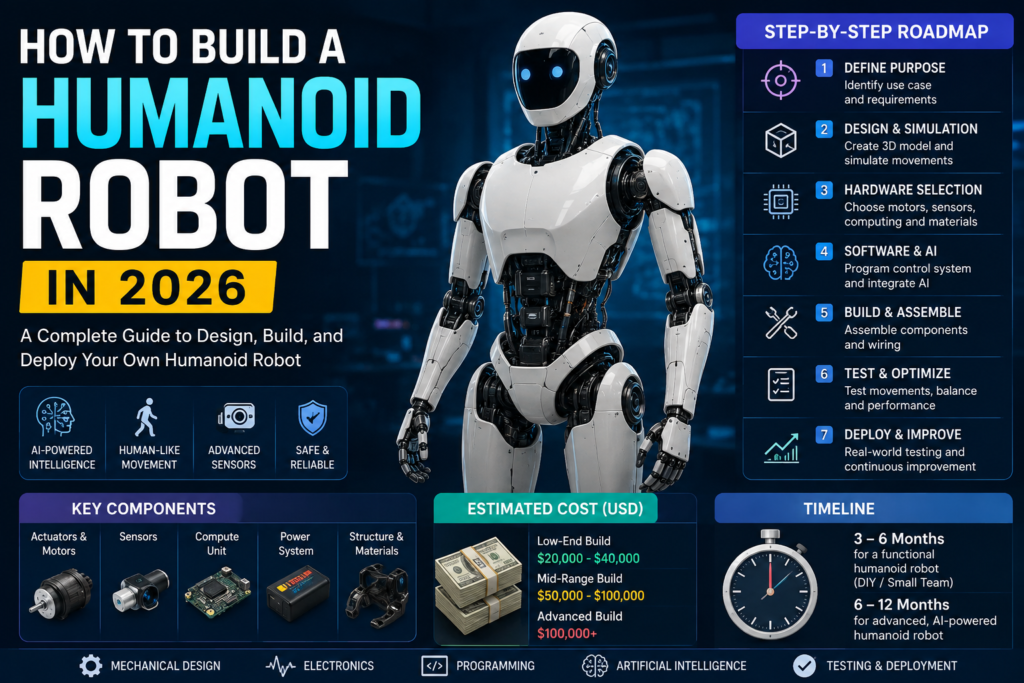
Can You Create a Humanoid Robot in Minutes?
The short answer is No.
While AI can help generate robot designs, software, CAD models, and control systems in minutes, building a real humanoid robot still requires hardware engineering, robotics expertise, manufacturing, AI training, and testing.
Today’s most advanced humanoid robots such as Tesla Optimus, Figure AI, Unitree G1, Atlas, and Apptronik Apollo are the result of years of engineering and millions of dollars in investment. Industry leaders still believe that truly general-purpose humanoid robots remain several years away from mass adoption.
However, an individual, startup, or engineering team can build a working humanoid robot prototype much faster and at a significantly lower cost than was possible a few years ago.
How Much Does It Cost to Build a Humanoid Robot?
The answer depends on the robot’s capabilities.
| Type | Estimated Cost |
|---|---|
| Educational Humanoid | $5,000 – $10,000 |
| Research Humanoid | $20,000 – $80,000 |
| Advanced Startup Prototype | $50,000 – $150,000 |
| Industrial Humanoid | $100,000 – $300,000+ |
Recent industry estimates place basic humanoid builds at several thousand dollars and advanced systems well into six figures depending on sensors, actuators, dexterity, and software capabilities.
Where Does the Money Go?
A humanoid robot is much more than a metal body.
1. Actuators (Largest Cost)
Actuators function as muscles.
They power:
- Legs
- Arms
- Hands
- Neck
- Torso
Actuators typically account for 40–60% of the robot’s total cost.
2. Sensors
Robots need sensors to understand the world.
Common sensors include:
- Cameras
- Depth sensors
- LiDAR
- emu sensors
- Force sensors
Sensor systems can represent 10–20% of total cost.
3. AI Compute
The robot requires onboard computing for:
- Vision
- Navigation
- Planning
- AI inference
Compute systems often account for 10–15% of the bill of materials.
4. Battery System
Battery packs power the robot.
Typical runtime:
- 2–8 hours
- Depending on workload
Battery systems usually represent 5–10% of total cost.
5. Mechanical Structure
Includes:
- Chassis
- Skeleton
- Covers
- Frames
- Fasteners
Example Startup Prototype Budget
Mechanical Components
- Frame: $2,000
- Joints: $8,000
- Actuators: $15,000
Subtotal:
$25,000
Electronics
- Cameras
- Sensors
- Controllers
- Wiring
Subtotal:
$5,000–$10,000
AI Computing
- NVIDIA Jetson
- GPU systems
- Embedded processors
Subtotal:
$3,000–$10,000
Battery System
Subtotal:
$1,000–$5,000
Software Development
- ROS2
- AI models
- Control software
- Simulation
Subtotal:
$10,000–$50,000
Estimated Startup Prototype Cost
$50,000 – $100,000
This is the range where many serious startup prototypes begin.
Complete Humanoid Robot road map
Phase 1: Define Objectives (Week 1)
Ask:
What should the robot do?
Examples:
- Warehouse work
- Home assistance
- Elder care
- Security
- Retail
- Manufacturing
Clear objectives reduce cost dramatically.
Phase 2: Design the Robot (Weeks 2–6)
Create:
- CAD models
- Joint architecture
- Weight distribution
- Mechanical design
Tools:
- Fusion 360
- SolidWorks
- Onshape
Phase 3: Build the Body (Month 2–3)
Develop:
- Frame
- Skeleton
- Joint assemblies
- Structural parts
Prototype using:
- 3D printing
- CNC machining
- Aluminum components
Phase 4: Install Electronics (Month 3–4)
Integrate:
- Cameras
- Sensors
- Actuators
- Power systems
- Compute hardware
Phase 5: Build the Brain (Month 4–6)
Software stack:
Robotics Layer
- ROS2
Computer Vision
- YOLO
- OpenCV
AI Models
- GPT models
- Claude
- Gemini
- Open-source LLMs
Motion Planning
- MoveIt
- Isaac Sim
Phase 6: Train the Robot (Month 5–8)
Robots learn through:
Simulation
Training in virtual environments.
Teleoperation
Humans control robots remotely.
Demonstration Learning
Robot watches human actions.
Reinforcement Learning
Robot improves through trial and error.
Phase 7: Real World Testing (Month 8–12)
Test:
- Walking
- Grasping
- Balance
- Navigation
- Safety
This stage often takes longer than hardware development.
Realistic Development Timeline
Hobbyist Project
6–12 months
University Research Robot
12–24 months
Startup MVP
12–18 months
Commercial Humanoid Robot
2–5 years
Tesla-Level Humanoid Platform
5–10 years
Even major companies continue refining humanoid robots before large-scale deployment. Commercial rollouts are still progressing gradually across the industry.
Can AI Build Humanoid Robots Automatically?
Not yet.
AI can assist with:
✅ Design optimization
✅ Code generation
✅ Motion planning
✅ Simulation
✅ Training
✅ Vision systems
But humans still handle:
- Hardware assembly
- Manufacturing
- Safety validation
- Mechanical engineering
- System integration
The future will likely involve AI-human collaboration rather than fully autonomous robot creation.
Business Opportunities
Humanoid robotics is becoming one of the fastest-growing technology sectors.
Potential opportunities include:
Warehouse Automation
- Picking
- Packing
- Loading
Manufacturing
- Assembly
- Inspection
Healthcare
- Elder assistance
- Hospital logistics
Retail
- Customer support
- Inventory management
Home Robotics
- Cleaning
- Assistance
- Monitoring
Companies worldwide are investing billions into humanoid robotics as they prepare for future commercial deployments.
Future Cost of Humanoid Robots
Most industry experts expect costs to fall significantly over the next decade.
Many manufacturers are targeting future price ranges of approximately:
$20,000–$50,000 per robot at scale, which could make humanoid robots economically viable for many industries.
Final Thoughts
Creating a humanoid robot in minutes is not realistic today. However, AI tools, better hardware, cheaper sensors, and open-source robotics software have dramatically reduced development barriers.
A motivated individual can build a basic humanoid prototype for under $10,000, while startups can create serious commercial prototypes in the $50,000–$150,000 range. Advanced industrial humanoids may cost significantly more, but prices continue to decline as the industry matures.
The next decade is likely to be one of the most exciting periods in robotics history, and humanoid robots could become as transformative as smartphones and personal computers were in previous generations.
Explore More AI & Robotics Guides on Aidacoit
- ChatGPT vs Gemini vs Claude vs Grok — Which AI Should You Actually Use?
- 30 Powerful Things Claude Can Do in 2026
- Best AI Gateways to Access Multiple Models
- How AI Is Training Humans to Build Physical Robots
- Why LangGraph Is Popular Across Enterprise AI Teams
- CrewAI vs AutoGen vs LangGraph vs OpenAI Agents SDK
- Best AI Development Platforms for Startups and Enterprises
- How to Find Trending AI Topics Before They Go Viral
Pingback: Exploring the Latest AI Tools and Technologies
Pingback: How to Write Blog Posts with AI: A Step-by-Step Guide
Pingback: AI Design Tools Compared — Canva AI vs Adobe Firefly vs Midjourney - Aidacoit
Pingback: Aidacoit.com Aidacoit - Aidacoit.com Aidacoit Aidacoit.com
Pingback: Best AI Image Generators in 2026 — Free and Paid Compared - Aidacoit
Pingback: ChatGPT vs Claude in 2026 — Which AI Is Actually Better? - Aidacoit
Pingback: 10 AI Tools That Can Replace Hours of Manual Work Every Week (2026)
Pingback: Jasper AI Review — Is It Worth $49/Month in 2026? - Aidacoit
Pingback: The Ultimate AI Model Comparison for 2026 - Aidacoit
Pingback: 10 Best AI Chatbots in 2026: Your Complete Guide to Options
Pingback: 5 Best AI Coding Assistants in 2026 — Tested and Compared
Pingback: Why LangGraph Is So Popular in Enterprises: Pros, Cons, and Real-World Use Cases in 2026 - Aidacoit
Pingback: Best AI Development Platforms in 2026 - Aidacoit
Pingback: Best Multi-Agent AI Platforms in 2026 - Aidacoit
Pingback: AI Agent and LLM Frameworks Comparison 2026 - Aidacoit
Pingback: ChatGPT vs Gemini vs Claude vs Grok (2026) – Ultimate AI Comparison Guide
Pingback: How Companies Are Using AI Agents in Production: Real-World Enterprise Use Cases - Aidacoit
Pingback: Is an AI Agent the Same as a Bot? Understanding the Key Differences in 2026 - Aidacoit
Pingback: Is AI Rilo Sold in 200 Cr.? What Is AI Rilo? Why Adobe Acquired This Indian AI Startup Within a Year of Launch - Aidacoit