Introduction
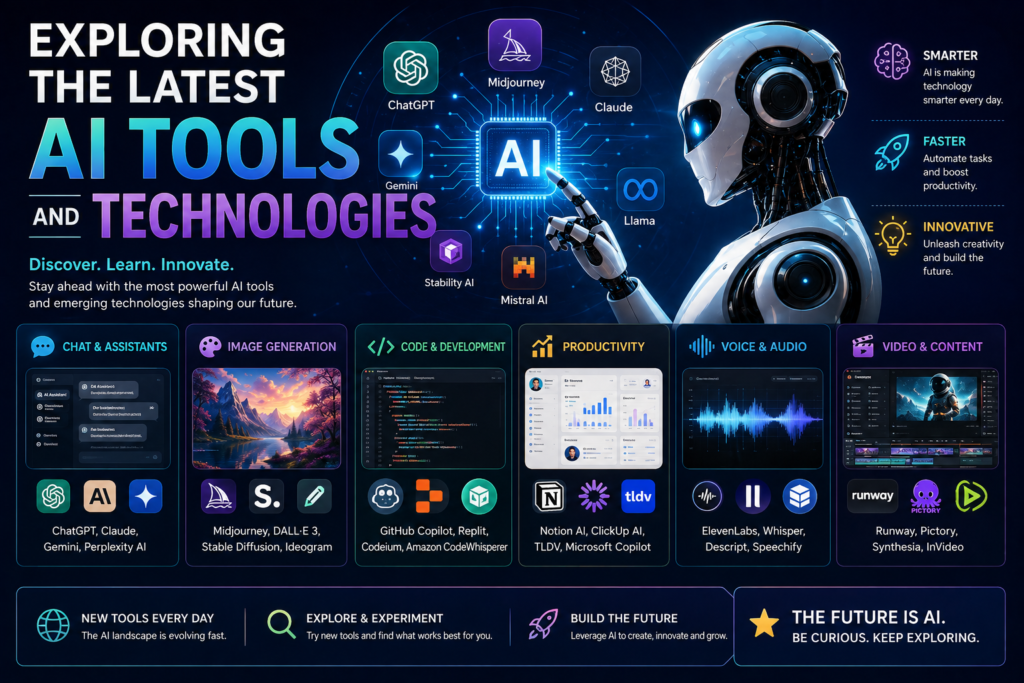
Artificial Intelligence (AI) continues to transform industries, businesses, and everyday life at an unprecedented pace. From AI-powered assistants and content generation tools to autonomous agents and robotics, the AI landscape in 2026 is more advanced and accessible than ever before.
Whether you’re a student, entrepreneur, developer, marketer, or business leader, understanding the latest AI tools and technologies can help you stay competitive and unlock new opportunities. This guide explores the most influential AI innovations of 2026, their applications, benefits, and what the future may hold.
What Are AI Tools?
AI tools are software applications and platforms that use artificial intelligence technologies such as:
- Machine Learning (ML)
- Natural Language Processing (NLP)
- Computer Vision
- Deep Learning
- Generative AI
- Reinforcement Learning
These tools automate tasks, generate insights, improve productivity, and enable intelligent decision-making.
Why AI Tools Matter in 2026
Organizations worldwide are increasingly investing in AI to:
- Reduce operational costs
- Improve customer experiences
- Increase employee productivity
- Accelerate innovation
- Automate repetitive tasks
- Gain competitive advantages
According to industry reports, AI adoption continues to grow across sectors including healthcare, finance, manufacturing, retail, education, and software development.
Top AI Tools Making an Impact in 2026
1. ChatGPT
ChatGPT remains one of the most popular AI assistants globally.
Key Features
- Conversational AI
- Content creation
- Research assistance
- Coding support
- Data analysis
- Business automation
Best For
- Students
- Writers
- Developers
- Business professionals
Benefits
- Saves time
- Enhances productivity
- Simplifies complex tasks
- Supports learning and research
2. Claude
Claude has become a preferred AI platform for businesses that require long-context reasoning and document analysis.
Key Features
- Advanced reasoning
- Large context windows
- Document summarization
- Enterprise AI applications
- Knowledge management
Ideal Users
- Researchers
- Legal professionals
- Enterprises
- Consultants
3. Google Gemini
Google Gemini integrates deeply with Google’s ecosystem.
Features
- Multimodal understanding
- Workspace integration
- Search augmentation
- Coding assistance
- Image and video understanding
Advantages
- Seamless integration with Google services
- Strong research capabilities
- Enterprise-grade security
4. GitHub Copilot
AI-assisted software development continues to evolve.
Key Capabilities
- Code completion
- Bug detection
- Refactoring suggestions
- Documentation generation
- Productivity enhancement
Benefits for Developers
- Faster development cycles
- Reduced coding errors
- Improved code quality
5. Midjourney and AI Image Generation Tools
AI-generated imagery has become increasingly sophisticated.
Common Applications
- Marketing graphics
- Product designs
- Concept art
- Social media content
- Branding materials
Advantages
- Rapid visual content creation
- Reduced design costs
- Enhanced creative workflows
The Rise of AI Agents
One of the most exciting developments in 2026 is the growth of AI agents.
What Are AI Agents?
AI agents are systems capable of:
- Planning tasks
- Executing workflows
- Using tools
- Making decisions
- Collaborating with other agents
Unlike traditional chatbots, AI agents can complete multi-step objectives with minimal human intervention.
Popular Agent Frameworks
LangGraph
Known for creating reliable, stateful AI applications.
CrewAI
Designed for collaborative multi-agent workflows.
OpenAI Agents SDK
Provides tools for building production-ready AI agents.
AutoGen
Facilitates communication among multiple AI agents.
AI Development Platforms
Developers now have access to powerful AI infrastructure platforms.
OpenAI API
Provides access to advanced language and multimodal models.
Google AI Studio
Offers rapid prototyping and model experimentation.
Vertex AI
Enterprise AI development platform from Google Cloud.
Azure AI Foundry
Supports AI deployment at scale.
AWS Bedrock
Provides managed access to leading foundation models.
Hugging Face
A hub for open-source AI models and machine learning communities.
Emerging AI Technologies to Watch
Multimodal AI
AI systems can now process:
- Text
- Images
- Audio
- Video
- Documents
This creates more natural and powerful user experiences.
AI Robotics
Robotics is becoming increasingly intelligent through:
- Vision systems
- Reinforcement learning
- Autonomous navigation
- Human-robot collaboration
Humanoid robots are expected to play a larger role in logistics, manufacturing, healthcare, and customer service.
AI Search Engines
Modern AI search combines:
- Traditional search
- Conversational responses
- Real-time information retrieval
- Personalized recommendations
Synthetic Data Generation
Organizations use AI-generated datasets to train models while improving privacy and reducing costs.
Benefits of Adopting AI Tools
Increased Productivity
AI automates repetitive tasks and accelerates workflows.
Better Decision-Making
Advanced analytics provide actionable insights.
Enhanced Customer Service
AI-powered assistants deliver faster and more consistent support.
Cost Savings
Automation reduces operational expenses.
Scalability
Organizations can handle larger workloads without proportional increases in staffing.
Challenges and Considerations
While AI offers significant advantages, organizations should also consider:
Data Privacy
Protecting user information remains critical.
Model Accuracy
AI outputs should be reviewed for correctness.
Security Risks
AI systems must be protected from misuse and vulnerabilities.
Ethical Concerns
Transparency and responsible AI practices are increasingly important.
How Businesses Can Get Started with AI
Step 1: Identify Use Cases
Focus on areas where automation can create measurable value.
Step 2: Select the Right Tools
Choose platforms that align with business objectives and budgets.
Step 3: Start Small
Pilot projects can demonstrate ROI before large-scale implementation.
Step 4: Train Teams
Invest in AI literacy and workforce readiness.
Step 5: Measure Results
Track performance improvements and optimize continuously.
The Future of AI Technology
The next wave of AI innovation is expected to include:
- More capable AI agents
- Advanced robotics
- Personalized AI assistants
- Autonomous business workflows
- Enhanced multimodal systems
- Improved AI reasoning capabilities
As AI continues to evolve, organizations that embrace these technologies responsibly will be better positioned for long-term success.
Conclusion
The latest AI tools and technologies are reshaping how people work, learn, create, and innovate. From conversational AI platforms like ChatGPT and Claude to advanced agent frameworks and robotics systems, the opportunities are expanding rapidly.
Businesses and individuals who stay informed about emerging AI trends can leverage these tools to improve productivity, reduce costs, and unlock new possibilities. As AI becomes increasingly integrated into everyday life, understanding and adopting the right technologies will be essential for thriving in the digital future.
If you enjoyed this article, you may also like:
- 5 AI Gateways That Offer Free Tokens in 2026
- How to Build a Humanoid Robot in 2026: Costs, Timeline & Complete Blueprint
- Best AI Research Tools in 2026: ChatGPT, Claude, Gemini & Perplexity
- Best AI Resume Builders in 2026 — Free
- ChatGPT Review — Is It Worth Paying For in 2026?
- 10 Best Free AI Tools You Should Use in 2026
- Best AI Video Generators in 2026 — Free and Paid
- Best AI for Students in 2026: Top 10 Tools for Learning
- How AI Learns From Humans to Build Physical Robots
Visit Aidacoit.com for more AI comparisons, practical AI tutorials, enterprise AI insights, and emerging technology trends.
Pingback: Jasper AI Review — Is It Worth $49/Month in 2026? - Aidacoit
Pingback: AI Design Tools Compared — Canva AI vs Adobe Firefly vs Midjourney - Aidacoit
Pingback: ChatGPT vs Claude in 2026 — Which AI Is Actually Better?
Pingback: The Ultimate AI Model Comparison for 2026 - Aidacoit
Pingback: Why LangGraph Is So Popular in Enterprises: Pros, Cons, and Real-World Use Cases in 2026 - Aidacoit
Pingback: Best AI Development Platforms in 2026 - Aidacoit
Pingback: Best Multi-Agent AI Platforms in 2026 - Aidacoit
Pingback: 10 AI Tools That Can Replace Hours of Manual Work Every Week (2026)
Pingback: ChatGPT vs Gemini vs Claude vs Grok (2026) – Ultimate AI Comparison Guide
Pingback: Claude AI Review — Best ChatGPT Alternative in 2026? - Aidacoit