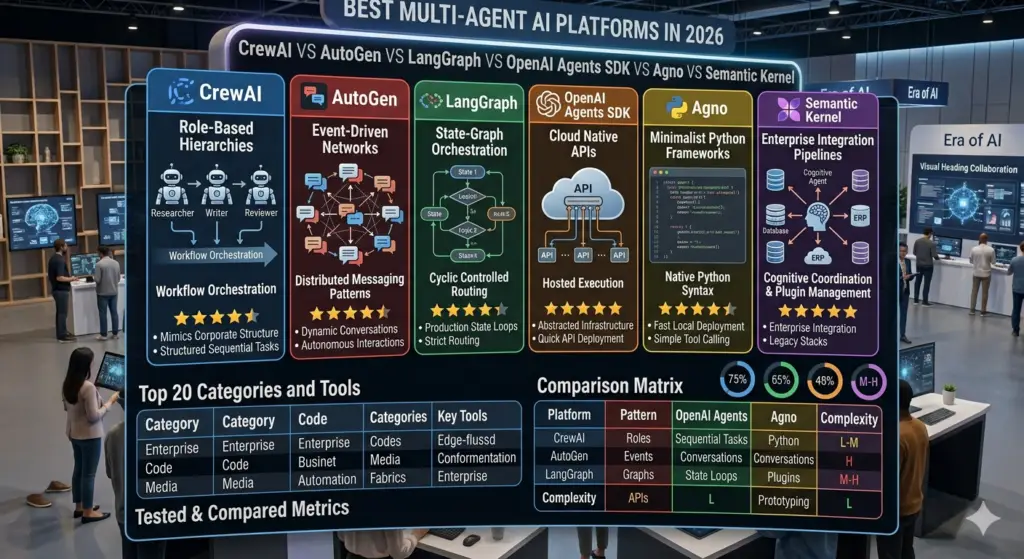
CrewAI vs LangGraph vs OpenAI Agents SDK vs AutoGen vs Agno vs Semantic Kernel (2026)
Introduction
The AI industry is rapidly shifting from single-agent systems to multi-agent AI architectures.
Instead of relying on one AI model to handle every task, organizations are building teams of specialized AI agents that collaborate to solve complex problems. One agent researches, another analyzes, another writes, and another validates the output.
This approach is transforming enterprise automation, customer support, software development, research workflows, and business operations.
As a result, demand for multi-agent platforms has exploded in 2026. Among the most popular solutions are:
- CrewAI
- AutoGen
- LangGraph
- OpenAI Agents SDK
- Agno
- Semantic Kernel
But which platform is actually best?
The answer depends on your goals, team expertise, infrastructure requirements, and scalability needs.
This guide compares the leading multi-agent platforms to help you choose the right solution.
What Is a Multi-Agent Platform?
A multi-agent platform allows multiple AI agents to collaborate on a shared objective.
For example:
Research Agent
↓
Analysis Agent
↓
Writing Agent
↓
Quality Assurance Agent
Instead of one model doing everything, specialized agents work together and often produce better outcomes.
Modern multi-agent systems support:
- Task delegation
- Tool usage
- Memory sharing
- Human approvals
- Workflow orchestration
- Autonomous decision-making
- Long-running processes
These capabilities make them ideal for enterprise AI deployments.
Quick Comparison Table
| Platform | Best For | Difficulty | Enterprise Readiness |
|---|---|---|---|
| LangGraph | Production AI systems | Advanced | Excellent |
| CrewAI | Fast multi-agent development | Easy | Good |
| OpenAI Agents SDK | OpenAI-native applications | Easy | Very Good |
| AutoGen | Agent collaboration and research | Medium | Moderate |
| Agno | Lightweight agent development | Easy | Growing |
| Semantic Kernel | Microsoft enterprise environments | Medium | Excellent |
LangGraph: The Enterprise Leader
LangGraph has emerged as the dominant framework for production-grade agent systems.
Unlike traditional agent frameworks, LangGraph uses a graph-based architecture where developers define states, transitions, loops, checkpoints, and execution paths.
This provides exceptional control over agent behavior and makes it ideal for enterprise deployments requiring reliability and observability. Multiple industry comparisons now position LangGraph as the default choice for serious production environments.
Advantages
- Durable execution
- Stateful workflows
- Human-in-the-loop support
- Excellent debugging tools
- Strong observability
- Large ecosystem
Limitations
- Steeper learning curve
- More setup required
- Complex architecture for beginners
Best Use Cases
- Enterprise automation
- Financial workflows
- AI operations
- Customer service platforms
- Agent orchestration at scale
Verdict
If your project will eventually serve thousands of users or automate critical business processes, LangGraph is often the safest long-term investment.
CrewAI: The Most Beginner-Friendly Multi-Agent Platform
CrewAI became popular because it made multi-agent systems easy to understand.
Instead of graphs and state machines, developers simply create agents with roles such as:
- Researcher
- Writer
- Reviewer
- Analyst
- Manager
The platform then coordinates these agents into a collaborative “crew.”
This role-based model dramatically reduces complexity and allows developers to create working multi-agent systems in a short amount of time.
Advantages
- Fast learning curve
- Excellent documentation
- Simple architecture
- Strong community support
- Rapid prototyping
Limitations
- Less control over workflows
- Limited orchestration compared to LangGraph
- Complex enterprise scenarios may require customization
Best Use Cases
- Content generation
- Research assistants
- Marketing automation
- Startup MVPs
- Proof-of-concept projects
Verdict
CrewAI is arguably the easiest way to start building multi-agent systems today.
OpenAI Agents SDK: Fastest Path to Production
OpenAI introduced the Agents SDK to simplify agent development within its ecosystem.
The SDK provides built-in support for:
- Tools
- Handoffs
- Tracing
- Sessions
- Guardrails
- Agent coordination
For teams already using OpenAI models, the Agents SDK offers one of the fastest routes from concept to deployment. Industry reviews consistently rank it among the simplest platforms to ship production agents.
Advantages
- Simple API design
- Built-in tracing
- Native guardrails
- Strong documentation
- Quick implementation
Limitations
- Strong dependence on OpenAI ecosystem
- Less workflow flexibility than LangGraph
- Higher vendor lock-in risk
Best Use Cases
- SaaS applications
- Customer support agents
- Internal productivity tools
- OpenAI-centered products
Verdict
For teams already committed to OpenAI, the Agents SDK is often the quickest way to build reliable AI agents.
AutoGen: The Research Favorite
AutoGen, originally developed by Microsoft Research, helped popularize the idea of AI agents communicating with each other.
Its conversational architecture enables multiple agents to debate, refine ideas, review code, and solve problems collaboratively.
Although newer frameworks have gained momentum, AutoGen remains highly respected for experimentation and advanced research workflows.
Advantages
- Strong agent-to-agent communication
- Flexible collaboration patterns
- Excellent research capabilities
- Good coding workflows
Limitations
- More complex than CrewAI
- Smaller production footprint
- Not always the easiest platform to scale
Best Use Cases
- Research assistants
- Coding agents
- AI experimentation
- Academic projects
Verdict
If your focus is exploration and experimentation rather than enterprise deployment, AutoGen remains a strong option.
Agno: The Rising Lightweight Alternative
Agno (formerly Phidata) has gained popularity among developers seeking simplicity and flexibility.
The framework focuses on creating lightweight AI agents with access to tools, memory, retrieval systems, and workflows without the complexity of larger orchestration platforms.
Many startups appreciate Agno because it allows rapid development while remaining model-agnostic.
Advantages
- Lightweight architecture
- Easy setup
- Flexible integrations
- Good developer experience
- Supports agent memory and tools
Limitations
- Smaller ecosystem
- Less enterprise adoption
- Fewer production case studies
Best Use Cases
- Startup products
- Internal automation
- Personal AI assistants
- Rapid experimentation
Verdict
Agno is one of the most promising emerging platforms for developers who want simplicity without sacrificing flexibility.
Semantic Kernel: Microsoft’s Enterprise Powerhouse
Semantic Kernel is Microsoft’s enterprise-oriented AI framework.
Unlike many agent platforms focused solely on orchestration, Semantic Kernel integrates AI deeply into existing business applications through plugins, planners, memory systems, and enterprise workflows.
It supports multiple programming languages and fits naturally into Azure-based environments. Industry comparisons consistently recommend it for organizations heavily invested in Microsoft technologies.
Advantages
- Enterprise-grade architecture
- Excellent Azure integration
- Strong governance features
- Multi-language support
- Security-focused design
Limitations
- Higher learning curve
- Less beginner-friendly
- Best suited for Microsoft ecosystems
Best Use Cases
- Enterprise software
- Azure deployments
- Corporate automation
- Internal business applications
Verdict
For large organizations already using Microsoft technologies, Semantic Kernel remains one of the strongest choices available.
Which Multi-Agent Platform Is Best?
The answer depends on your priorities.
Choose LangGraph If:
- You need enterprise-grade reliability.
- Workflow control matters.
- Long-running agents are required.
Choose CrewAI If:
- You want rapid development.
- You are new to multi-agent systems.
- Your workflow resembles a team of specialists.
Choose OpenAI Agents SDK If:
- You use OpenAI extensively.
- Fast deployment is important.
- You want built-in tracing and guardrails.
Choose AutoGen If:
- Research is your priority.
- Agent collaboration is central to the project.
- You need advanced conversational workflows.
Choose Agno If:
- You prefer lightweight frameworks.
- Startup agility is important.
- Simplicity matters more than enterprise features.
Choose Semantic Kernel If:
- Your organization uses Azure.
- Enterprise governance is critical.
- You need deep Microsoft integration.
Final Verdict
The multi-agent ecosystem has matured significantly in 2026, but there is no universal winner.
LangGraph leads in enterprise orchestration and production reliability. CrewAI offers the easiest learning curve and fastest development experience. OpenAI Agents SDK provides the simplest path for OpenAI-centric applications. AutoGen remains valuable for research-focused collaboration. Agno is emerging as a lightweight alternative, while Semantic Kernel continues to dominate Microsoft enterprise environments.
For most serious production deployments, LangGraph is currently the strongest overall choice. For startups and solo developers, CrewAI and Agno provide faster results with less complexity. Enterprise Microsoft customers will likely find Semantic Kernel the most natural fit.
The best platform is the one that matches your team’s expertise, infrastructure strategy, and long-term AI roadmap.
If you enjoyed this article, you may also like:
- 5 AI Gateways That Offer Free Tokens in 2026
- How to Build a Humanoid Robot in 2026: Costs, Timeline & Complete Blueprint
- Best AI Research Tools in 2026: ChatGPT, Claude, Gemini & Perplexity
- Best AI Resume Builders in 2026 — Free
- ChatGPT Review — Is It Worth Paying For in 2026?
- 10 Best Free AI Tools You Should Use in 2026
- Best AI Video Generators in 2026 — Free and Paid
- Best AI for Students in 2026: Top 10 Tools for Learning
- How AI Learns From Humans to Build Physical Robots
- How AI Learns From Humans to Build Physical Robots
- Why LangGraph Is So Popular in Enterprises — Pros, Cons & Real-World Use Cases in 2026
- ChatGPT vs Gemini vs Claude vs Grok 2026
- DeepSeek V4 vs Grok 4 vs Claude Opus 5 vs Nvidia Nemotron vs Gemini 2.5 Pro — The Ultimate AI Model Comparison for 2026
- AI Agent and LLM Frameworks Comparison 2026: LangChain vs LangGraph vs CrewAI vs AutoGen vs LlamaIndex vs Semantic Kernel
- Best Multi-Agent AI Platforms in 2026: CrewAI vs AutoGen vs LangGraph vs OpenAI Agents SDK vs Agno vs Semantic Kernel
- Best AI Development Platforms in 2026: OpenAI API vs Anthropic API vs Google AI Studio vs Vertex AI vs Azure AI Foundry vs AWS Bedrock vs Hugging Face
- Exploring the Latest AI Tools and Technologies
- How to Use ChatGPT for Business — A Complete Beginner Guide
- How to Write Blog Posts with AI — A Proven Step-by-Step Guide
- Best AI Coding Assistants 2026
- Ultimate Guide to the 10 Best AI Chatbots in 2026
- Claude AI Review — Best ChatGPT Alternative in 2026
- Jasper AI Review — Is It Worth $49/Month in 2026?
- How to Use AI for Social Media Marketing — Complete Guide
- AI Tools for Small Business Owners — Save 10 Hours/Week
- AI Tools for Content Creators
- Best AI Music Generators in 2026 — Create Songs in Minutes
- AI Design Tools Compared: Canva AI vs Adobe Firefly vs Midjourney
- Best AI Writing Tools 2026
- 10 Free AI Tools You Should Try in 2026
- Best AI Image Generators in 2026 — Free and Paid Compared
- Best AI Productivity Tools in 2026 — Work Smarter, Not Harder
- ChatGPT vs Claude in 2026 — Which AI Is Actually Better?
Visit Aidacoit.com for more AI comparisons, practical AI tutorials, enterprise AI insights, and emerging technology trends.
Pingback: Best AI Image Generators in 2026 — Free and Paid Compared - Aidacoit
Pingback: ChatGPT vs Claude in 2026 — Which AI Is Actually Better?
Pingback: 10 Best AI Chatbots in 2026: Your Complete Guide to Options
Pingback: 5 Best AI Coding Assistants in 2026 — Tested and Compared
Pingback: AI Agent and LLM Frameworks Comparison 2026 - Aidacoit
Pingback: 10 AI Tools That Can Replace Hours of Manual Work Every Week (2026)
Pingback: Best AI Development Platforms in 2026 - Aidacoit
Pingback: How Companies Are Using AI Agents in Production: Real-World Enterprise Use Cases - Aidacoit
Pingback: Is an AI Agent the Same as a Bot? Understanding the Key Differences in 2026 - Aidacoit
Pingback: Is AI Rilo Sold in 200 Cr.? What Is AI Rilo? Why Adobe Acquired This Indian AI Startup Within a Year of Launch - Aidacoit