Introduction
Artificial Intelligence has moved far beyond experimentation. In 2026, businesses of every size are building AI-powered applications, intelligent agents, customer support systems, automation workflows, coding assistants, research tools, and enterprise knowledge platforms.
The foundation of every successful AI application is the development platform behind it.
Whether you’re building a startup MVP, enterprise AI solution, autonomous agent system, or Retrieval-Augmented Generation (RAG) application, choosing the right AI development platform can significantly impact cost, scalability, security, and long-term success.
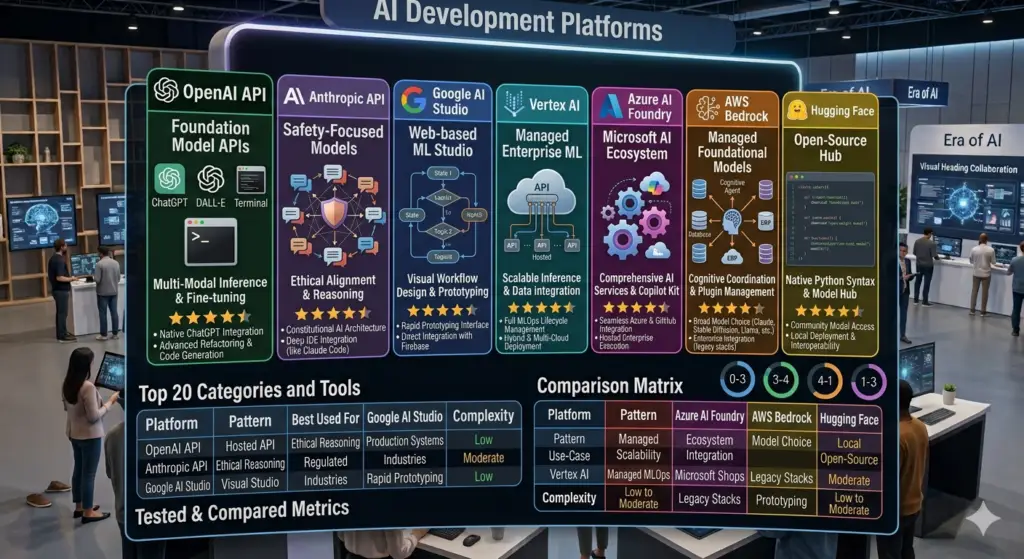
Today’s AI ecosystem is dominated by several major platforms:
- OpenAI API
- Anthropic API
- Google AI Studio
- Vertex AI
- Azure AI Foundry
- AWS Bedrock
- Hugging Face
Each platform serves a different audience and offers unique advantages.
This guide compares the leading AI development platforms and helps you determine which one best fits your business needs.
What Is an AI Development Platform?
An AI development platform provides developers with the tools, infrastructure, APIs, models, and deployment capabilities needed to build AI-powered applications.
Modern AI platforms typically include:
- Large Language Models (LLMs)
- Embedding models
- Image generation models
- Speech capabilities
- Agent frameworks
- Fine-tuning tools
- Security controls
- Monitoring and analytics
- Cloud deployment infrastructure
Instead of building AI systems from scratch, developers use these platforms to accelerate development and reduce complexity.
Quick Comparison Table
| Platform | Best For | Enterprise Ready | Ease of Use |
|---|---|---|---|
| OpenAI API | General AI applications | Excellent | Very Easy |
| Anthropic API | Enterprise AI and safety | Excellent | Easy |
| Google AI Studio | Rapid Gemini development | Good | Very Easy |
| Vertex AI | Enterprise AI on Google Cloud | Excellent | Medium |
| Azure AI Foundry | Large enterprise deployments | Excellent | Medium |
| AWS Bedrock | Multi-model enterprise environments | Excellent | Medium |
| Hugging Face | Open-source AI development | Good | Easy |
OpenAI API: The Industry Standard
OpenAI remains one of the most widely used AI development platforms in the world.
Its API gives developers access to advanced language models, reasoning models, embeddings, image generation, speech systems, and agent-building capabilities.
One of OpenAI’s biggest advantages is simplicity. Developers can build sophisticated AI applications with relatively little code.
Advantages
- Easy-to-use API
- Excellent documentation
- Strong reasoning and coding models
- Extensive developer ecosystem
- Built-in tools and agent support
Limitations
- Vendor dependency
- Premium pricing for advanced usage
- Less flexibility than open-source alternatives
Best Use Cases
- AI assistants
- SaaS products
- Customer support automation
- AI agents
- Content generation
Verdict
For most startups and developers, OpenAI remains the easiest platform to start building AI-powered applications.
Anthropic API: Enterprise Reliability and Safety
Anthropic has become a favorite among enterprises due to its focus on reliability, safety, and long-context reasoning.
The Claude family of models is known for strong writing quality, research capabilities, coding assistance, and enterprise-grade workflows.
Many organizations choose Anthropic when accuracy, governance, and predictable behavior are critical.
Advantages
- Excellent reasoning
- Strong coding performance
- High-quality content generation
- Large context windows
- Enterprise-focused design
Limitations
- Smaller ecosystem than OpenAI
- Fewer third-party integrations
- Premium pricing
Best Use Cases
- Enterprise knowledge systems
- Research assistants
- Document analysis
- AI-powered workflows
- Professional content creation
Verdict
Anthropic is often the preferred choice for businesses that prioritize reliability and enterprise-grade AI performance.
Google AI Studio: Fastest Way to Build with Gemini
Google AI Studio is Google’s developer-focused platform for building applications powered by Gemini models.
The platform emphasizes simplicity and rapid experimentation. Developers can quickly test prompts, prototype applications, and integrate Gemini capabilities without managing complex infrastructure.
Google AI Studio is especially attractive for startups and independent developers looking to experiment with Gemini’s multimodal capabilities.
Advantages
- Beginner-friendly interface
- Quick prototyping
- Access to Gemini models
- Multimodal capabilities
- Easy API integration
Limitations
- Not designed for large enterprise deployments
- Limited infrastructure controls
- Less comprehensive than Vertex AI
Best Use Cases
- Prototypes
- AI experiments
- Small applications
- Startup MVPs
- Gemini development
Verdict
Google AI Studio is one of the fastest ways to start building with Gemini models.
Vertex AI: Google’s Enterprise AI Platform
Vertex AI represents Google’s full-scale enterprise AI offering.
Unlike AI Studio, Vertex AI includes advanced capabilities such as:
- Model deployment
- Agent development
- MLOps
- Monitoring
- Security controls
- Data integration
- Enterprise governance
Vertex AI allows businesses to combine Gemini models with Google’s cloud infrastructure and analytics ecosystem.
Advantages
- Enterprise-grade infrastructure
- Advanced deployment capabilities
- Strong MLOps features
- Google Cloud integration
- Multimodal AI support
Limitations
- Higher learning curve
- More complex pricing
- Requires Google Cloud expertise
Best Use Cases
- Enterprise AI applications
- Large-scale deployments
- Data-intensive projects
- AI-powered business platforms
Verdict
Organizations already using Google Cloud often find Vertex AI to be the most powerful option available.
Azure AI Foundry: Enterprise AI at Scale
Microsoft has aggressively expanded its AI ecosystem through Azure AI Foundry.
The platform combines AI models, development tools, agent frameworks, monitoring, security, and governance into a unified environment.
One major advantage is deep integration with Microsoft’s business ecosystem, including:
- Microsoft 365
- Azure Cloud
- GitHub
- Power Platform
- Dynamics 365
Advantages
- Strong enterprise governance
- Excellent security controls
- OpenAI model access
- Microsoft ecosystem integration
- Scalable infrastructure
Limitations
- Complexity for beginners
- Enterprise-focused pricing
- Learning curve for Azure services
Best Use Cases
- Corporate AI deployments
- Enterprise automation
- Internal business applications
- Microsoft-centric organizations
Verdict
Azure AI Foundry is one of the strongest choices for large enterprises and regulated industries.
AWS Bedrock: Multi-Model Enterprise Flexibility
AWS Bedrock takes a different approach from most competitors.
Instead of promoting a single model family, Bedrock gives organizations access to multiple leading AI providers through one platform.
Businesses can use models from different vendors while maintaining centralized governance and infrastructure.
This flexibility makes Bedrock particularly attractive for enterprises that want to avoid vendor lock-in.
Advantages
- Multiple model providers
- Enterprise scalability
- Strong security
- AWS ecosystem integration
- Flexible deployment options
Limitations
- More complex setup
- Steeper learning curve
- AWS expertise often required
Best Use Cases
- Enterprise AI applications
- Multi-model strategies
- Large cloud environments
- Highly regulated industries
Verdict
AWS Bedrock is ideal for organizations seeking maximum flexibility and long-term scalability.
Hugging Face: The Open-Source AI Leader
Hugging Face has become the center of the open-source AI ecosystem.
Unlike cloud-first platforms, Hugging Face provides access to thousands of open-source models, datasets, and development tools.
Developers can experiment with models, fine-tune them, host them, and deploy them in production environments.
This openness has made Hugging Face a favorite among researchers, startups, and AI enthusiasts.
Advantages
- Massive model library
- Open-source ecosystem
- Strong community support
- Flexible deployment options
- Cost-effective experimentation
Limitations
- More technical setup
- Requires infrastructure management
- Enterprise features vary by deployment
Best Use Cases
- Research projects
- Custom model development
- Fine-tuning
- Open-source AI applications
- Academic environments
Verdict
For developers who value flexibility and open-source innovation, Hugging Face remains unmatched.
Which AI Development Platform Should You Choose?
Choose OpenAI API If:
- You want the fastest path to production.
- Ease of use is a priority.
- You’re building customer-facing AI applications.
Choose Anthropic API If:
- Reliability matters.
- You need long-context reasoning.
- Enterprise workflows are important.
Choose Google AI Studio If:
- You’re prototyping with Gemini.
- You want a beginner-friendly platform.
Choose Vertex AI If:
- You’re already using Google Cloud.
- Enterprise scalability is critical.
Choose Azure AI Foundry If:
- Your company relies on Microsoft technologies.
- Governance and security are top priorities.
Choose AWS Bedrock If:
- You want access to multiple AI providers.
- Vendor flexibility matters.
Choose Hugging Face If:
- Open-source AI is your priority.
- You need custom models and fine-tuning.
Final Verdict
The AI development platform market has become highly competitive, and each provider offers unique advantages.
OpenAI API remains the best overall choice for most developers and startups due to its simplicity and ecosystem. Anthropic API excels in enterprise reasoning and reliability. Google AI Studio is ideal for rapid Gemini development, while Vertex AI delivers enterprise-grade Google Cloud capabilities.
For large organizations, Azure AI Foundry and AWS Bedrock provide exceptional scalability, governance, and deployment flexibility. Meanwhile, Hugging Face continues to dominate the open-source AI landscape.
The best platform ultimately depends on your business goals, technical expertise, cloud strategy, and long-term AI roadmap.
Organizations that carefully evaluate these factors will be better positioned to build scalable, secure, and future-ready AI applications.
FAQ
Which AI development platform is best for startups?
OpenAI API is generally the easiest and fastest platform for startups to build and launch AI-powered products.
Which platform is best for enterprises?
Azure AI Foundry, Vertex AI, AWS Bedrock, and Anthropic API are among the strongest enterprise-focused solutions.
Is Hugging Face free?
Many Hugging Face resources are free and open source, although enterprise hosting and advanced services may require paid plans.
Which platform is best for AI agents?
OpenAI API, Anthropic API, Vertex AI, Azure AI Foundry, and AWS Bedrock all provide strong support for agent-based applications.
Which AI platform has the largest ecosystem?
OpenAI currently has one of the largest developer ecosystems, while Hugging Face leads the open-source community.
If you enjoyed this article, you may also like:
- 5 AI Gateways That Offer Free Tokens in 2026
- How to Build a Humanoid Robot in 2026: Costs, Timeline & Complete Blueprint
- Best AI Research Tools in 2026: ChatGPT, Claude, Gemini & Perplexity
- Best AI Resume Builders in 2026 — Free
- ChatGPT Review — Is It Worth Paying For in 2026?
- 10 Best Free AI Tools You Should Use in 2026
- Best AI Video Generators in 2026 — Free and Paid
- Best AI for Students in 2026: Top 10 Tools for Learning
- How AI Learns From Humans to Build Physical Robots
- How AI Learns From Humans to Build Physical Robots
- Why LangGraph Is So Popular in Enterprises — Pros, Cons & Real-World Use Cases in 2026
- ChatGPT vs Gemini vs Claude vs Grok 2026
- DeepSeek V4 vs Grok 4 vs Claude Opus 5 vs Nvidia Nemotron vs Gemini 2.5 Pro — The Ultimate AI Model Comparison for 2026
- AI Agent and LLM Frameworks Comparison 2026: LangChain vs LangGraph vs CrewAI vs AutoGen vs LlamaIndex vs Semantic Kernel
- Best Multi-Agent AI Platforms in 2026: CrewAI vs AutoGen vs LangGraph vs OpenAI Agents SDK vs Agno vs Semantic Kernel
- Best AI Development Platforms in 2026: OpenAI API vs Anthropic API vs Google AI Studio vs Vertex AI vs Azure AI Foundry vs AWS Bedrock vs Hugging Face
- Exploring the Latest AI Tools and Technologies
- How to Use ChatGPT for Business — A Complete Beginner Guide
- How to Write Blog Posts with AI — A Proven Step-by-Step Guide
- Best AI Coding Assistants 2026
- Ultimate Guide to the 10 Best AI Chatbots in 2026
- Claude AI Review — Best ChatGPT Alternative in 2026
- Jasper AI Review — Is It Worth $49/Month in 2026?
- How to Use AI for Social Media Marketing — Complete Guide
- AI Tools for Small Business Owners — Save 10 Hours/Week
- AI Tools for Content Creators
- Best AI Music Generators in 2026 — Create Songs in Minutes
- AI Design Tools Compared: Canva AI vs Adobe Firefly vs Midjourney
- Best AI Writing Tools 2026
- 10 Free AI Tools You Should Try in 2026
- Best AI Image Generators in 2026 — Free and Paid Compared
- Best AI Productivity Tools in 2026 — Work Smarter, Not Harder
- ChatGPT vs Claude in 2026 — Which AI Is Actually Better?
Visit Aidacoit.com for more AI comparisons, practical AI tutorials, enterprise AI insights, and emerging technology trends.
Pingback: 10 Best AI Video Generators in 2026
Pingback: Claude AI Review — Best ChatGPT Alternative in 2026? - Aidacoit
Pingback: Aidacoit.com Aidacoit - Aidacoit.com Aidacoit Aidacoit.com
Pingback: Best AI Image Generators in 2026 — Free and Paid Compared - Aidacoit
Pingback: 10 AI Tools That Can Replace Hours of Manual Work Every Week (2026)
Pingback: The Ultimate AI Model Comparison for 2026 - Aidacoit
Pingback: 5 Best AI Coding Assistants in 2026 — Tested and Compared
Pingback: Why LangGraph Is So Popular in Enterprises
Pingback: ChatGPT vs Gemini vs Claude vs Grok – Which AI Should You Actually Use in 2026? - Aidacoit
Pingback: Best Multi-Agent AI Platforms in 2026 - Aidacoit