Introduction
Artificial Intelligence is rapidly moving beyond simple chatbots. Modern AI systems can plan tasks, use tools, access databases, coordinate with other agents, and execute complex workflows autonomously. These capabilities are made possible through AI agent and LLM frameworks.
As organizations race to build AI-powered products, choosing the right framework has become one of the most important technical decisions. The wrong choice can lead to scalability issues, maintenance challenges, and costly rewrites later.
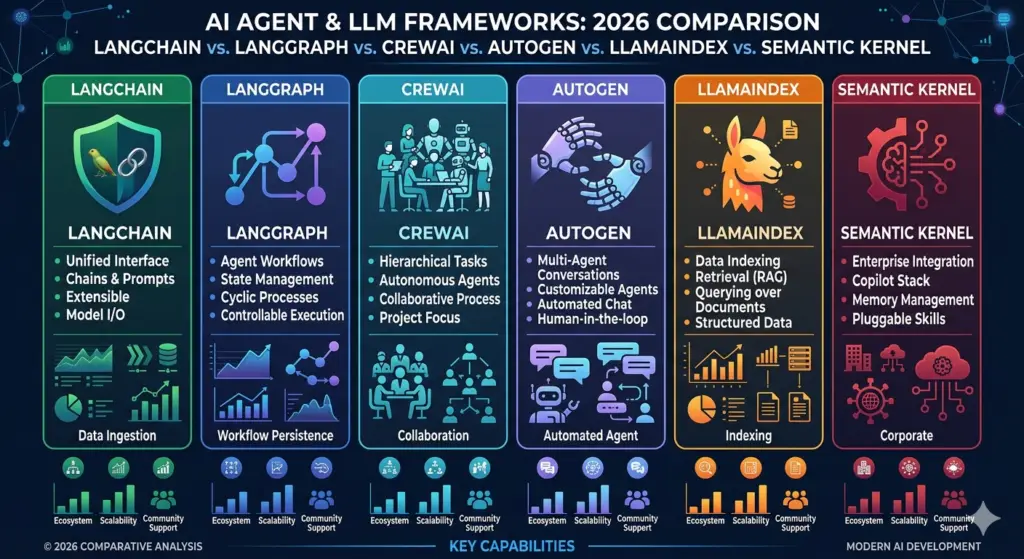
In 2026, several frameworks dominate the market, including LangChain, LangGraph, CrewAI, AutoGen, LlamaIndex, and Semantic Kernel. Each framework takes a different approach to building intelligent AI systems and serves different business needs.
This guide provides a detailed comparison to help developers, startups, and enterprises select the best framework for their projects.
What Is an AI Agent Framework?
An AI agent framework is a software layer that enables Large Language Models (LLMs) to perform actions beyond simple text generation. These frameworks provide capabilities such as:
- Tool calling
- Memory management
- Multi-step reasoning
- Workflow orchestration
- Multi-agent collaboration
- Human-in-the-loop approvals
- Integration with external systems
Instead of asking a model a single question, AI agents can plan, execute tasks, retrieve information, and adapt based on results.
Quick Comparison Table
| Framework | Best For | Difficulty | Production Readiness |
|---|---|---|---|
| LangChain | General AI Applications | Medium | High |
| LangGraph | Complex AI Agents | Advanced | Very High |
| CrewAI | Multi-Agent Teams | Easy | High |
| AutoGen | Conversational Agents | Medium | Moderate |
| LlamaIndex | RAG Applications | Easy | High |
| Semantic Kernel | Enterprise Microsoft Stack | Medium | High |
LangChain: The Foundation of Modern AI Development
LangChain remains one of the most widely adopted frameworks in the AI ecosystem. It provides abstractions for prompts, chains, memory, tools, agents, and model integrations.
One of LangChain’s biggest advantages is its extensive ecosystem. Developers can connect models from OpenAI, Anthropic, Google, DeepSeek, Mistral, and many other providers through a consistent interface.
Advantages
- Huge developer community
- Extensive integrations
- Flexible architecture
- Supports multiple model providers
- Strong documentation
Limitations
- Can become complex in large projects
- Learning curve for advanced implementations
- Sometimes requires additional frameworks for production orchestration
Best Use Cases
- AI chatbots
- Custom assistants
- Rapid prototyping
- AI-powered SaaS applications
LangGraph: The Production-Grade Agent Framework
LangGraph is widely considered the evolution of agent orchestration. Built by the LangChain team, it introduces graph-based workflows that allow developers to build reliable and stateful AI systems.
Unlike traditional chains, LangGraph provides explicit control over agent execution, branching logic, retries, memory persistence, and human approval checkpoints. Many organizations consider it the leading framework for production-grade AI agents.
Advantages
- Excellent workflow control
- Durable execution
- Human-in-the-loop support
- Enterprise observability
- Stateful orchestration
Limitations
- Higher learning curve
- More complex architecture
- Longer setup time
Best Use Cases
- Enterprise AI agents
- Autonomous workflows
- Customer support automation
- Financial analysis systems
- Multi-step business processes
For companies deploying AI at scale, LangGraph is increasingly becoming the preferred choice.
CrewAI: The Fastest Path to Multi-Agent Systems
CrewAI has gained massive popularity because of its simple and intuitive approach to multi-agent collaboration.
Instead of building complex workflows, developers create specialized agents such as:
- Research Agent
- Writer Agent
- Reviewer Agent
- Analyst Agent
These agents work together as a “crew” to complete tasks. This role-based design makes CrewAI extremely beginner-friendly while still supporting sophisticated workflows.
Advantages
- Easy to learn
- Rapid development
- Natural multi-agent architecture
- Strong community support
- Great for content workflows
Limitations
- Less flexible than LangGraph
- Not ideal for highly deterministic workflows
- Limited control over execution paths
Best Use Cases
- Content creation pipelines
- Research automation
- Marketing workflows
- Business intelligence tasks
- Team-based agent systems
For startups and solo developers, CrewAI often provides the fastest route from idea to working AI agent.
AutoGen: Microsoft’s Multi-Agent Pioneer
AutoGen helped popularize the concept of multiple AI agents communicating with each other to solve complex problems.
The framework focuses on conversational collaboration, where agents exchange messages, execute code, and coordinate actions until a task is completed. Recent developments have merged many AutoGen concepts into Microsoft’s broader agent ecosystem.
Advantages
- Strong conversational workflows
- Effective code execution
- Multi-agent collaboration
- Microsoft ecosystem integration
Limitations
- Less active innovation compared to competitors
- Complex agent coordination
- Not always ideal for production systems
Best Use Cases
- Research agents
- Coding assistants
- Experimental AI systems
- Academic projects
AutoGen remains influential but is increasingly viewed as part of Microsoft’s larger agent strategy.
LlamaIndex: The King of RAG Applications
While other frameworks focus heavily on agent orchestration, LlamaIndex specializes in Retrieval-Augmented Generation (RAG).
RAG allows AI systems to access external knowledge sources such as:
- PDFs
- Databases
- Websites
- Enterprise documents
- Knowledge bases
LlamaIndex simplifies data ingestion, indexing, retrieval, and context management. This makes it one of the most important frameworks for enterprise AI deployments.
Advantages
- Excellent document processing
- Powerful retrieval pipelines
- Strong enterprise support
- Optimized for RAG applications
Limitations
- Less focused on agent orchestration
- Often paired with other frameworks
Best Use Cases
- Enterprise search
- Knowledge assistants
- Document intelligence
- Research systems
- Internal company chatbots
Semantic Kernel: Microsoft’s Enterprise Framework
Semantic Kernel was designed to help enterprises integrate AI into existing applications and business processes.
The framework supports multiple programming languages including:
- C#
- Python
- Java
This flexibility makes it attractive for large organizations already invested in Microsoft technologies. Recent developments have further aligned Semantic Kernel with Microsoft’s broader AI agent ecosystem.
Advantages
- Enterprise-focused design
- Strong Microsoft integration
- Multi-language support
- Security and governance features
Limitations
- Smaller open-source community
- Less beginner-friendly
- Best suited for Microsoft environments
Best Use Cases
- Enterprise automation
- Azure AI deployments
- Internal business applications
- Large-scale corporate AI systems
Which Framework Should You Choose?
Choose LangChain If:
- You are building general AI applications.
- You need broad model support.
- You want maximum flexibility.
Choose LangGraph If:
- You need production-grade AI agents.
- Workflow control is critical.
- Reliability matters.
Choose CrewAI If:
- You want rapid development.
- Multi-agent teamwork is your focus.
- You prefer simplicity.
Choose AutoGen If:
- You need conversational agent collaboration.
- You work heavily within Microsoft’s ecosystem.
Choose LlamaIndex If:
- Your project is document-heavy.
- RAG is a core requirement.
Choose Semantic Kernel If:
- Your organization uses Azure extensively.
- Enterprise governance is essential.
Final Verdict
The AI agent ecosystem has matured significantly in 2026. There is no single framework that dominates every use case.
LangChain remains the most versatile foundation for AI development. LangGraph has emerged as the leading solution for production-grade agent orchestration. CrewAI offers the easiest path to multi-agent systems. LlamaIndex continues to lead the RAG space, while Semantic Kernel and Microsoft’s agent ecosystem provide strong enterprise capabilities.
For most developers building serious AI products today, the winning combination is often LangChain + LangGraph + LlamaIndex, while startups focused on rapid execution frequently choose CrewAI.
As AI agents become a core part of modern software, selecting the right framework will play a major role in determining the success of your AI initiatives.
If you enjoyed this article, you may also like:
- 5 AI Gateways That Offer Free Tokens in 2026
- How to Build a Humanoid Robot in 2026: Costs, Timeline & Complete Blueprint
- Best AI Research Tools in 2026: ChatGPT, Claude, Gemini & Perplexity
- Best AI Resume Builders in 2026 — Free
- ChatGPT Review — Is It Worth Paying For in 2026?
- 10 Best Free AI Tools You Should Use in 2026
- Best AI Video Generators in 2026 — Free and Paid
- Best AI for Students in 2026: Top 10 Tools for Learning
- How AI Learns From Humans to Build Physical Robots
- How AI Learns From Humans to Build Physical Robots
- Why LangGraph Is So Popular in Enterprises — Pros, Cons & Real-World Use Cases in 2026
- ChatGPT vs Gemini vs Claude vs Grok 2026
- DeepSeek V4 vs Grok 4 vs Claude Opus 5 vs Nvidia Nemotron vs Gemini 2.5 Pro — The Ultimate AI Model Comparison for 2026
- AI Agent and LLM Frameworks Comparison 2026: LangChain vs LangGraph vs CrewAI vs AutoGen vs LlamaIndex vs Semantic Kernel
- Best Multi-Agent AI Platforms in 2026: CrewAI vs AutoGen vs LangGraph vs OpenAI Agents SDK vs Agno vs Semantic Kernel
- Best AI Development Platforms in 2026: OpenAI API vs Anthropic API vs Google AI Studio vs Vertex AI vs Azure AI Foundry vs AWS Bedrock vs Hugging Face
- Exploring the Latest AI Tools and Technologies
- How to Use ChatGPT for Business — A Complete Beginner Guide
- How to Write Blog Posts with AI — A Proven Step-by-Step Guide
- Best AI Coding Assistants 2026
- Ultimate Guide to the 10 Best AI Chatbots in 2026
- Claude AI Review — Best ChatGPT Alternative in 2026
- Jasper AI Review — Is It Worth $49/Month in 2026?
- How to Use AI for Social Media Marketing — Complete Guide
- AI Tools for Small Business Owners — Save 10 Hours/Week
- AI Tools for Content Creators
- Best AI Music Generators in 2026 — Create Songs in Minutes
- AI Design Tools Compared: Canva AI vs Adobe Firefly vs Midjourney
- Best AI Writing Tools 2026
- 10 Free AI Tools You Should Try in 2026
- Best AI Image Generators in 2026 — Free and Paid Compared
- Best AI Productivity Tools in 2026 — Work Smarter, Not Harder
- ChatGPT vs Claude in 2026 — Which AI Is Actually Better?
Visit Aidacoit.com for more AI
Pingback: Best AI Image Generators in 2026 — Free and Paid Compared - Aidacoit
Pingback: Jasper AI Review — Is It Worth $49/Month in 2026? - Aidacoit
Pingback: The Ultimate AI Model Comparison for 2026 - Aidacoit
Pingback: 10 Best AI Chatbots in 2026: Your Complete Guide to Options
Pingback: Best AI Development Platforms in 2026 - Aidacoit
Pingback: Best Multi-Agent AI Platforms in 2026 - Aidacoit
Pingback: 10 AI Tools That Can Replace Hours of Manual Work Every Week (2026)
Pingback: Is AI Rilo Sold in 200 Cr.? What Is AI Rilo? Why Adobe Acquired This Indian AI Startup Within a Year of Launch - Aidacoit
Pingback: Is an AI Agent the Same as a Bot? Understanding the Key Differences in 2026 - Aidacoit