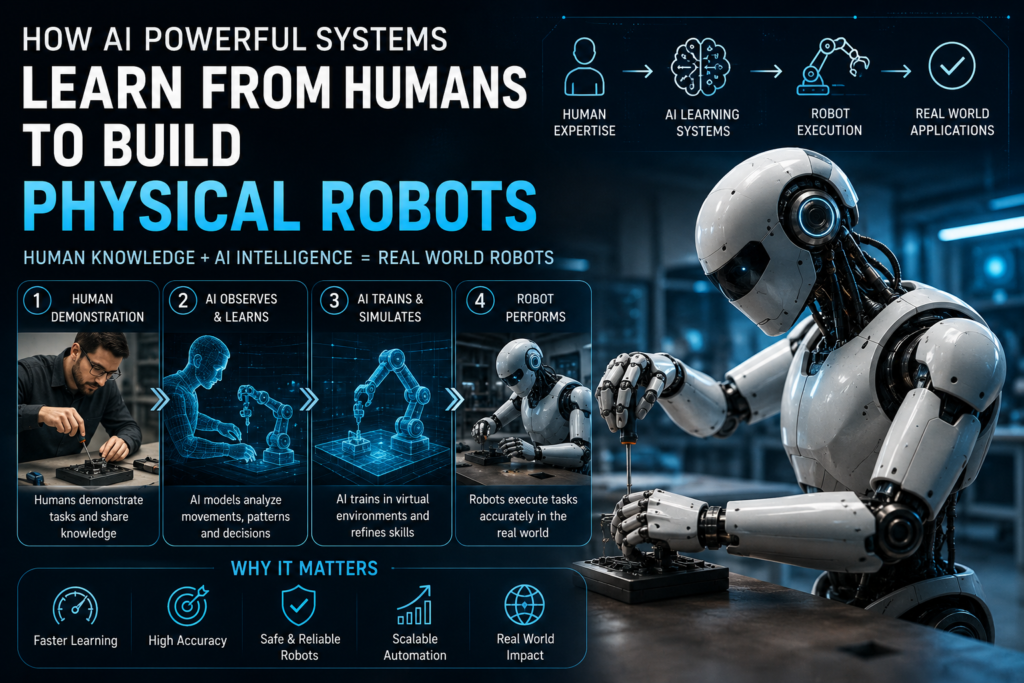
Discover how AI trains effortlessly physical robots using human demonstrations, videos, simulations, reinforcement learning, and embodied AI. Learn the technologies powering the next generation of humanoid robots.
The AI revolution is expanding beyond chatbot and virtual assistants. The next frontier is Physical AI—robots that can observe humans, learn tasks, and perform them autonomously in the real world.
Introduction
Companies such as Tesla, Figure AI, OpenAI-backed robotics startups, NVIDIA, Boston Dynamics, and numerous research labs are racing to create robots that can learn almost like humans. Instead of programming every movement manually, modern robots learn by watching people perform tasks.
This approach is transforming manufacturing, logistics, healthcare, construction, retail, and even household automation.
The big question is:
How exactly does AI learn from humans and turn that knowledge into physical robot actions?
Let’s explore the complete process.
What Is Physical AI?
Physical AI refers to artificial intelligence systems that interact with and understand the physical world through sensors, cameras, movement, and real-world actions. Unlike Large Language Models (LLMs) that operate primarily in text, physical AI enables robots to perceive, reason, and act in real environments. Researchers increasingly describe this as embodied AI, where intelligence is connected directly to physical actions and outcomes.
Examples include:
- Humanoid robots
- Warehouse robots
- Industrial robotic arms
- Delivery robots
- Healthcare assistants
- Autonomous service robots
The goal is to create machines that can learn tasks similarly to humans.
The Traditional Problem With Robots
For decades, robots were programmed using rigid instructions:
- Pick object.
- Move arm.
- Rotate gripper.
- Place object.
Every scenario required custom programming.
This approach worked in factories but failed in dynamic environments because robots could not adapt when conditions changed.
Modern AI solves this problem by enabling robots to learn from experience rather than explicit programming.
How AI Trains Robots From Human Demonstrations
The most important breakthrough is called:
Learning From Demonstration (LfD)
Learning From Demonstration allows robots to observe humans performing tasks and then imitate those actions. Instead of writing thousands of rules, engineers provide examples and allow machine-learning models to learn the behavior.
For example:
A human demonstrates:
- Picking up a cup
- Opening a drawer
- Folding clothes
- Sorting packages
The robot records:
- Visual information
- Hand movements
- Object positions
- Motion trajectories
- Task outcomes
AI then learns the underlying pattern behind the task.
Step 1: Collect Human Demonstration Data
The first stage involves gathering large amounts of human behavior data.
Methods Used
Teleoperation
A human controls a robot remotely.
The robot records:
- Arm movement
- Hand movement
- Camera feeds
- Force feedback
This creates high-quality training data for AI models.
Motion Capture Systems
Sensors track human body movements.
Examples:
- Gloves
- VR controllers
- Body tracking suits
These systems capture detailed human actions that can later be translated into robot movements.
First-Person Video
Researchers are increasingly training robots using first-person videos of humans performing tasks. New frameworks have shown robots can learn manipulation skills from as little as 30 minutes of human video without requiring robot-specific demonstrations.
Step 2: Convert Human Actions Into Robot Actions
Humans and robots have different bodies.
A human hand has:
- Fingers
- Flexible joints
- Fine motor control
A robot may have:
- Grippers
- Different joint structures
- Different ranges of motion
AI must bridge this “embodiment gap.” Modern systems translate human demonstrations into robot-compatible actions using imitation learning and adaptation algorithms.
Example:
Human Action:
- Grab coffee mug
Robot Action:
- Calculate grip force
- Position robotic gripper
- Adjust trajectory
- Execute pickup
The robot learns the intent rather than copying every motion exactly.
Step 3: Train Foundation Models for Robotics
Just as ChatGPT learns from billions of text examples, robotics AI learns from massive datasets of human actions.
Researchers now train large-scale robotic foundation models using:
- Human demonstrations
- Robot demonstrations
- Simulations
- Video datasets
These models learn:
- Object recognition
- Task planning
- Motion generation
- Environmental understanding
Many recent humanoid robot systems rely heavily on human demonstration data as a foundational learning source.
Step 4: Use Simulation to Scale Learning
Real-world robot training is expensive.
A robot might:
- Drop objects
- Break equipment
- Move slowly
- Require supervision
To solve this, companies train robots inside virtual worlds.
Digital Simulation
Robots practice millions of times in simulation before entering the real world.
Benefits:
- Faster training
- Lower costs
- Safer experimentation
- Massive scalability
OpenAI demonstrated that robots trained in simulation can learn new tasks after seeing a single demonstration and then transfer those skills to real-world robots.
Step 5: Reinforcement Learning
After imitation learning, robots improve through trial and error.
This process is called Reinforcement Learning (RL).
Example
Goal:
Pick up a box.
Rewards:
✅ Successful grasp
✅ Correct placement
Penalties:
❌ Drop object
❌ Collision
❌ Incorrect placement
After thousands of attempts, the robot discovers optimal behavior.
Many modern robotics systems combine Learning From Demonstration with Reinforcement Learning for faster skill acquisition.
Step 6: World Models and Embodied AI
The newest trend in robotics is the development of world models.
A world model enables a robot to predict:
- What will happen next
- How objects behave
- How actions affect outcomes
This is similar to how humans mentally simulate actions before performing them.
Industry leaders believe world models will drive the next major breakthrough in embodied AI and humanoid robotics.
Can Robots Learn Only From Videos?
Surprisingly, yes.
Recent research demonstrates that robots can learn tasks directly from ordinary human videos without requiring robot-generated training data. Some systems achieve strong real-world performance by converting human video demonstrations into robot-compatible action sequences.
This is significant because:
- Billions of human videos already exist
- Training data becomes easier to collect
- Learning scales dramatically
Many researchers believe human video datasets will become a major source of future robot intelligence.
Industries That Will Be Transformed
Manufacturing
Robots learn assembly tasks by observing workers.
Warehousing
Robots learn:
- Picking
- Sorting
- Packing
Healthcare
Future robots may assist with:
- Patient care
- Medication delivery
- Rehabilitation
Construction
Learning From Demonstration has already been used to teach robots construction-related tasks through human examples.
Home Automation
Future household robots may:
- Fold laundry
- Clean homes
- Organize items
- Prepare simple meals
Challenges Still Remaining
Despite rapid progress, major obstacles remain.
Data Collection
Physical-world data is far harder to collect than internet text data. Robotics companies are investing heavily in acquiring large-scale human and robot interaction datasets.
Safety
Robots must operate safely around humans.
Generalization
A robot that learns in one environment must perform equally well in unfamiliar settings.
Cost
Humanoid robots remain expensive to build and deploy at scale.
The Future of Human-Trained Robots
The robotics industry is approaching what many experts describe as a “ChatGPT moment” for physical AI. Researchers are combining:
- Large Language Models
- World Models
- Computer Vision
- Learning From Demonstration
- Reinforcement Learning
The result will be robots capable of understanding instructions, observing humans, learning new skills, and adapting to changing environments with minimal retraining. Industry leaders expect major advances in embodied intelligence over the coming years.
Conclusion
The future of robotics is no longer about manually programming every movement. Instead, AI systems are learning directly from human demonstrations, videos, simulations, and real-world experience.
Through Learning From Demonstration, imitation learning, reinforcement learning, and embodied AI, robots are gradually acquiring the ability to understand and perform complex physical tasks.
As these technologies mature, the line between digital intelligence and physical capability will continue to blur. The next generation of robots will not simply follow instructions—they will learn, adapt, and improve by observing the world around them.
Pingback: 10 AI Tools That Can Replace Hours of Manual Work Every Week (2026)