Artificial intelligence is rapidly moving beyond simple chatbots.
Modern AI applications are increasingly expected to search databases, read documents, access business applications, call APIs, execute actions, retrieve live information, and work with enterprise systems.
But there is a major problem.
Every AI application can potentially need a different integration for every tool or data source. That creates a complicated web of APIs, custom connectors, authentication systems, and one-off integrations.
This is where Model Context Protocol (MCP) enters the picture.
MCP is an open protocol designed to standardize how AI applications connect with external data sources and tools. The official specification describes MCP as a protocol for sharing context with language models, exposing tools to AI systems, and building composable integrations and workflows.
The simplest way to understand it is:
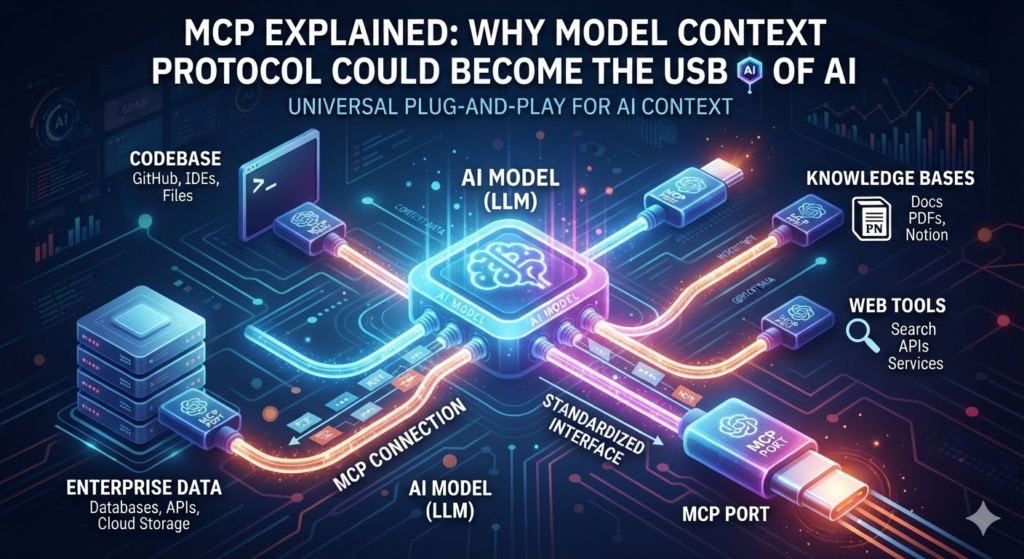
MCP could become for AI what USB became for computers and electronic devices: a common way to connect different systems.
Anthropic itself describes MCP as similar to a USB-C port for AI applications.
And in 2026, MCP is becoming increasingly important as AI agents move from answering questions to actually performing tasks.
What Is Model Context Protocol (MCP)?
Model Context Protocol, or MCP, is an open standard that allows AI applications to connect with external tools, data sources, and services in a standardized way.
Instead of building a completely different integration between an AI application and every external system, developers can use MCP as a common communication layer.
For example, an AI assistant could potentially connect to:
- Databases
- GitHub repositories
- File systems
- CRM platforms
- Enterprise applications
- Search systems
- APIs
- Cloud services
- Business intelligence platforms
- Internal company tools
The MCP specification uses JSON-RPC 2.0 for its messaging model and defines standardized ways for applications to expose resources, prompts, and tools.
This makes MCP particularly interesting for the growing world of AI agents.
Why Does AI Need MCP?
Imagine a company has an AI assistant that needs access to:
- Salesforce
- SAP
- PostgreSQL
- Google Drive
- Jira
- GitHub
- Internal HR systems
Without a common integration standard, developers may need to build and maintain separate integrations for each system.
Now imagine another AI application needs access to the same systems.
The same integration problem can appear again.
This can result in:
AI Application → Custom API → Database
AI Application → Custom API → CRM
AI Application → Custom API → GitHub
AI Application → Custom API → Internal tools
The number of integrations can grow rapidly.
MCP attempts to provide a common protocol layer.
Conceptually:
AI Application → MCP → Tools / Data / Services
That standardization is one of the main reasons MCP has attracted significant attention.
MCP vs Traditional API Integrations
MCP does not mean APIs are disappearing.
Instead, MCP can sit above or alongside existing APIs and provide a standardized interface for AI applications.
Consider a traditional integration.
Traditional approach
An AI application might need custom logic for:
- Authentication
- API requests
- Parameter formatting
- Response processing
- Error handling
- Tool descriptions
- Permissions
With MCP, a server can expose standardized capabilities to an MCP-compatible client.
The AI application can discover available capabilities and invoke supported tools using the MCP protocol.
This can make integrations more reusable and easier to compose.
How Does MCP Work?
MCP uses a relatively simple architecture.
There are three important components:
1. MCP Host
The host is the AI application that the user interacts with.
Examples could include an AI assistant, coding environment, enterprise AI application, or another LLM-powered application.
The host manages the overall interaction.
2. MCP Client
The MCP client is the connector inside the host application.
It communicates with MCP servers and helps the AI application access their capabilities.
3. MCP Server
The MCP server exposes data, tools, or other capabilities to the AI application.
An MCP server could provide access to:
- A database
- Files
- APIs
- Search
- GitHub
- Enterprise applications
- Internal business systems
The basic relationship looks like this:
User
↓
AI Application / MCP Host
↓
MCP Client
↓
MCP Server
↓
Tool / Database / API / Business System
The official specification defines hosts, clients, and servers as the fundamental participants in the MCP architecture.
What Can an MCP Server Provide?
One of the most important aspects of MCP is that servers can expose different types of capabilities.
1. Tools
Tools allow an AI system to perform actions.
For example:
- Search a database
- Create a ticket
- Send information to another system
- Query an API
- Run a business operation
- Retrieve analytics
Tools are particularly important for AI agents because they allow the model to move from generating text to taking actions.
2. Resources
Resources provide contextual information.
For example:
- Documents
- Files
- Database information
- Knowledge-base content
- Application data
This can help an AI system obtain the information it needs to answer a question or perform a task.
3. Prompts
MCP can also expose reusable prompt templates and workflows.
This can help organizations standardize certain interactions with AI systems.
Together, these capabilities make MCP more than just a simple API connector.
Why MCP Could Become the USB of AI
The USB comparison is powerful because it illustrates the integration problem.
Before USB became widely adopted, connecting different peripherals to computers could involve different connectors and standards.
USB helped establish a common connection mechanism.
MCP is attempting something conceptually similar for AI.
Instead of:
AI Model → Custom Integration A
AI Model → Custom Integration B
AI Model → Custom Integration C
You can imagine:
AI Application → MCP → Many Tools and Data Sources
This doesn’t mean MCP will literally replace every API or integration technology.
Rather, MCP could become a common interoperability layer for AI applications.
That distinction is important.
MCP Is Not an AI Model
One common misconception is that MCP is another AI model.
It isn’t.
MCP is a protocol.
Think of the difference this way:
| Technology | Purpose |
|---|---|
| GPT / Claude / Gemini | AI models |
| RAG | Method for retrieving relevant information |
| Vector database | Stores/searches embeddings |
| API | Lets software communicate |
| MCP | Standardizes AI access to tools and context |
| AI Agent | Uses models, tools, memory and workflows to accomplish tasks |
MCP doesn’t make a language model smarter by itself.
Instead, it can make it easier for an AI application to access the information and capabilities it needs.
MCP vs RAG: Are They the Same?
No.
This is an important distinction.
RAG (Retrieval-Augmented Generation) is primarily a technique for retrieving relevant information and providing it to an AI model.
For example:
User Question → Search Knowledge Base → Retrieve Documents → LLM → Answer
MCP addresses a broader integration problem.
An MCP-connected AI application could potentially access:
- Documents
- Databases
- APIs
- Tools
- Business applications
So RAG and MCP can actually work together.
For example:
User
↓
AI Agent
↓
MCP
↓
Enterprise Search / RAG System
↓
Relevant Documents
↓
AI Model
MCP can therefore act as a standardized connection layer while RAG handles information retrieval.
MCP and AI Agents
This is where MCP becomes particularly interesting.
Traditional chatbots primarily respond to questions.
AI agents are increasingly designed to:
- Understand a goal
- Plan steps
- Retrieve information
- Use tools
- Execute actions
- Check results
- Continue until the task is completed
For example, imagine an employee asks:
“Find all overdue customer contracts, identify the responsible account managers, and create follow-up tasks.”
An AI agent might need to:
- Search the contract database
- Identify overdue contracts
- Query the CRM
- Find account managers
- Create tasks
- Return a summary
MCP can provide standardized access to those tools.
This is one reason MCP is closely associated with the emerging agentic AI ecosystem.
Why Enterprises Are Interested in MCP
Enterprise AI has a major integration problem.
Large organizations typically have hundreds or thousands of systems.
They may use:
- SAP
- Salesforce
- ServiceNow
- Microsoft systems
- Oracle
- Databases
- Data warehouses
- Internal applications
- Cloud services
- Legacy systems
AI becomes significantly more useful when it can interact with these systems.
MCP could potentially provide a standardized interface for AI applications to access enterprise capabilities.
This could reduce duplicated integration work and make AI systems easier to extend.
However, enterprise adoption also introduces serious requirements around authentication, authorization, auditing, security, governance, and data privacy.
MCP should therefore not be treated as a magic security layer.
Organizations still need strong controls around every tool and data source exposed to an AI system.
MCP Security: The Part Enterprises Cannot Ignore
Giving an AI access to enterprise systems is fundamentally different from allowing it to answer questions.
An AI that can read a database is one thing.
An AI that can modify records, send emails, create financial transactions, or delete data is something else entirely.
Organizations should consider:
Authentication
Who is connecting to the MCP server?
Authorization
What is the AI actually allowed to do?
Least privilege
Does the AI really need write access?
Audit logging
Can administrators see what tools were used?
Data protection
What information can be exposed to the model?
Human approval
Should certain actions require human confirmation?
These considerations become increasingly important as AI agents gain more autonomy.
The 2026 MCP specification includes authorization hardening and changes intended to make enterprise deployments more robust.
What Changed in MCP in 2026?
MCP is evolving rapidly.
The July 28, 2026 MCP specification introduced a significant architectural change: MCP moved toward a stateless protocol core. This is designed to make MCP servers easier to scale using ordinary HTTP infrastructure.
The new specification also introduced or formalized improvements including:
- Stateless request handling
- Multi Round-Trip Requests
- Header-based routing
- Cacheable list results
- Authorization hardening
- A formal extensions framework
- MCP Apps
- Tasks as an extension
- Updated SDKs
The roadmap published in August 2026 also highlights future work around agentic messaging, HTTP-native transport, enterprise security, agent identity, and developer experience.
These developments show that MCP is moving beyond an experimental connector concept toward infrastructure for production AI systems.
MCP Adoption Is Growing
MCP’s ecosystem has expanded significantly.
In December 2025, Anthropic announced that it was donating MCP to the Agentic AI Foundation under the Linux Foundation, with founding support from organizations including Anthropic, OpenAI, Google, Microsoft, Amazon Web Services, Cloudflare and Bloomberg. Anthropic also reported more than 10,000 active public MCP servers at that time.
By July 2026, the MCP project reported hundreds of millions of monthly SDK downloads, while Anthropic reported more than 400 million monthly SDK downloads.
These numbers do not guarantee that MCP will become the universal AI integration standard.
But they demonstrate that the ecosystem is expanding quickly.
MCP vs APIs vs Plugins
These technologies can look similar, but they solve different problems.
| Technology | Primary Purpose |
|---|---|
| API | Software-to-software communication |
| Plugin | Extending an application with additional functionality |
| RAG | Retrieving relevant information for an AI model |
| MCP | Standardized AI access to context and tools |
| AI Agent | Autonomous or semi-autonomous task execution |
MCP does not eliminate APIs.
In many cases, an MCP server may sit in front of existing APIs and expose selected capabilities to AI applications.
Real-World MCP Use Cases
MCP can potentially be used across many industries.
Software Development
An AI coding assistant could access:
- Git repositories
- Issue trackers
- Documentation
- CI/CD systems
- Databases
Customer Support
An AI agent could access:
- CRM records
- Customer history
- Knowledge bases
- Ticketing systems
Finance
AI systems could potentially connect to:
- Financial databases
- Reporting systems
- Analytics platforms
- Internal business tools
High-risk financial actions would require particularly strong authorization and approval controls.
Human Resources
An AI assistant could work with:
- Employee policies
- HR databases
- Internal documents
- Workflow systems
IT Operations
AI agents could interact with:
- Monitoring platforms
- Incident systems
- Cloud infrastructure
- Logs
- Ticketing platforms
This is where MCP could become especially powerful: one AI interface connected to many enterprise capabilities.
What MCP Does Not Solve
MCP is powerful, but it is not a complete enterprise AI architecture.
You still need:
- An AI model
- Identity management
- Security controls
- Data governance
- Observability
- Application logic
- RAG when knowledge retrieval is required
- Databases
- APIs
- Workflow orchestration
- Human approval mechanisms
A realistic enterprise AI architecture might look like:
User
↓
AI Application
↓
AI Agent / LLM
↓
MCP
↓
Tools + APIs + Enterprise Systems
↓
Databases / Knowledge Bases / Applications
MCP is one component of this architecture—not the entire architecture.
MCP vs n8n: Are They Competitors?
Not necessarily.
This is another important distinction for businesses evaluating AI infrastructure.
n8n is primarily a workflow automation and orchestration platform.
MCP is a protocol for connecting AI applications with tools and context.
They can potentially complement each other.
For example:
AI Agent → MCP → n8n workflow → Multiple Enterprise Systems
In this architecture, MCP provides the AI-facing integration layer while n8n handles workflow automation.
Other technologies such as LangGraph, CrewAI, Microsoft Power Automate, Temporal and Camunda can also occupy different parts of an enterprise AI architecture.
The future enterprise AI stack is therefore likely to contain multiple layers rather than one technology replacing everything else.
Why Developers Should Learn MCP
If you’re building AI applications in 2026, MCP is worth understanding.
Developers who learn MCP can work on:
- AI agents
- AI-powered applications
- Enterprise AI
- Developer tools
- AI automation
- Tool integrations
- AI infrastructure
- RAG systems
- Agentic workflows
The important skill isn’t simply memorizing MCP commands.
Developers should understand:
LLMs + APIs + tools + security + MCP + agents + data
That combination is increasingly important in modern AI engineering.
Will MCP Become the USB of AI?
Possibly—but it is too early to declare MCP the universal standard.
There are several reasons to be optimistic.
Reason 1: AI needs interoperability
The number of AI applications and tools is growing rapidly.
A common protocol can reduce integration complexity.
Reason 2: Agentic AI needs tools
AI agents need standardized ways to discover and use capabilities.
MCP directly addresses this requirement.
Reason 3: Ecosystem support matters
MCP has attracted support across major AI and technology organizations, and the protocol has been placed under the Linux Foundation’s Agentic AI Foundation initiative.
Reason 4: The protocol is evolving
The 2026 specification is addressing scalability, authorization, extensions and enterprise deployment requirements.
But there are also challenges.
Competing standards could emerge.
Security risks could slow enterprise adoption.
Organizations may continue using proprietary integrations.
And widespread adoption does not automatically mean universal standardization.
So the more accurate statement is:
MCP has a credible path to becoming a common interoperability layer for AI, but the market has not finished deciding the winner.
The Future of MCP
The most interesting possibility is not simply connecting an AI chatbot to a database.
It is creating an ecosystem where AI agents can discover and use capabilities from many different systems.
Imagine asking an enterprise AI assistant:
“Analyze this month’s sales performance, identify customers at risk, create follow-up tasks for account managers, and prepare a management summary.”
The agent could potentially:
- Retrieve sales data
- Query CRM systems
- Analyze customer information
- Generate recommendations
- Create workflow tasks
- Produce a report
The AI model provides reasoning.
The enterprise systems provide data.
The tools provide actions.
MCP can provide a standardized connection layer between them.
That is the bigger idea behind MCP.
Final Verdict: Is MCP Worth Learning in 2026?
Yes.
If you’re interested in AI agents, enterprise AI, AI automation, AI infrastructure or LLM application development, MCP is an important technology to understand.
It is not a replacement for APIs, RAG, databases, workflow engines or AI models.
Instead, MCP can connect these components into a more interoperable AI ecosystem.
The “USB of AI” analogy is therefore useful—but with one important qualification.
USB became successful because it standardized physical connectivity across a huge hardware ecosystem.
MCP is attempting a similar standardization for AI-to-tool and AI-to-data connectivity.
Whether it ultimately becomes the universal standard remains to be seen.
But given its growing ecosystem, industry support, and rapid protocol development, MCP is one of the most important AI infrastructure technologies to watch in 2026 and beyond.
Frequently Asked Questions About MCP
What is MCP in AI?
MCP, or Model Context Protocol, is an open protocol that standardizes how AI applications connect to external data sources, tools and services.
Is MCP a replacement for APIs?
No. MCP and APIs solve different problems. MCP can provide a standardized AI-facing interface while APIs continue to provide underlying software-to-software communication.
Is MCP the same as RAG?
No. RAG focuses on retrieving relevant information for an AI model. MCP provides a standardized mechanism for AI applications to access tools, resources and context.
What is an MCP server?
An MCP server is a service that exposes resources, tools or other capabilities that an MCP-compatible AI application can use.
What is an MCP client?
An MCP client is the component inside an AI host application that communicates with MCP servers.
Is MCP only for Claude?
No. MCP is an open protocol and its ecosystem extends beyond a single AI model or vendor. Anthropic originally introduced MCP, but the protocol has since gained broader ecosystem participation.
Is MCP useful for enterprise AI?
Yes. MCP can potentially simplify how AI applications interact with enterprise tools and data. However, enterprises still need strong identity, authorization, security, governance and auditing controls.
Will MCP replace n8n?
Not necessarily. n8n is a workflow automation platform, while MCP is a protocol for connecting AI applications with tools and context. They can be complementary technologies.
Key Takeaway
MCP is not another AI model. It is an interoperability layer.
As AI moves from “answer my question” toward “complete this task,” standardized access to tools and enterprise systems becomes increasingly important.
That is why MCP could become one of the foundational technologies behind the next generation of AI agents.
If you enjoyed this article, you may also like:
- 5 AI Gateways That Offer Free Tokens in 2026
- How to Build a Humanoid Robot in 2026: Costs, Timeline & Complete Blueprint
- Best AI Research Tools in 2026: ChatGPT, Claude, Gemini & Perplexity
- Best AI Resume Builders in 2026 — Free
- ChatGPT Review — Is It Worth Paying For in 2026?
- 10 Best Free AI Tools You Should Use in 2026
- Best AI Video Generators in 2026 — Free and Paid
- Best AI for Students in 2026: Top 10 Tools for Learning
- How AI Learns From Humans to Build Physical Robots
- How AI Learns From Humans to Build Physical Robots
- Why LangGraph Is So Popular in Enterprises — Pros, Cons & Real-World Use Cases in 2026
- ChatGPT vs Gemini vs Claude vs Grok 2026
- DeepSeek V4 vs Grok 4 vs Claude Opus 5 vs Nvidia Nemotron vs Gemini 2.5 Pro — The Ultimate AI Model Comparison for 2026
- AI Agent and LLM Frameworks Comparison 2026: LangChain vs LangGraph vs CrewAI vs AutoGen vs LlamaIndex vs Semantic Kernel
- Best Multi-Agent AI Platforms in 2026: CrewAI vs AutoGen vs LangGraph vs OpenAI Agents SDK vs Agno vs Semantic Kernel
- Best AI Development Platforms in 2026: OpenAI API vs Anthropic API vs Google AI Studio vs Vertex AI vs Azure AI Foundry vs AWS Bedrock vs Hugging Face
- Exploring the Latest AI Tools and Technologies
- How to Use ChatGPT for Business — A Complete Beginner Guide
- How to Write Blog Posts with AI — A Proven Step-by-Step Guide
- Best AI Coding Assistants 2026
- Ultimate Guide to the 10 Best AI Chatbots in 2026
- Claude AI Review — Best ChatGPT Alternative in 2026
- Jasper AI Review — Is It Worth $49/Month in 2026?
- How to Use AI for Social Media Marketing — Complete Guide
- AI Tools for Small Business Owners — Save 10 Hours/Week
- AI Tools for Content Creators
- Best AI Music Generators in 2026 — Create Songs in Minutes
- AI Design Tools Compared: Canva AI vs Adobe Firefly vs Midjourney
- Best AI Writing Tools 2026
- 10 Free AI Tools You Should Try in 2026
- Best AI Image Generators in 2026 — Free and Paid Compared
- Best AI Productivity Tools in 2026 — Work Smarter, Not Harder
- ChatGPT vs Claude in 2026 — Which AI Is Actually Better?
- ChatGPT vs Gemini vs Claude vs Grok (2026): Which AI Assistant Should You Actually Use?
Visit Aidacoit.com for more AI comparisons, practical AI tutorials, enterprise AI insights, and emerging technology trends.