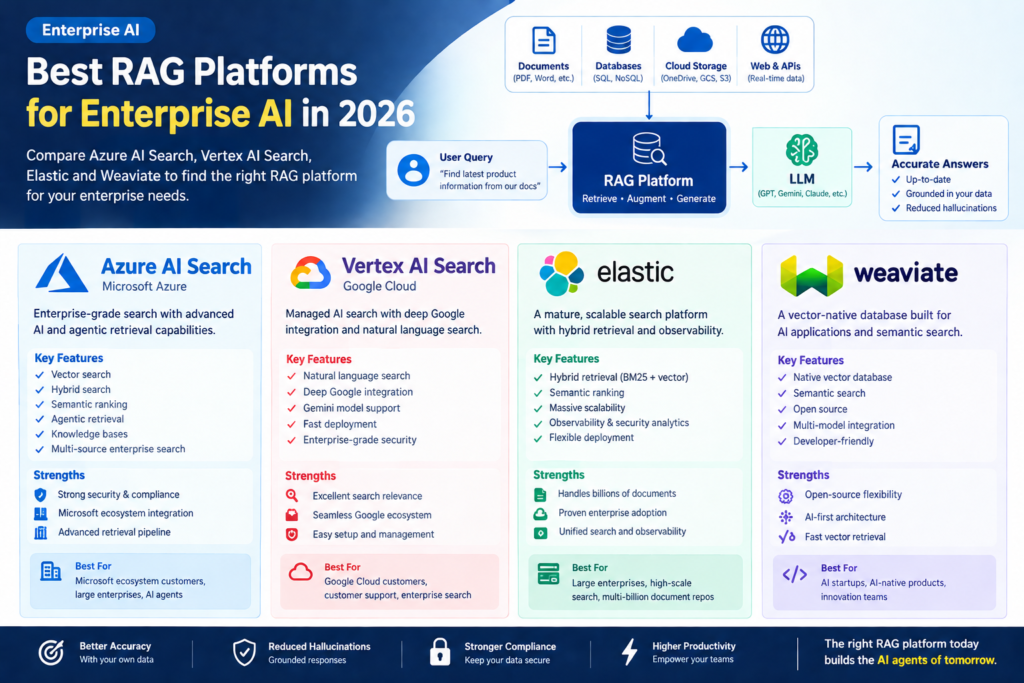
Artificial Intelligence is only as good as the data it can access. While Large Language Models (LLMs) such as ChatGPT, Gemini, Claude, and Grok are powerful, they often struggle with private enterprise data, real-time information, and company-specific knowledge.
This is where Retrieval-Augmented Generation (RAG) comes in.
RAG combines powerful AI models with enterprise knowledge bases, allowing organizations to retrieve relevant information from internal documents, databases, websites, and repositories before generating answers. As AI agents become mainstream in 2026, choosing the right RAG platform has become a critical technology decision.
In this guide, we compare four leading enterprise RAG platforms:
- Azure AI Search
- Google Vertex AI Search
- Elastic
- Weaviate
What Is a RAG Platform?
A RAG platform enables AI systems to:
- Store enterprise knowledge
- Index documents and structured data
- Perform semantic and vector search
- Retrieve relevant information
- Feed context into LLMs
- Generate accurate, grounded responses
Without RAG, AI models rely only on training data. With RAG, they can answer questions using your organization’s latest information.
Why Enterprises Need RAG
Modern businesses face several challenges:
- Information scattered across systems
- Outdated knowledge bases
- Data privacy requirements
- Hallucination risks in AI responses
- Massive document repositories
A RAG architecture solves these problems by providing relevant context before the model generates answers.
Benefits include:
- More accurate AI responses
- Reduced hallucinations
- Better compliance
- Real-time knowledge access
- Improved employee productivity
1. Azure AI Search
Azure AI Search has emerged as one of the most powerful enterprise RAG platforms.
Microsoft has heavily invested in AI Search by adding:
- Vector search
- Hybrid search
- Semantic ranking
- Agentic Retrieval
- Knowledge Bases
- Multi-source enterprise search
Azure AI Search now supports advanced retrieval pipelines specifically designed for enterprise AI and agent applications. It combines vector retrieval, keyword search, semantic ranking, and AI-driven query planning.
Key Features
Agentic Retrieval
One of Microsoft’s biggest innovations is Agentic Retrieval.
The system can:
- Understand complex questions
- Break them into sub-queries
- Search multiple data sources
- Merge results intelligently
- Return citation-backed responses
This significantly improves answer quality for AI agents and copilots.
Hybrid Search
Azure combines:
- Keyword search
- Semantic search
- Vector search
Hybrid retrieval often produces higher relevance than vector-only systems.
Enterprise Security
Supports:
- Microsoft Entra ID
- SharePoint permissions
- Private networking
- Role-based access controls
Best For
- Microsoft ecosystem customers
- Large enterprises
- Internal copilots
- Enterprise AI agents
- Knowledge management systems
2. Vertex AI Search
Google’s Vertex AI Search is designed for organizations already invested in the Google Cloud ecosystem.
It powers:
- Enterprise search
- AI assistants
- Customer support bots
- Knowledge retrieval systems
Key Features
Natural Language Search
Users can ask questions conversationally.
The platform understands:
- Intent
- Context
- Synonyms
- User language variations
Deep Google Integration
Works seamlessly with:
- BigQuery
- Google Cloud Storage
- Gemini Models
- Google Workspace
Fast Deployment
Google focuses on ease of setup, allowing enterprises to build search experiences with minimal infrastructure management.
Strengths
- Excellent search relevance
- Strong Gemini integration
- Managed cloud experience
- Rapid deployment
Limitations
- Less flexible than open-source alternatives
- Higher cloud dependency
- Best suited for Google Cloud users
Best For
- Google Cloud customers
- Customer support applications
- Enterprise search portals
- Gemini-powered AI solutions
3. Elastic
Elastic is one of the most mature search platforms in the world.
Originally famous for Elasticsearch, it has evolved into a complete vector database and AI retrieval platform.
Key Features
Hybrid Retrieval
Elastic supports:
- BM25 search
- Vector search
- Semantic ranking
- Hybrid retrieval
This combination is particularly effective for enterprise knowledge systems.
Massive Scalability
Elastic is trusted by:
- Financial institutions
- Governments
- E-commerce giants
- Telecommunications providers
Handling billions of documents is one of its strongest advantages.
Observability Integration
Unlike many RAG platforms, Elastic also supports:
- Logs
- Monitoring
- Security analytics
This creates a unified platform for search and operational intelligence.
Strengths
- Extremely scalable
- Proven enterprise adoption
- Flexible deployment
- Strong hybrid search
Challenges
- Requires expertise
- Operational complexity
- Infrastructure management overhead
Best For
- Large enterprises
- High-scale search environments
- Multi-billion document repositories
- Technical teams
4. Weaviate
Weaviate has become one of the most popular vector-native databases for AI applications.
Unlike traditional search systems, Weaviate was built specifically for AI and vector retrieval.
Key Features
Native Vector Database
Supports:
- Embeddings
- Semantic search
- Similarity matching
- AI-native indexing
Open Source
Organizations can:
- Self-host
- Customize architecture
- Avoid vendor lock-in
Multi-Model Integration
Works with:
- OpenAI
- Anthropic
- Cohere
- Hugging Face
- Google Gemini
Strengths
- Developer-friendly
- Open-source flexibility
- AI-first architecture
- Fast vector retrieval
Limitations
- Less mature enterprise search capabilities
- Smaller ecosystem than Elastic or Azure
- Additional engineering effort required
Best For
- AI startups
- AI-native products
- Innovation teams
- Vector-first workloads
Feature Comparison
| Feature | Azure AI Search | Vertex AI Search | Elastic | Weaviate |
|---|---|---|---|---|
| Vector Search | Yes | Yes | Yes | Yes |
| Hybrid Search | Excellent | Good | Excellent | Moderate |
| Semantic Ranking | Yes | Yes | Yes | Limited |
| Agentic Retrieval | Yes | Emerging | Limited | No |
| Open Source | No | No | Partial | Yes |
| Enterprise Security | Excellent | Excellent | Excellent | Good |
| Multi-Cloud Support | Moderate | Moderate | Excellent | Excellent |
| Ease of Use | High | High | Medium | Medium |
| Scalability | Excellent | Excellent | Excellent | High |
Which RAG Platform Should You Choose?
Choose Azure AI Search If
- You use Microsoft Azure
- You need enterprise-grade security
- You are building AI agents
- You want advanced retrieval capabilities
Choose Vertex AI Search If
- Your company uses Google Cloud
- You rely on Gemini models
- You want managed AI search
Choose Elastic If
- You need extreme scalability
- You manage billions of documents
- You have experienced engineering teams
Choose Weaviate If
- You prefer open source
- You need a vector-first architecture
- You are building AI-native products
Future of Enterprise RAG
By 2026, RAG is evolving beyond simple document retrieval.
The next generation includes:
- Agentic Retrieval
- Multi-Agent Knowledge Systems
- Autonomous Research Agents
- Graph RAG
- Multimodal Retrieval
- Real-Time Enterprise Knowledge Networks
Organizations that invest in modern RAG infrastructure today will be better positioned to deploy enterprise AI agents tomorrow.
Final Verdict
For most large enterprises in 2026, Azure AI Search currently offers the most complete RAG ecosystem due to its combination of hybrid search, semantic ranking, security controls, and emerging agentic retrieval capabilities.
However, the ideal platform depends on your cloud strategy:
- Azure AI Search → Best overall enterprise RAG platform
- Vertex AI Search → Best for Google Cloud users
- Elastic → Best for large-scale search workloads
- Weaviate → Best open-source AI-native solution
The future belongs to organizations that can connect AI models with trusted enterprise knowledge, and the right RAG platform is the foundation of that transformation.
If you enjoyed this article, you may also like:
- 5 AI Gateways That Offer Free Tokens in 2026
- How to Build a Humanoid Robot in 2026: Costs, Timeline & Complete Blueprint
- Best AI Research Tools in 2026: ChatGPT, Claude, Gemini & Perplexity
- Best AI Resume Builders in 2026 — Free
- ChatGPT Review — Is It Worth Paying For in 2026?
- 10 Best Free AI Tools You Should Use in 2026
- Best AI Video Generators in 2026 — Free and Paid
- Best AI for Students in 2026: Top 10 Tools for Learning
- How AI Learns From Humans to Build Physical Robots
- How AI Learns From Humans to Build Physical Robots
- Why LangGraph Is So Popular in Enterprises — Pros, Cons & Real-World Use Cases in 2026
- ChatGPT vs Gemini vs Claude vs Grok 2026
- DeepSeek V4 vs Grok 4 vs Claude Opus 5 vs Nvidia Nemotron vs Gemini 2.5 Pro — The Ultimate AI Model Comparison for 2026
- AI Agent and LLM Frameworks Comparison 2026: LangChain vs LangGraph vs CrewAI vs AutoGen vs LlamaIndex vs Semantic Kernel
- Best Multi-Agent AI Platforms in 2026: CrewAI vs AutoGen vs LangGraph vs OpenAI Agents SDK vs Agno vs Semantic Kernel
- Best AI Development Platforms in 2026: OpenAI API vs Anthropic API vs Google AI Studio vs Vertex AI vs Azure AI Foundry vs AWS Bedrock vs Hugging Face
- Exploring the Latest AI Tools and Technologies
- How to Use ChatGPT for Business — A Complete Beginner Guide
- How to Write Blog Posts with AI — A Proven Step-by-Step Guide
- Best AI Coding Assistants 2026
- Ultimate Guide to the 10 Best AI Chatbots in 2026
- Claude AI Review — Best ChatGPT Alternative in 2026
- Jasper AI Review — Is It Worth $49/Month in 2026?
- How to Use AI for Social Media Marketing — Complete Guide
- AI Tools for Small Business Owners — Save 10 Hours/Week
- AI Tools for Content Creators
- Best AI Music Generators in 2026 — Create Songs in Minutes
- AI Design Tools Compared: Canva AI vs Adobe Firefly vs Midjourney
- Best AI Writing Tools 2026
- 10 Free AI Tools You Should Try in 2026
- Best AI Image Generators in 2026 — Free and Paid Compared
- Best AI Productivity Tools in 2026 — Work Smarter, Not Harder
- ChatGPT vs Claude in 2026 — Which AI Is Actually Better?
- ChatGPT vs Gemini vs Claude vs Grok (2026): Which AI Assistant Should You Actually Use?
Visit Aidacoit.com for more AI comparisons, practical AI tutorials, enterprise AI insights, and emerging technology trends.