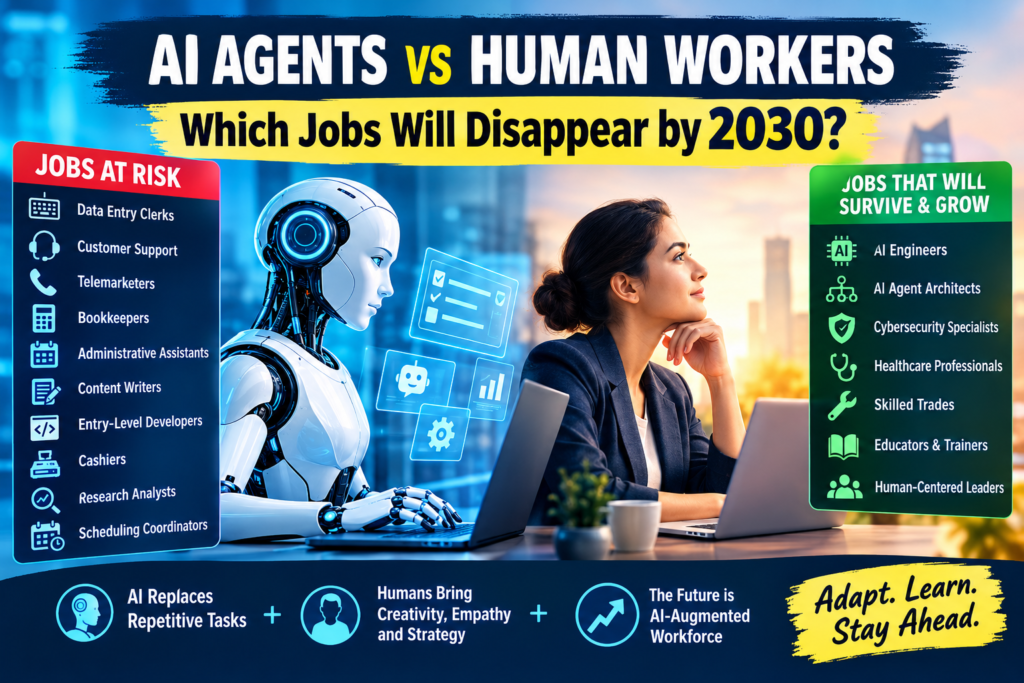
The Great Workplace Transformation Has Already Begun
Artificial Intelligence is no longer just a chatbot answering questions. Modern AI agents can analyze data, write reports, schedule meetings, manage workflows, create software code, interact with customers, and even make business decisions with minimal human supervision.
As businesses race to adopt AI agents, one question dominates discussions across industries:
Will AI replace human workers by 2030?
The answer is more complex than a simple yes or no.
While some jobs are likely to shrink dramatically, many professions will evolve rather than disappear. At the same time, entirely new careers will emerge that do not exist today. According to the World Economic Forum, technological transformation could displace approximately 92 million jobs globally by 2030 while creating around 170 million new roles, resulting in a net increase in employment.
This article explores which jobs are most vulnerable, which careers will thrive, and how workers can prepare for the age of AI agents.
What Are AI Agents?
Unlike traditional software that follows predefined instructions, AI agents can:
- Understand goals
- Plan tasks independently
- Use multiple tools
- Learn from feedback
- Execute complex workflows
For example, an AI customer service agent can:
- Read a customer complaint
- Access company databases
- Analyze the issue
- Draft a solution
- Process refunds
- Follow up with the customer
All without human intervention.
This capability is why many experts believe AI agents will become the digital workforce of the future.
AI Agents vs Human Workers
What AI Agents Do Better
1. Speed
AI can process thousands of documents in minutes.
2. Scalability
One AI agent can handle workloads that previously required multiple employees.
3. Availability
AI works 24/7 without breaks, holidays, or sick leave.
4. Consistency
AI performs repetitive tasks with minimal variation.
What Humans Still Do Better
1. Creativity
Groundbreaking ideas, innovation, and artistic expression still rely heavily on human thinking.
2. Emotional Intelligence
Empathy, trust-building, leadership, and counseling remain difficult for AI.
3. Strategic Judgment
Complex decisions involving ethics, uncertainty, and long-term consequences require human oversight.
4. Physical Dexterity
Many real-world tasks remain challenging for automation and robotics.
Research increasingly suggests that the future of work will involve collaboration between humans, AI agents, and robots rather than complete replacement.
10 Jobs Most Likely to Disappear or Shrink by 2030
1. Data Entry Clerks
Data entry is one of the easiest tasks for AI to automate.
AI systems can:
- Extract information from documents
- Validate records
- Update databases automatically
Demand for manual data entry is expected to decline significantly.
2. Customer Support Representatives
Modern AI agents can already:
- Handle FAQs
- Reset passwords
- Process refunds
- Track orders
- Escalate complex cases
Customer service is consistently identified as one of the most automatable occupations.
3. Telemarketers
AI voice agents can:
- Call customers
- Answer objections
- Schedule appointments
- Qualify leads
At a fraction of the cost of human teams.
4. Basic Bookkeepers
AI accounting tools can:
- Categorize expenses
- Reconcile accounts
- Generate financial reports
- Detect anomalies
Routine bookkeeping work is increasingly automated.
5. Administrative Assistants
AI assistants now manage:
- Calendars
- Emails
- Meeting notes
- Travel planning
- Workflow coordination
Many traditional administrative tasks may require fewer workers by 2030.
6. Basic Content Writers
AI can rapidly create:
- Product descriptions
- SEO drafts
- Social media posts
- Standard reports
Writers who only produce generic content face growing competition from AI tools.
7. Entry-Level Software Developers
AI coding agents can:
- Generate code
- Write tests
- Debug applications
- Review pull requests
Junior developers performing repetitive coding tasks may experience the greatest disruption, while experienced engineers who design systems and supervise AI are likely to remain in demand.
8. Cashiers
Self-checkout systems combined with AI-powered retail technology continue reducing demand for traditional cashier roles. The World Economic Forum lists cashier-related occupations among the fastest-declining categories.
9. Basic Research Analysts
AI can summarize:
- Market reports
- Financial data
- Industry trends
- Competitor information
Tasks involving information gathering and summarization are increasingly automated.
10. Scheduling Coordinators
AI agents can coordinate:
- Meetings
- Team calendars
- Resource allocation
- Appointment booking
With little human involvement.
Jobs That Will Survive and Grow
While headlines focus on job losses, many professions are expected to expand.
AI Engineers
Companies need experts who can:
- Build AI systems
- Fine-tune models
- Deploy agents
- Monitor performance
Demand remains extremely strong.
AI Agent Architects
A new role emerging rapidly involves designing multi-agent systems and enterprise automation workflows.
Responsibilities include:
- Agent orchestration
- Workflow automation
- Tool integration
- Governance
Cybersecurity Specialists
As AI adoption grows, cyber threats become more sophisticated.
Organizations need professionals who can:
- Protect systems
- Monitor threats
- Ensure compliance
Cybersecurity remains one of the safest career paths.
Healthcare Professionals
Doctors, nurses, therapists, and caregivers rely heavily on:
- Human interaction
- Judgment
- Empathy
AI will assist them rather than replace them.
Skilled Trades
Electricians, plumbers, mechanics, and technicians perform physical tasks that remain difficult to automate at scale.
Educators and Trainers
Future workers will require constant reskilling.
Teachers, trainers, and learning specialists are likely to remain essential.
Human-Centered Leadership Roles
Organizations still need leaders who can:
- Build culture
- Resolve conflicts
- Inspire teams
- Navigate uncertainty
These responsibilities extend beyond AI capabilities.
The Rise of the AI-Augmented Worker
The biggest misconception is that AI will replace all workers.
A more realistic outcome is:
Workers using AI will replace workers who do not use AI.
Many organizations are adopting a hybrid model where:
- AI handles routine tasks
- Humans manage strategy
- AI generates options
- Humans make final decisions
- AI accelerates execution
- Humans ensure quality
Several industry studies indicate augmentation is likely to have a larger impact than outright replacement for many occupations.
How to Future-Proof Your Career
Learn AI Tools
Understand:
- ChatGPT
- Claude
- Gemini
- AI coding assistants
- Enterprise AI platforms
Develop Human Skills
Focus on:
- Communication
- Negotiation
- Leadership
- Creativity
- Critical thinking
These remain difficult to automate.
Master AI Collaboration
The future belongs to people who can:
- Manage AI agents
- Design workflows
- Validate AI outputs
- Improve business processes
Build Domain Expertise
Industry knowledge combined with AI skills creates a powerful competitive advantage.
Examples include:
- AI for healthcare
- AI for finance
- AI for legal services
- AI for manufacturing
Will AI Agents Replace Humans Completely?
The evidence suggests that complete replacement is unlikely.
History shows that transformative technologies often eliminate certain tasks while creating new opportunities. Current forecasts suggest significant job disruption, but also substantial job creation and workforce transformation by 2030.
Even the most advanced AI agents still require:
- Human supervision
- Ethical oversight
- Strategic direction
- Accountability
The companies achieving the greatest success are increasingly those that combine human talent with AI capabilities rather than attempting to remove humans entirely. Recent high-profile attempts at aggressive AI-led workforce replacement have highlighted the operational challenges of eliminating human expertise too quickly.
Final Thoughts
By 2030, AI agents will transform nearly every industry.
Some jobs—especially repetitive, rules-based, and administrative roles—will shrink dramatically. Others will evolve into AI-assisted positions. Meanwhile, new careers focused on AI management, governance, cybersecurity, automation, and human-AI collaboration will emerge.
The winners of the next decade will not be those competing against AI.
They will be those who learn how to work alongside it.
The future is not AI versus humans. The future is AI-powered humans versus everyone else.
If you enjoyed this article, you may also like:
- 5 AI Gateways That Offer Free Tokens in 2026
- How to Build a Humanoid Robot in 2026: Costs, Timeline & Complete Blueprint
- Best AI Research Tools in 2026: ChatGPT, Claude, Gemini & Perplexity
- Best AI Resume Builders in 2026 — Free
- ChatGPT Review — Is It Worth Paying For in 2026?
- 10 Best Free AI Tools You Should Use in 2026
- Best AI Video Generators in 2026 — Free and Paid
- Best AI for Students in 2026: Top 10 Tools for Learning
- How AI Learns From Humans to Build Physical Robots
- How AI Learns From Humans to Build Physical Robots
- Why LangGraph Is So Popular in Enterprises — Pros, Cons & Real-World Use Cases in 2026
- ChatGPT vs Gemini vs Claude vs Grok 2026
- DeepSeek V4 vs Grok 4 vs Claude Opus 5 vs Nvidia Nemotron vs Gemini 2.5 Pro — The Ultimate AI Model Comparison for 2026
- AI Agent and LLM Frameworks Comparison 2026: LangChain vs LangGraph vs CrewAI vs AutoGen vs LlamaIndex vs Semantic Kernel
- Best Multi-Agent AI Platforms in 2026: CrewAI vs AutoGen vs LangGraph vs OpenAI Agents SDK vs Agno vs Semantic Kernel
- Best AI Development Platforms in 2026: OpenAI API vs Anthropic API vs Google AI Studio vs Vertex AI vs Azure AI Foundry vs AWS Bedrock vs Hugging Face
- Exploring the Latest AI Tools and Technologies
- How to Use ChatGPT for Business — A Complete Beginner Guide
- How to Write Blog Posts with AI — A Proven Step-by-Step Guide
- Best AI Coding Assistants 2026
- Ultimate Guide to the 10 Best AI Chatbots in 2026
- Claude AI Review — Best ChatGPT Alternative in 2026
- Jasper AI Review — Is It Worth $49/Month in 2026?
- How to Use AI for Social Media Marketing — Complete Guide
- AI Tools for Small Business Owners — Save 10 Hours/Week
- AI Tools for Content Creators
- Best AI Music Generators in 2026 — Create Songs in Minutes
- AI Design Tools Compared: Canva AI vs Adobe Firefly vs Midjourney
- Best AI Writing Tools 2026
- 10 Free AI Tools You Should Try in 2026
- Best AI Image Generators in 2026 — Free and Paid Compared
- Best AI Productivity Tools in 2026 — Work Smarter, Not Harder
- ChatGPT vs Claude in 2026 — Which AI Is Actually Better?
- ChatGPT vs Gemini vs Claude vs Grok (2026): Which AI Assistant Should You Actually Use?
Visit Aidacoit.com for more AI comparisons, practical AI tutorials, enterprise AI insights, and emerging technology trends.