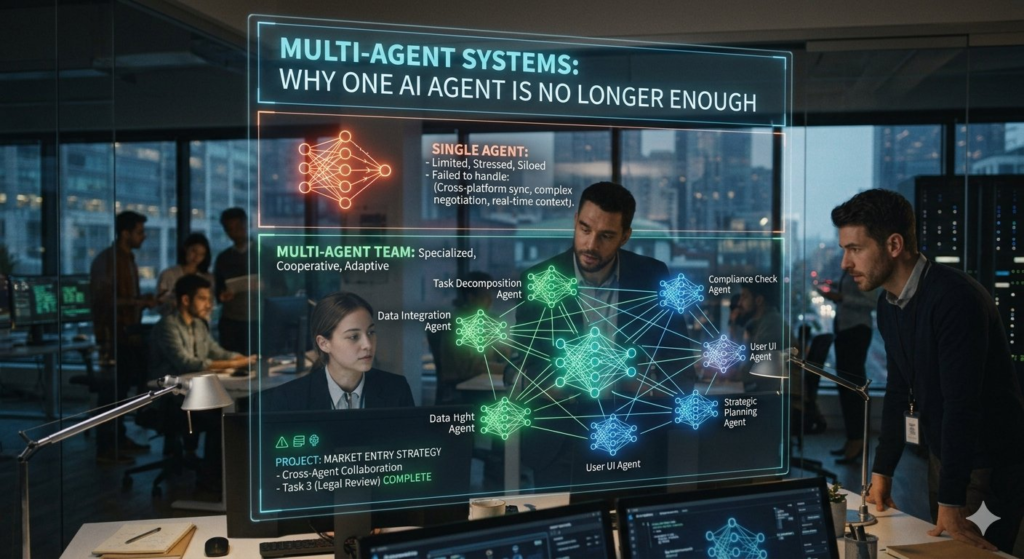
Artificial intelligence is moving beyond simple chatbots and single-purpose AI assistants. The next major evolution is multi-agent AI—systems where multiple specialized AI agents work together to solve complex problems.
A single AI agent can research information, write code, analyze data, call APIs, and automate tasks. But when a workflow becomes highly complex, asking one agent to do everything can create problems involving context, reliability, coordination, cost, and security.
This is why Multi-Agent Systems (MAS) are attracting increasing attention across enterprise AI, software development, automation, cybersecurity, research, and business operations.
Instead of building one AI agent that tries to handle every responsibility, organizations can create a network of specialized agents that collaborate toward a common goal.
Think of it this way:
A single AI agent can behave like an employee. A multi-agent system can behave more like an AI-powered organization.
What Is a Multi-Agent System?
A Multi-Agent System is an AI architecture in which multiple autonomous or semi-autonomous agents work together to accomplish a larger objective.
Each agent can be designed for a specific role and may have its own:
- Instructions
- Tools
- Knowledge sources
- Memory
- APIs
- Permissions
- Reasoning strategy
- Responsibilities
For example, an AI-powered software development system could contain:
- Manager Agent – coordinates the overall workflow
- Research Agent – gathers technical information
- Coding Agent – writes or modifies code
- Testing Agent – tests the implementation
- Security Agent – checks for security issues
- Documentation Agent – prepares technical documentation
Rather than forcing one AI model to perform all of these tasks, the system distributes work among specialized agents.
Why Is One AI Agent No Longer Enough?
Single AI agents are becoming increasingly capable. Modern agents can access tools, search information, work with databases, execute code, interact with APIs, and maintain context.
However, complexity creates a new challenge.
Imagine asking one agent to:
- Research a market.
- Analyze customer data.
- Create a business strategy.
- Write software.
- Test the software.
- Perform a security review.
- Prepare documentation.
- Deploy the application.
The agent now has to understand multiple domains and decide which tools, information, and actions are appropriate at every stage.
As the number of responsibilities increases, the architecture becomes harder to manage.
This creates a strong argument for specialized AI agents working together.
Single-Agent vs Multi-Agent AI
A traditional single-agent architecture might look like this:
                    User
                      |
                      v
                  AI Agent
                      |
          +-----------+-----------+
          |           |           |
        Search       APIs      Database
          |           |           |
          +-----------+-----------+
                      |
                    Result
The agent is responsible for coordinating almost everything.
A multi-agent architecture distributes those responsibilities:
                     User
                       |
                       v
               Orchestrator Agent
                       |
          +------------+------------+
          |            |            |
          v            v            v
      Research      Data Agent    Planning
       Agent                       Agent
          |            |            |
          +------------+------------+
                       |
             +---------+---------+
             |         |         |
             v         v         v
          Coding    Security   Testing
           Agent      Agent      Agent
             |         |         |
             +---------+---------+
                       |
                       v
                 Final Result
The important difference is specialization and coordination.
How Multi-Agent AI Systems Work
A typical multi-agent workflow contains several stages.
1. The User Defines a Goal
The process begins with a high-level objective.
For example:
“Analyze our sales data and identify the reasons for declining revenue.”
The request can be passed to an orchestrator or manager agent.
2. The Manager Agent Breaks Down the Task
The manager determines which smaller tasks are required.
For example:
- Retrieve sales information.
- Analyze regional performance.
- Compare customer segments.
- Identify unusual changes.
- Research possible external factors.
- Validate the findings.
- Prepare a final report.
3. Tasks Are Delegated
The manager assigns individual tasks to specialized agents.
Manager Agent
     |
     +----> Data Agent
     |
     +----> Analytics Agent
     |
     +----> Research Agent
     |
     +----> Validation Agent
Each agent focuses on its assigned responsibility.
4. Agents Collaborate
The agents can exchange information.
For example, an analytics agent might discover that enterprise sales declined significantly.
The research agent can then investigate possible reasons for that decline.
This creates a workflow where agents don’t simply operate independently—they can use information generated by other agents.
5. Results Are Verified
Another agent can review the output before the final answer is generated.
This creates a process such as:
Generate → Review → Validate → Finalize
For enterprise applications, this additional verification layer can be particularly useful.
Types of Multi-Agent Architectures
There is no single architecture that works for every AI application.
Several patterns are possible.
Hierarchical Multi-Agent Systems
A manager or orchestrator controls several specialized agents.
                  Manager
                     |
          +----------+----------+
          |          |          |
       Agent A    Agent B    Agent C
This approach resembles a traditional organizational hierarchy.
The manager determines which agent should perform each task.
Peer-to-Peer Agents
In a peer-to-peer architecture, agents can communicate directly with each other.
Agent A <----> Agent B
   ^              |
   |              v
Agent D <----> Agent C
This can be useful when tasks require dynamic collaboration between agents.
Sequential Agents
Each agent completes a specific stage before passing the result to the next agent.
Research
   ↓
Analysis
   ↓
Writing
   ↓
Review
   ↓
Publishing
This approach is relatively easy to understand and can work well for predictable workflows.
Parallel Agents
Multiple agents work on different tasks at the same time.
                 Manager
              /     |      \
             /      |       \
        Research   Data   Security
          Agent    Agent    Agent
             \      |       /
              \     |      /
                Final Agent
Parallel execution can reduce overall workflow time when tasks are independent.
Why AI Agent Specialization Matters
Specialization is one of the biggest advantages of multi-agent systems.
Consider software development.
A single agent might have to understand:
- Business requirements
- Programming
- Databases
- Cloud infrastructure
- Cybersecurity
- Testing
- Documentation
A multi-agent system can distribute these responsibilities.
Coding Agent
Responsible for implementing software.
Database Agent
Works with schemas, queries, and database-related tasks.
Testing Agent
Creates and executes tests.
Security Agent
Reviews code and configurations for potential security problems.
Documentation Agent
Creates technical documentation.
This architecture can also make it easier to control access.
For example, a research agent could have access to information sources without having permission to modify production systems.
Multi-Agent Systems in Enterprise AI
Enterprise environments are particularly interesting because business processes often involve multiple systems and departments.
Consider an insurance claim workflow.
A multi-agent system could contain:
Customer Agent: Collects information from the customer.
Document Agent: Extracts relevant information from submitted documents.
Fraud Analysis Agent: Identifies potentially suspicious patterns.
Policy Agent: Checks relevant policy information.
Finance Agent: Calculates financial information.
Compliance Agent: Reviews applicable compliance requirements.
Manager Agent: Coordinates the overall workflow.
Human approval can remain part of the process when decisions involve significant financial, legal, or operational consequences.
This approach transforms AI from a simple chatbot into an AI-powered workflow system.
Multi-Agent Systems vs AI Chatbots
Multi-agent systems are often confused with AI chatbots, but they are fundamentally different concepts.
A chatbot is primarily designed to communicate with users.
A single AI agent can perform tasks using tools.
A multi-agent system coordinates multiple agents to complete a larger objective.
For example:
Chatbot
“What is the status of my order?”
Single AI Agent
The agent checks an order management system and provides the answer.
Multi-Agent System
The workflow could involve:
Customer Agent → Order Agent → Inventory Agent → Shipping Agent → Manager Agent → Customer
The user may see one conversational interface, while several AI agents operate behind the scenes.
The Rise of Agentic Workflows
Multi-agent systems are part of a broader shift toward agentic AI.
Traditional automation often follows predefined rules:
IF X happens
THEN execute Y
Agentic systems can operate more dynamically:
Goal
 ↓
Plan
 ↓
Select tools
 ↓
Execute
 ↓
Observe
 ↓
Adjust
 ↓
Verify
 ↓
Complete
Multi-agent AI adds another layer:
Goal
 ↓
Manager Agent
 ↓
Task Decomposition
 ↓
Specialized Agents
 ↓
Collaboration
 ↓
Verification
 ↓
Final Result
This architecture can be useful for workflows where every step cannot easily be defined in advance.
The Biggest Potential Advantage: Parallel Execution
One reason organizations are interested in multi-agent architectures is the ability to perform independent tasks simultaneously.
Imagine asking an AI system to research a company.
Instead of one agent performing every investigation sequentially, several agents could work on different areas:
- Market research
- Competitor analysis
- Financial information
- Product research
- Customer sentiment
Their results can then be combined by a manager agent.
However, parallel execution does not automatically make a system faster. Model latency, API response times, dependencies between tasks, and orchestration overhead all influence the final performance.
Are Multi-Agent Systems Always Better?
No.
Adding more agents can introduce new problems.
Higher Costs
Every agent may consume model tokens and computational resources.
A workflow involving several agents can therefore cost significantly more than a carefully designed single-agent workflow.
More Latency
Agents may need to communicate with each other, call external APIs, or wait for other tasks.
This can increase response time.
Coordination Complexity
Someone—or something—must coordinate all the agents.
Poor orchestration can create unnecessary loops and duplicated work.
Error Propagation
If one agent produces an incorrect result and another agent treats that result as reliable information, the error can spread through the workflow.
Debugging Challenges
With many agents involved, developers need detailed observability to understand:
- Which agent made a decision?
- Which tool did it call?
- What information did it receive?
- Why did it take a particular action?
- Where did the workflow fail?
Therefore, more agents do not automatically mean better AI.
Agent Governance Is Becoming Critical
As AI agents gain more autonomy, governance becomes increasingly important.
Each agent should have clearly defined:
- Permissions
- Responsibilities
- Tools
- Data access
- Spending limits
- Approval requirements
- Logging requirements
- Security controls
- Failure-handling mechanisms
For example, a research agent might be allowed to search public information but have no permission to modify an enterprise database.
A coding agent might be allowed to modify source code but require human approval before production deployment.
A finance agent might generate an analysis but require authorization before executing a transaction.
This leads to an important principle:
The level of AI autonomy should match the potential risk of the action.
Why Multi-Agent AI Needs Guardrails
Agentic systems can potentially interact with real systems and take actions.
That makes security and governance essential.
A production architecture could include:
User
 ↓
Orchestrator
 ↓
AI Agent
 ↓
Policy / Guardrail Layer
 ↓
Tool or API
 ↓
Result Validation
 ↓
Human Approval
 ↓
Action
Guardrails can help control:
- API access
- Sensitive data
- Database permissions
- Financial transactions
- External communications
- Tool usage
- Rate limits
- Human approvals
The goal isn’t necessarily to eliminate autonomy.
It is to make autonomy controlled, observable, and appropriate for the task.
Will Multi-Agent Systems Replace Traditional SaaS?
This is one of the most interesting questions surrounding agentic AI.
Traditional software often works like this:
User
 ↓
Application
 ↓
Business Logic
 ↓
Database
An agent-powered architecture could look more like:
User
 ↓
AI Interface
 ↓
Agent Orchestrator
 ↓
Specialized Agents
 ↓
APIs + Databases + SaaS
The important point is that AI agents may not need to eliminate SaaS applications.
Instead, they could change how users interact with them.
Rather than manually opening multiple applications, a user might say:
“Prepare this month’s sales report, identify unusual changes, summarize the findings, and prepare an email for the leadership team.”
The agent could interact with several existing enterprise systems behind the scenes.
Could AI Agents Become the New Interface to Software?
This is a major possibility for the future of enterprise applications.
Today, employees often need to learn how to use dozens of software platforms.
Tomorrow, the interface could increasingly become conversational or goal-oriented.
Instead of navigating:
- CRM
- ERP
- Analytics platforms
- Project management tools
- HR systems
users could communicate with an AI agent that coordinates actions across those systems.
This does not necessarily mean those applications disappear.
Their role could shift toward becoming systems of record and infrastructure, while AI agents become the primary interaction layer.
The Emerging Multi-Agent AI Stack
A mature enterprise multi-agent platform could contain several layers:
                       User
                         ↓
                  AI Interface
                         ↓
                   Orchestrator
                         ↓
          +--------------+--------------+
          ↓              ↓              ↓
     Research Agent   Data Agent   Coding Agent
          ↓              ↓              ↓
        Tools           APIs        Databases
          ↓              ↓              ↓
             Enterprise Systems
Surrounding these components are additional capabilities such as:
- Identity
- Security
- Governance
- Memory
- Observability
- Evaluation
- Policy enforcement
- Human approval
This could become an important component of the enterprise AI technology stack.
How Developers Can Prepare for Multi-Agent AI
Developers building AI applications should understand more than just prompt engineering.
Important areas include:
Agent Orchestration
Understand how multiple agents can be coordinated and how tasks can be delegated.
Tool Calling
Learn how agents interact with APIs, databases, search systems, code execution environments, and business applications.
RAG
Retrieval-Augmented Generation can provide agents with access to external or organizational knowledge.
Memory
Understand how agents can maintain relevant context across interactions and workflows.
MCP and Tool Connectivity
Learn how emerging standards and frameworks can allow AI systems to interact with external tools and resources.
Observability
Build systems that allow developers to inspect agent actions, tool calls, decisions, and failures.
Evaluation
Agentic systems need systematic testing because their behavior can vary across different inputs and execution paths.
Security
Developers need to consider identity, permissions, prompt injection, data leakage, unauthorized tool use, and excessive autonomy.
The Future May Not Be One Giant AI
One of the most interesting possibilities is that the future of AI may not revolve around a single model or a single super-agent doing everything.
Instead, AI systems could increasingly consist of specialized agents working together.
The evolution could look something like:
Traditional Software
One application performs predefined functions.
↓
AI Assistant
AI helps users interact with software.
↓
AI Agent
AI performs tasks using tools.
↓
Multi-Agent System
Multiple specialized agents collaborate.
↓
Agentic Enterprise
AI agents coordinate workflows across applications, databases, APIs, and business functions.
The challenge will be making these systems reliable enough for real-world use.
Final Thoughts
Multi-agent systems represent an important evolution in the development of AI agents.
A single agent can be extremely capable, but complex enterprise workflows often involve many different responsibilities, systems, and types of expertise.
Multi-agent architectures provide a way to divide those responsibilities among specialized agents while using an orchestration layer to coordinate their work.
However, multi-agent AI also introduces new challenges.
More agents can mean:
- More cost
- More latency
- More complexity
- More security considerations
- More opportunities for errors
The real breakthrough may therefore not come from simply creating more AI agents.
It may come from building systems that know which agent should do what, what each agent is allowed to access, when agents should collaborate, when results should be verified, and when a human should remain in control.
That is the real promise of multi-agent AI.
The future of enterprise AI may not be one AI agent doing everything.
It may be a coordinated digital workforce in which specialized AI agents work together to accomplish goals that would be difficult for a single agent to handle alone.
If you enjoyed this article, you may also like:
- 5 AI Gateways That Offer Free Tokens in 2026
- How to Build a Humanoid Robot in 2026: Costs, Timeline & Complete Blueprint
- Best AI Research Tools in 2026: ChatGPT, Claude, Gemini & Perplexity
- Best AI Resume Builders in 2026 — Free
- ChatGPT Review — Is It Worth Paying For in 2026?
- 10 Best Free AI Tools You Should Use in 2026
- Best AI Video Generators in 2026 — Free and Paid
- Best AI for Students in 2026: Top 10 Tools for Learning
- How AI Learns From Humans to Build Physical Robots
- How AI Learns From Humans to Build Physical Robots
- Why LangGraph Is So Popular in Enterprises — Pros, Cons & Real-World Use Cases in 2026
- ChatGPT vs Gemini vs Claude vs Grok 2026
- DeepSeek V4 vs Grok 4 vs Claude Opus 5 vs Nvidia Nemotron vs Gemini 2.5 Pro — The Ultimate AI Model Comparison for 2026
- AI Agent and LLM Frameworks Comparison 2026: LangChain vs LangGraph vs CrewAI vs AutoGen vs LlamaIndex vs Semantic Kernel
- Best Multi-Agent AI Platforms in 2026: CrewAI vs AutoGen vs LangGraph vs OpenAI Agents SDK vs Agno vs Semantic Kernel
- Best AI Development Platforms in 2026: OpenAI API vs Anthropic API vs Google AI Studio vs Vertex AI vs Azure AI Foundry vs AWS Bedrock vs Hugging Face
- Exploring the Latest AI Tools and Technologies
- How to Use ChatGPT for Business — A Complete Beginner Guide
- How to Write Blog Posts with AI — A Proven Step-by-Step Guide
- Best AI Coding Assistants 2026
- Ultimate Guide to the 10 Best AI Chatbots in 2026
- Claude AI Review — Best ChatGPT Alternative in 2026
- Jasper AI Review — Is It Worth $49/Month in 2026?
- How to Use AI for Social Media Marketing — Complete Guide
- AI Tools for Small Business Owners — Save 10 Hours/Week
- AI Tools for Content Creators
- Best AI Music Generators in 2026 — Create Songs in Minutes
- AI Design Tools Compared: Canva AI vs Adobe Firefly vs Midjourney
- Best AI Writing Tools 2026
- 10 Free AI Tools You Should Try in 2026
- Best AI Image Generators in 2026 — Free and Paid Compared
- Best AI Productivity Tools in 2026 — Work Smarter, Not Harder
- ChatGPT vs Claude in 2026 — Which AI Is Actually Better?
- ChatGPT vs Gemini vs Claude vs Grok (2026): Which AI Assistant Should You Actually Use?
Visit Aidacoit.com for more AI comparisons, practical AI tutorials, enterprise AI insights, and emerging technology trends.