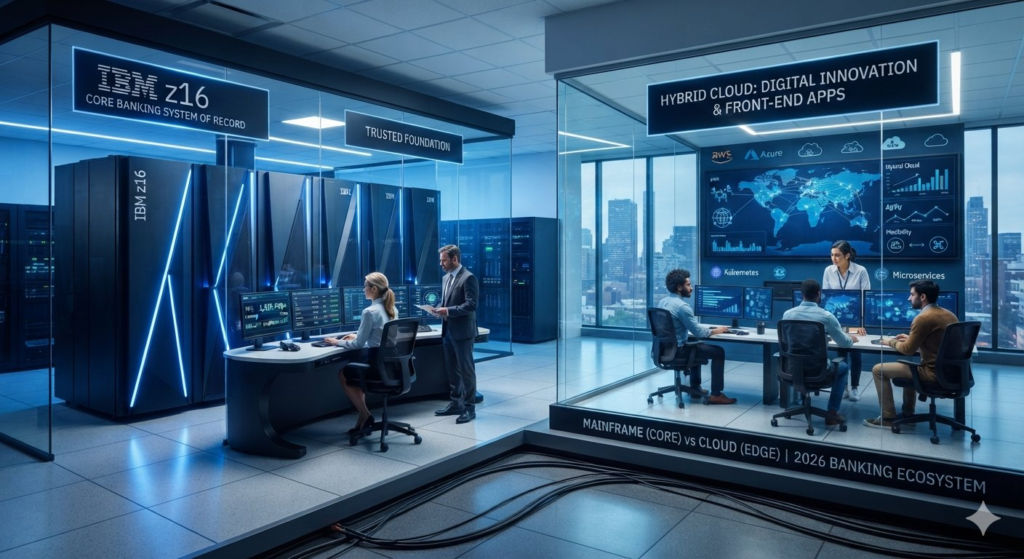
Cloud computing has transformed the technology industry. Companies can now run applications, store data and scale computing resources without owning massive physical data centers.
So, does that mean the mainframe is finally becoming obsolete?
Not quite.
In 2026, IBM mainframes remain an important part of the technology infrastructure used by banks, insurance companies, governments and other large organizations. At the same time, these organizations are rapidly adopting cloud computing, artificial intelligence and modern application architectures.
The result is not necessarily mainframe vs cloud.
Increasingly, it is mainframe and cloud working together.
This article explains why banks still rely on IBM mainframes, how mainframes compare with cloud platforms, and why hybrid computing could define the future of banking technology.
What Is a Mainframe?
A mainframe is a powerful enterprise computer designed to process enormous amounts of data and transactions reliably.
IBM is the most prominent company associated with modern mainframes. Its current IBM Z platform is designed for mission-critical workloads requiring high availability, security and transaction processing capabilities.
Unlike a typical desktop or server, a mainframe is designed to handle thousands or even millions of transactions and users while maintaining strict reliability and data integrity.
For decades, banks have used mainframes to run core banking systems.
These systems can support activities such as:
- Processing bank transactions
- Managing customer accounts
- Processing payments
- Handling credit and debit card transactions
- Running financial databases
- Processing large batch workloads
- Supporting ATM and banking applications
- Maintaining records and regulatory data
Many of these systems were built over decades and have become deeply integrated into banking operations.
What Is Cloud Computing?
Cloud computing provides computing resources through data centers operated by cloud providers.
Instead of purchasing and maintaining all infrastructure themselves, organizations can access computing power, storage, databases, networking and software through cloud platforms.
Major cloud providers include:
- Amazon Web Services (AWS)
- Microsoft Azure
- Google Cloud
- IBM Cloud
Cloud computing is particularly attractive for modern applications because organizations can quickly increase or decrease resources according to demand.
For example, an online banking application may need significantly more computing resources during a major product launch or a period of unusually high traffic.
Cloud platforms make this kind of scaling much easier.
Mainframe vs Cloud: What’s the Difference?
The biggest difference is the way these technologies are designed and used.
Traditional mainframes are optimized for reliability, security, centralized processing and extremely high-volume transaction workloads.
Cloud computing is optimized for flexibility, scalability, distributed applications and rapid deployment.
Neither technology is automatically better for every workload.
| Feature | IBM Mainframe | Cloud Computing |
|---|---|---|
| Transaction processing | Excellent | Excellent |
| Reliability | Extremely high | Extremely high |
| Scalability | Very high | Extremely flexible |
| Infrastructure flexibility | Lower | Very high |
| Legacy applications | Excellent | Requires modernization |
| Modern application development | More specialized | Excellent |
| Deployment speed | More controlled | Very fast |
| AI integration | Increasing | Very strong |
| Cost model | Infrastructure-focused | Consumption-based |
| Best suited for | Mission-critical workloads | Modern & variable workloads |
The right choice depends on the application.
Why Do Banks Still Use IBM Mainframes?
1. Reliability Matters More Than Almost Anything
A bank cannot afford to have its core transaction system repeatedly go offline.
Imagine trying to withdraw money, transfer funds or make a payment and discovering that the banking infrastructure is unavailable.
For financial institutions, reliability is not simply a technical feature. It is a business requirement.
IBM Z systems have been designed specifically for mission-critical enterprise workloads where availability and resilience are extremely important.
That makes mainframes attractive for core banking environments.
2. Banks Process Huge Numbers of Transactions
Banks process enormous volumes of transactions every day.
These transactions include:
- Deposits
- Withdrawals
- Fund transfers
- Card payments
- Loan payments
- Interest calculations
- Account updates
- Clearing and settlement activities
Many traditional banking systems were designed specifically around high-volume transaction processing.
Replacing such systems isn’t as simple as moving a website from one server to another.
A bank may have decades of business rules, databases and applications connected to its mainframe.
3. Legacy Applications Still Matter
The word “legacy” sometimes makes older technology sound useless.
That’s not necessarily true.
A legacy banking application may be decades old, but if it reliably processes millions of transactions and contains critical business logic, replacing it can be extremely risky.
Banks therefore have to consider:
Does replacing the system provide enough benefit to justify the cost and risk?
In many cases, the answer is not immediately yes.
Instead, banks are modernizing around their existing systems.
4. Security Is Critical
Financial institutions operate under strict security and regulatory requirements.
Mainframes have long been designed with enterprise security and access controls in mind.
Modern IBM Z systems also include hardware and software capabilities designed to protect sensitive data and support confidential computing and encryption.
However, it is important to remember that no technology is automatically secure simply because it is a mainframe or cloud platform.
Security depends on architecture, configuration, software, identity management, monitoring and operational practices.
5. Moving Everything to the Cloud Is Risky
Cloud migration can provide major benefits, but moving a bank’s entire core infrastructure is a huge undertaking.
A large financial institution may have:
- Decades of historical data
- Millions of customers
- Thousands of applications
- Complex integrations
- Regulatory requirements
- Mainframe-based business logic
- Multiple databases
- Existing APIs and interfaces
A poorly executed migration could create significant operational and financial risks.
As a result, many banks prefer gradual modernization instead of a single massive migration.
Does This Mean Mainframes Are Better Than Cloud?
No.
Cloud computing has advantages that mainframes cannot easily match.
Cloud platforms make it easier to:
- Launch new applications
- Experiment with new technologies
- Scale resources
- Build distributed applications
- Deploy software rapidly
- Integrate AI services
- Use managed databases
- Support modern DevOps workflows
For a new mobile banking application, analytics platform or customer-facing digital service, cloud infrastructure may be a natural choice.
But that doesn’t mean the bank has to remove its mainframe.
This is where hybrid architecture becomes important.
Mainframe and Cloud: The Rise of Hybrid Banking
Instead of choosing between mainframe and cloud, financial institutions can connect both environments.
A simplified architecture might look like this:
Customer → Mobile/Web App → Cloud Services → APIs → Mainframe → Core Banking Data
The cloud can handle modern digital applications while the mainframe continues processing critical transactions.
This approach can provide banks with the benefits of modernization without forcing them to immediately replace their core systems.
Why Hybrid Cloud Makes Sense for Banks
Hybrid architectures allow organizations to use different technologies for different workloads.
For example:
Mainframe
Can handle:
- Core banking transactions
- Customer account processing
- High-volume batch workloads
- Critical financial records
Cloud
Can handle:
- Mobile applications
- Customer portals
- Data analytics
- AI applications
- Development environments
- Digital services
- Modern APIs
The two environments can communicate through APIs and integration platforms.
This approach allows banks to modernize gradually.
What About AI and Mainframes?
Artificial intelligence is changing the mainframe conversation.
Banks increasingly want to apply AI to existing enterprise data and applications.
Instead of immediately moving all that data somewhere else, organizations can explore ways to bring AI capabilities closer to existing enterprise systems.
AI can potentially help banks with:
- Fraud detection
- Risk analysis
- Customer service
- Transaction monitoring
- Security
- Code modernization
- Application development
- Operational analytics
IBM has also been positioning IBM Z as part of an enterprise AI strategy, including capabilities designed to bring AI closer to mission-critical workloads.
This could become increasingly important as banks look for ways to modernize without abandoning their existing infrastructure.
Mainframe Modernization Is the Real Trend
One of the biggest misconceptions about the mainframe is that modernization means replacing it.
In reality, modernization can take several forms.
Banks can:
- Connect mainframes to APIs
- Modernize user interfaces
- Integrate cloud services
- Refactor selected applications
- Add AI capabilities
- Modernize development processes
- Improve data accessibility
- Move selected workloads to cloud platforms
This creates a gradual transformation rather than a complete technology replacement.
Why Don’t Banks Simply Move Everything to the Cloud?
There are several reasons.
Cost
Large-scale cloud migration can require significant investment in software, engineering, data migration and operational changes.
Cloud also isn’t automatically cheaper.
Organizations must carefully manage cloud usage, storage, networking and application architecture to control costs.
Complexity
Banking systems are interconnected.
Changing one component can affect multiple other systems.
Risk
Core banking infrastructure handles highly sensitive financial transactions.
Banks generally cannot treat migration like an ordinary IT project.
Existing Expertise
Large financial institutions already have teams, processes and infrastructure built around their existing mainframe environments.
Replacing everything at once would mean replacing not only technology but also years of operational knowledge.
Are Mainframes Dying in 2026?
The short answer is:
No. But they are changing.
The mainframe of the future is unlikely to operate as an isolated system hidden from modern applications.
Instead, it is increasingly becoming part of a broader hybrid architecture.
Modern mainframe environments can connect with:
- Cloud platforms
- APIs
- Containers
- AI systems
- Analytics platforms
- Modern development tools
- Distributed applications
The mainframe is therefore evolving from a traditional centralized computing platform into one component of a larger enterprise technology ecosystem.
IBM Mainframe vs Cloud: Which One Should Banks Choose?
There isn’t a universal answer.
The better question is:
Which workload belongs where?
A bank may choose a mainframe for extremely critical transaction processing while using cloud infrastructure for digital applications and analytics.
For example:
| Banking Workload | Potential Technology |
|---|---|
| Core account processing | Mainframe |
| High-volume transaction processing | Mainframe |
| Mobile banking interface | Cloud |
| Customer web application | Cloud |
| AI experimentation | Cloud |
| Fraud analytics | Hybrid |
| Legacy banking application | Mainframe |
| Modern API layer | Cloud/Hybrid |
| Enterprise data integration | Hybrid |
This workload-based approach is likely to become more common.
The Future of Mainframes in Banking
The future of banking infrastructure will probably not be a simple battle between mainframes and cloud computing.
Instead, banks are likely to build increasingly hybrid environments.
Mainframes will continue to handle workloads where reliability, transaction processing, security and existing business logic are extremely important.
Cloud platforms will continue to power modern applications, analytics, AI and rapidly changing digital services.
The technologies will increasingly be connected rather than isolated.
Mainframe vs Cloud in 2026: Final Verdict
The prediction that cloud computing would completely eliminate mainframes has not come true.
Banks still trust IBM mainframes because their core systems require reliability, high-volume transaction processing, security and continuity.
At the same time, banks cannot ignore cloud computing.
Customers expect modern mobile apps, instant services, personalized experiences and AI-powered products. Building these capabilities often requires modern cloud-native technologies.
That’s why the most realistic future isn’t:
Mainframe OR Cloud
It is:
Mainframe + Cloud + AI
The mainframe may no longer be the entire foundation of a bank’s technology infrastructure, but for many financial institutions, it remains an important part of the foundation.
And in 2026, the real story isn’t that the mainframe survived the cloud revolution.
It’s that the mainframe is adapting to it.
Frequently Asked Questions
Is the mainframe still used in 2026?
Yes. Mainframes continue to be used for mission-critical enterprise workloads, including financial transaction processing and other high-volume workloads.
Why do banks still use IBM mainframes?
Banks value mainframes for reliability, transaction processing, security, scalability and the ability to run long-established critical applications.
Is cloud computing replacing mainframes?
Cloud computing is replacing or modernizing some workloads, but it has not eliminated mainframes. Many organizations are adopting hybrid architectures that combine mainframe and cloud technologies.
Is IBM Z a mainframe?
Yes. IBM Z is IBM’s modern mainframe platform family designed for enterprise and mission-critical workloads.
Which is better: mainframe or cloud?
Neither is universally better. Mainframes are particularly strong for certain mission-critical workloads, while cloud platforms provide flexibility, rapid deployment and modern application capabilities.
Will mainframes disappear in the future?
There is no clear indication that mainframes will disappear soon. Their role is evolving as organizations connect them with cloud, APIs, AI and modern application architectures.
Why don’t banks migrate everything to the cloud?
Large banks have complex legacy systems, sensitive data, regulatory requirements and mission-critical applications. A complete migration can be expensive, risky and technically complex, so many organizations modernize gradually.
If you enjoyed this article, you may also like:
- 5 AI Gateways That Offer Free Tokens in 2026
- How to Build a Humanoid Robot in 2026: Costs, Timeline & Complete Blueprint
- Best AI Research Tools in 2026: ChatGPT, Claude, Gemini & Perplexity
- Best AI Resume Builders in 2026 — Free
- ChatGPT Review — Is It Worth Paying For in 2026?
- 10 Best Free AI Tools You Should Use in 2026
- Best AI Video Generators in 2026 — Free and Paid
- Best AI for Students in 2026: Top 10 Tools for Learning
- How AI Learns From Humans to Build Physical Robots
- How AI Learns From Humans to Build Physical Robots
- Why LangGraph Is So Popular in Enterprises — Pros, Cons & Real-World Use Cases in 2026
- ChatGPT vs Gemini vs Claude vs Grok 2026
- DeepSeek V4 vs Grok 4 vs Claude Opus 5 vs Nvidia Nemotron vs Gemini 2.5 Pro — The Ultimate AI Model Comparison for 2026
- AI Agent and LLM Frameworks Comparison 2026: LangChain vs LangGraph vs CrewAI vs AutoGen vs LlamaIndex vs Semantic Kernel
- Best Multi-Agent AI Platforms in 2026: CrewAI vs AutoGen vs LangGraph vs OpenAI Agents SDK vs Agno vs Semantic Kernel
- Best AI Development Platforms in 2026: OpenAI API vs Anthropic API vs Google AI Studio vs Vertex AI vs Azure AI Foundry vs AWS Bedrock vs Hugging Face
- Exploring the Latest AI Tools and Technologies
- How to Use ChatGPT for Business — A Complete Beginner Guide
- How to Write Blog Posts with AI — A Proven Step-by-Step Guide
- Best AI Coding Assistants 2026
- Ultimate Guide to the 10 Best AI Chatbots in 2026
- Claude AI Review — Best ChatGPT Alternative in 2026
- Jasper AI Review — Is It Worth $49/Month in 2026?
- How to Use AI for Social Media Marketing — Complete Guide
- AI Tools for Small Business Owners — Save 10 Hours/Week
- AI Tools for Content Creators
- Best AI Music Generators in 2026 — Create Songs in Minutes
- AI Design Tools Compared: Canva AI vs Adobe Firefly vs Midjourney
- Best AI Writing Tools 2026
- 10 Free AI Tools You Should Try in 2026
- Best AI Image Generators in 2026 — Free and Paid Compared
- Best AI Productivity Tools in 2026 — Work Smarter, Not Harder
- ChatGPT vs Claude in 2026 — Which AI Is Actually Better?
- ChatGPT vs Gemini vs Claude vs Grok (2026): Which AI Assistant Should You Actually Use?
Visit Aidacoit.com for more AI comparisons, practical AI tutorials, enterprise AI insights, and emerging technology trends.