By Aidacoit.com | Artificial Intelligence, Automation & Career Development
Artificial intelligence is moving beyond chatbots and content generation. Businesses are increasingly exploring how to integrate AI into customer service, software development, finance, healthcare, operations, sales, and enterprise workflows. However, adopting an AI tool is only one part of the process. Organizations also need people who can identify business problems, select the right AI solutions, integrate them with existing systems, manage risks, and deliver measurable business results.
This is where an AI implementation expert becomes valuable.
An AI implementation expert helps organizations move from experimenting with AI to using it in real business environments. The role combines AI knowledge, business analysis, workflow automation, systems integration, data management, security, and change management.
The good news is that you do not necessarily need a PhD in artificial intelligence to enter this field. Depending on your target role, you can build a strong foundation through practical projects, technical skills, industry knowledge, and experience implementing AI solutions.
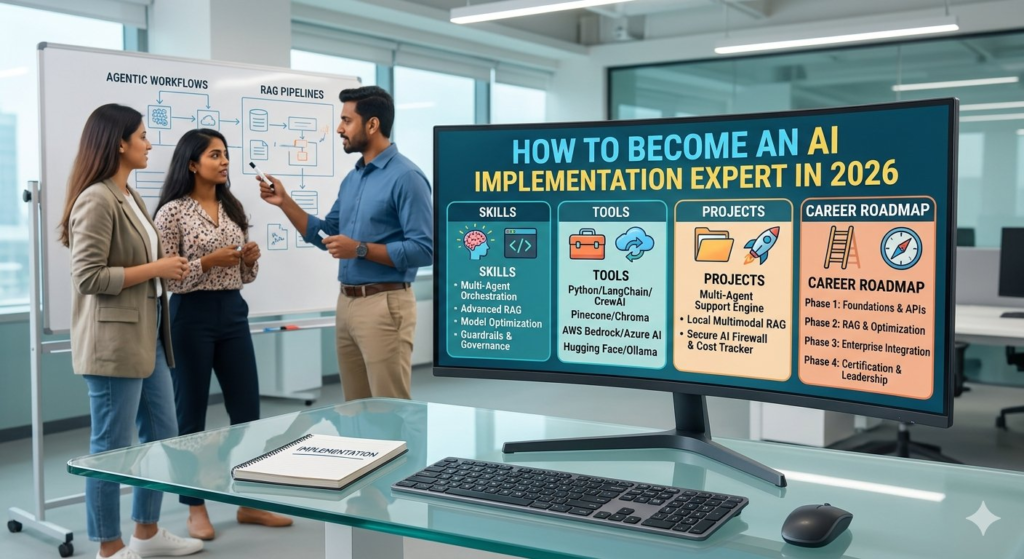
In this guide, Aidacoit.com explains how to become an AI implementation expert in 2026, which skills to prioritize, which tools to learn, how to build a portfolio, and how to prepare for career opportunities.
What Is an AI Implementation Expert?
An AI implementation expert is a professional who helps businesses introduce AI into their existing processes, products, and technology environments.
Unlike someone who only knows how to use AI chatbots, an implementation expert focuses on solving business problems through working AI solutions.
For example, a company may want to reduce the time employees spend answering customer queries. An AI implementation expert might analyze the support process, identify repetitive questions, connect a language model to approved knowledge sources, integrate the solution with the company’s customer-support platform, and establish safeguards for situations that require human assistance.
The objective is not simply to build an AI demonstration. It is to deliver a solution that works reliably, integrates with business operations, and produces measurable value.
AI user vs. AI developer vs. AI implementation expert
| Role | Primary responsibility | Typical skills |
|---|---|---|
| AI tool user | Uses existing AI applications | Prompting, research, productivity |
| AI developer | Builds AI-powered software | Programming, APIs, testing, data |
| AI/ML engineer | Develops and deploys machine-learning systems | Statistics, ML, software engineering |
| AI implementation expert | Integrates AI into business workflows and delivers adoption | Business analysis, AI architecture, integration, automation, governance |
| AI transformation leader | Oversees AI strategy and organizational change | Strategy, leadership, operating models, value realization |
These roles overlap, and job titles vary between companies. Some AI implementation positions are highly technical, while others emphasize consulting, architecture, and business transformation.
Why Are AI Implementation Skills Becoming Important?
Businesses can access powerful AI models and ready-made AI applications, but successful implementation requires more than purchasing a subscription.
Organizations must determine which problems are suitable for AI, assess data quality, connect AI to existing systems, protect sensitive information, and measure whether the solution improves performance.
Common implementation challenges include:
- Choosing the right AI model or platform for a business problem.
- Integrating AI with enterprise applications and databases.
- Reducing incorrect or unsupported AI-generated responses.
- Managing security, privacy, and access permissions.
- Automating workflows without losing necessary human oversight.
- Evaluating cost, performance, reliability, and return on investment.
- Helping employees adopt new AI-enabled processes.
Professionals who can address these challenges can help businesses turn AI investments into operational improvements.
However, demand varies by industry, geography, company budgets, and individual experience. Learning AI implementation is a career development opportunity, not a guarantee of employment or income.
1. Understand the Fundamentals of Artificial Intelligence
Before implementing AI solutions, you need to understand the technologies involved and the problems each technology can solve.
You do not need to master every AI discipline at once. Start with the concepts most relevant to business applications.
Generative AI and large language models
Generative AI systems can produce text, summarize documents, answer questions, generate code, and support other tasks.
Large language models (LLMs) are frequently used to build AI assistants, knowledge-search systems, document-processing applications, and conversational interfaces.
Learn the basics of:
- How LLMs generate responses.
- Tokens, context windows, and model limitations.
- Prompt design and structured outputs.
- Model selection and API usage.
- Hallucinations and response evaluation.
- Latency, cost, and reliability trade-offs.
Retrieval-augmented generation (RAG)
RAG is a technique that allows an AI application to retrieve relevant information from external sources before generating a response.
For example, an enterprise assistant could retrieve information from approved company policies, technical documentation, or product manuals.
Learn how document ingestion, chunking, embeddings, retrieval, ranking, and source citations work together.
AI agents
AI agents can use tools, retrieve information, and execute sequences of actions toward a defined objective, depending on their design and permissions.
An agent might retrieve a customer record, check an order status, and prepare a response. A production implementation should also define what the agent is permitted to do, which actions require approval, and how failures are handled.
Understand the difference between a simple workflow, an LLM-powered application, and an agent that makes decisions about which steps or tools to use.
Machine learning fundamentals
Learn enough machine learning to understand classification, prediction, training data, evaluation, and model performance.
This knowledge is particularly useful when implementing predictive analytics, recommendation systems, forecasting, or custom machine-learning solutions.
Practical recommendation: Begin with generative AI, APIs, RAG, and workflow automation. Expand into deeper machine-learning concepts when your target projects require them.
2. Develop the Technical Skills Needed for AI Implementation
You do not need the same technical depth for every AI implementation role. However, technical literacy is essential if you want to design solutions that work beyond a demonstration.
Programming and APIs
Python is a useful starting point because it is widely used in AI development, data processing, and automation.
Focus on:
- Python fundamentals and data structures.
- Working with JSON and files.
- Calling REST APIs.
- Authentication and API keys.
- Error handling and logging.
- Basic Git and version control.
- Writing and testing reusable functions.
You should also understand how applications communicate with each other. AI implementation often involves connecting a model to an existing business system rather than building an entire platform from scratch.
Databases and data management
AI applications depend on the quality and accessibility of information.
Learn SQL basics, relational databases, data formats, document processing, and access controls. For RAG applications, understand embeddings and vector search.
A technically impressive AI model can still produce poor results when the underlying information is incomplete, inconsistent, outdated, or inaccessible.
Cloud and deployment fundamentals
Learn the basics of deploying an application in a cloud or controlled enterprise environment.
Useful concepts include:
- Application hosting and environment configuration.
- Secrets and credential management.
- Logging and monitoring.
- Authentication and authorization.
- Scaling and performance.
- Cost monitoring and usage limits.
- Backup, recovery, and incident handling.
You do not need to become a cloud architect immediately. The goal is to understand what is required to move an AI solution from a local experiment into a reliable application.
3. Learn the Most Useful AI Implementation Tools
Tool selection depends on the organization’s technology stack, data policies, existing applications, and technical requirements. Avoid trying to learn every AI platform simultaneously.
The following tools are useful starting points.
AI models and application platforms
<box gap={3}>
<row align=start gap={3}>
<AsyncImage query=”OpenAI logo official black white” aspectRatio=”1:1″ maxWidth=”76px”/>
<box flex=”1″ gap={1}>
**OpenAI API**
  Useful for building AI-powered applications involving text generation, structured outputs, tool use, and supported multimodal capabilities.

  <text color="secondary" size="sm">Learn: API integration, model selection, structured outputs, evaluation.</text>
  [Official website](https://platform.openai.com/)
</box>
</row>
<divider color=”subtle”/>
<row align=start gap={3}>
<AsyncImage query=”Anthropic Claude AI official logo” aspectRatio=”1:1″ maxWidth=”76px”/>
<box flex=”1″ gap={1}>
**Anthropic Claude**
  Useful for exploring AI-assisted workflows, document analysis, coding, and tool-enabled applications.

  <text color="secondary" size="sm">Learn: API usage, tool calling, long-context workflows, testing.</text>
  [Official website](https://www.anthropic.com/)
</box>
</row>
<divider color=”subtle”/>
<row align=start gap={3}>
<AsyncImage query=”Microsoft Azure AI Foundry official logo” aspectRatio=”1:1″ maxWidth=”76px”/>
<box flex=”1″ gap={1}>
**Microsoft Azure AI Foundry**
  Relevant for organizations building AI applications within Microsoft's cloud ecosystem, subject to available services and configurations.

  <text color="secondary" size="sm">Learn: model deployment, enterprise integration, access control, evaluation.</text>
  [Official website](https://ai.azure.com/)
</box>
</row>
</box>
Workflow automation tools
<box gap={3}>
<row align=start gap={3}>
<AsyncImage query=”n8n workflow automation official logo” aspectRatio=”1:1″ maxWidth=”76px”/>
<box flex=”1″ gap={1}>
**n8n**
  A workflow automation platform useful for connecting APIs, business applications, and AI services into repeatable processes.

  <text color="secondary" size="sm">Learn: triggers, API nodes, branching, error handling, human approvals.</text>
  [Official website](https://n8n.io/)
</box>
</row>
<divider color=”subtle”/>
<row align=start gap={3}>
<AsyncImage query=”Microsoft Power Automate official logo” aspectRatio=”1:1″ maxWidth=”76px”/>
<box flex=”1″ gap={1}>
**Microsoft Power Automate**
  Useful for automating business processes and integrating supported Microsoft and third-party services.

  <text color="secondary" size="sm">Learn: business process automation, connectors, approvals, governance.</text>
  [Official website](https://www.microsoft.com/en-us/power-platform/products/power-automate)
</box>
</row>
</box>
RAG, orchestration, and evaluation
Once you understand the basics, explore frameworks and tools such as LangChain, LlamaIndex, vector databases, and AI evaluation platforms.
Learn how to connect documents to an AI application, retrieve relevant information, evaluate response quality, and identify failure cases.
You do not need every framework. Choose one stack and complete a working project before expanding to alternatives.
Important: Verify each tool’s current pricing, licensing, enterprise features, and data-handling terms before using it in a business environment.
4. Master AI Workflow Automation
Workflow automation is one of the most practical entry points into AI implementation because it connects AI capabilities to processes that businesses already perform.
A useful implementation typically combines several components:
- A trigger, such as a new email, uploaded document, or customer request.
- Data extraction and validation.
- An AI model that classifies, summarizes, or generates information.
- Business rules that determine the next step.
- An integration with a CRM, ticketing system, database, or other application.
- Logging, error handling, and human approval where necessary.
Example: AI-powered customer support automation
Imagine a company receives hundreds of customer emails every day.
A basic implementation could:
- Identify the type of customer request.
- Extract relevant order or account information.
- Retrieve approved information from a knowledge base.
- Draft a response using the retrieved information.
- Route sensitive or uncertain requests to a human employee.
- Record the outcome for monitoring and improvement.
The implementation expert must define what happens when information is missing, the model gives an incorrect answer, or a request requires a refund or another sensitive action.
This is the difference between an impressive AI demonstration and a useful business solution.
5. Learn AI Agents, RAG, and Enterprise Integration
As your skills develop, move beyond single-step AI tasks toward applications that interact with business information and systems.
Build a RAG-based knowledge assistant
Create an application that answers questions from a collection of approved documents.
Your project should demonstrate:
- Document ingestion and processing.
- Relevant retrieval of information.
- Responses grounded in retrieved sources.
- Citations or links to supporting documents.
- Handling of questions that cannot be answered.
- Evaluation of answer accuracy and retrieval quality.
This is a useful portfolio project because it demonstrates practical understanding of AI, data, application design, and reliability.
Explore AI agents with controlled permissions
Build a simple agent that can call approved tools, such as retrieving a record or checking a status.
Start with read-only operations. Add write operations only when you understand the security and operational implications.
A production-oriented agent should have clear tool permissions, input validation, execution limits, audit logs, and human approval for consequential actions.
Understand enterprise integration
Enterprise applications often have existing identity systems, APIs, databases, business rules, and security policies.
Learn how AI solutions interact with these systems without bypassing established controls.
Also become familiar with the Model Context Protocol (MCP), which provides a standardized way for AI applications to connect with supported tools and data sources. Understand its authentication, permission, and security considerations before using it in production.
6. Understand AI Security, Governance, and Reliability
A business may be impressed by an AI demonstration but reject the solution if it exposes sensitive information, produces unreliable answers, or creates unacceptable operational risks.
An AI implementation expert must consider security and governance from the beginning.
Essential areas to understand
Data privacy: Determine what information can be sent to an AI service, where it is processed, and how it is retained.
Access control: Ensure the application does not expose information to users who are not authorized to see it.
Prompt injection: Understand how malicious instructions embedded in user input or retrieved content can influence an AI system.
Output validation: Check generated information before it is used in business processes.
Human oversight: Define which actions require review or approval.
Monitoring: Track failures, latency, costs, user feedback, and quality over time.
Evaluation: Test the solution using realistic examples, including edge cases and deliberately incorrect or adversarial inputs.
Auditability: Maintain appropriate records of important actions and decisions.
For a structured starting point, explore the NIST AI Risk Management Framework.
Responsible implementation is not an optional final step. It is part of building a solution that a business can trust.
7. Learn to Measure AI Business Value and ROI
An AI implementation expert should be able to explain why a solution is worth building.
Business leaders rarely approve projects simply because a model is impressive. They want to understand the operational benefit, cost, risks, and expected results.
Before implementation, define a baseline and identify measurable objectives.
For example, a customer-support automation project might measure:
- Average handling time.
- First-contact resolution.
- Response accuracy.
- Escalation rate.
- Customer satisfaction.
- Cost per resolved request.
- Employee productivity.
A simple ROI calculation is:
ROI (%) = (Net benefit ÷ Total investment) × 100
Suppose an AI workflow produces an estimated annual benefit of ₹12 lakh and costs ₹8 lakh to implement and operate during the same period.
Net benefit = ₹12 lakh − ₹8 lakh = ₹4 lakh.
ROI = ₹4 lakh ÷ ₹8 lakh × 100 = 50%.
This is an illustrative calculation, not a prediction. Real estimates should account for implementation expenses, ongoing model usage, infrastructure, human review, maintenance, adoption, and the value of any released capacity.
If a workflow saves employee time, distinguish between theoretical time saved and actual financial benefit. Time savings create value, but they do not automatically translate into reduced expenditure.
8. Build Three Real-World AI Implementation Projects
Courses can help you learn concepts, but practical projects demonstrate whether you can apply them.
Start with three projects that become progressively more complex.
Project 1: AI document-processing workflow
Business problem: Employees spend too much time extracting information from invoices, forms, or other business documents.
Build: A workflow that accepts a document, extracts specified fields, validates the results, and routes exceptions for review.
Demonstrate: Data validation, structured outputs, error handling, and human approval.
Measure: Extraction accuracy, processing time, and exception rate.
Project 2: Enterprise knowledge assistant
Business problem: Employees struggle to find information across internal documentation.
Build: A RAG application that retrieves approved information and answers questions with supporting references.
Demonstrate: Document processing, retrieval, access control, citations, and evaluation.
Measure: Answer accuracy, retrieval quality, unanswered questions, and response time.
Project 3: AI-enabled business process
Business problem: A business process involves repetitive steps across multiple applications.
Build: An automated workflow that uses AI for a specific task, applies deterministic business rules, integrates with an application, and escalates uncertain cases to a human.
Demonstrate: API integration, workflow orchestration, logging, security, and operational monitoring.
Measure: End-to-end completion time, error rate, cost per transaction, and business outcomes.
For each project, document the original problem, architecture, tools, design decisions, test results, limitations, and potential business impact.
Use synthetic or properly authorized data. Never publish confidential company information in a portfolio.
9. Do You Need an AI Certification?
Certifications can help structure your learning and demonstrate familiarity with a platform. However, a certification alone does not prove that you can implement a reliable AI solution.
Choose certifications according to the type of role you want.
| Career direction | Useful learning focus |
|---|---|
| AI implementation consultant | Business analysis, AI fundamentals, workflow design, ROI |
| AI solution architect | Architecture, APIs, security, cloud, integration |
| AI automation specialist | Workflow orchestration, APIs, business rules, error handling |
| AI application developer | Python, model APIs, RAG, testing, deployment |
| Enterprise AI leader | AI strategy, governance, operating models, adoption, value realization |
You can explore official training resources from Microsoft Learn, AWS Skill Builder, Google Cloud, OpenAI, and other platform providers.
Before enrolling, verify that the course or certification is still offered and relevant to your target role.
A strong portfolio containing working demonstrations and clear evaluation results can complement formal training.
10. How to Become an AI Implementation Expert Without a Computer Science Degree
A computer science degree can be useful for technical roles, but it is not the only path into AI implementation.
The most suitable route depends on your existing experience.
If you come from a business or operations background
Start by identifying repetitive processes and learning how AI can support them.
Focus on business analysis, workflow mapping, no-code or low-code automation, prompt design, data fundamentals, and performance measurement.
Build a small workflow that solves a genuine business problem and document its limitations.
If you come from software development
Build on your programming experience.
Focus on model APIs, RAG, agent tool use, testing, security, cloud deployment, and evaluation. Demonstrate that your applications are reliable and maintainable, not just functional in a demonstration.
If you come from project management or consulting
Learn to translate business requirements into implementable AI solutions.
Focus on use-case prioritization, architecture fundamentals, stakeholder management, governance, change management, and ROI measurement.
Partner with technical specialists when a project requires deeper engineering expertise.
If you already work in enterprise technology or automation
You may be able to build on your existing experience with integrations, enterprise architecture, business processes, and delivery management.
Focus on modern AI application patterns, model evaluation, RAG, agent security, AI governance, and production implementation.
Your advantage may come from combining your existing domain knowledge with the ability to design and deliver AI-enabled workflows.
11. A 90-Day Roadmap to Become an AI Implementation Expert
You can use the following plan to move from foundational knowledge toward practical implementation experience.
<box border radius=”lg” padding={4} gap={4}>
<box gap={1}>
<row align=”center” gap={2}>
<badge color=”info”>Days 1–30</badge>
<title size=”md”>Build the foundation</title>
</row>
– Learn LLM fundamentals, prompting, model limitations, and APIs.
– Learn basic Python and JSON if your target role requires technical implementation.
– Explore one AI model platform and one workflow automation tool.
– Identify a repetitive process that could benefit from AI.
– Create a simple proof of concept.
<text color=”secondary” size=”sm”>Milestone: A working AI demonstration with a clearly defined use case.</text>
</box>
<divider color=”subtle”/>
<box gap={1}>
<row align=”center” gap={2}>
<badge color=”info”>Days 31–60</badge>
<title size=”md”>Build an integrated solution</title>
</row>
– Learn RAG or structured AI workflow design.
– Connect the application to an approved data source or API.
– Add validation, error handling, and human review.
– Test realistic and difficult scenarios.
– Document the architecture and limitations.
<text color=”secondary” size=”sm”>Milestone: A working application that integrates AI with a real workflow or controlled test environment.</text>
</box>
<divider color=”subtle”/>
<box gap={1}>
<row align=”center” gap={2}>
<badge color=”info”>Days 61–90</badge>
<title size=”md”>Demonstrate implementation capability</title>
</row>
– Add monitoring, access controls, and basic cost tracking.
– Measure quality and performance against a baseline.
– Prepare a case study explaining the business value.
– Publish a safe demonstration or code sample where appropriate.
– Prepare for interviews or identify a suitable pilot project.
<text color=”secondary” size=”sm”>Milestone: A documented portfolio project showing the problem, solution, evaluation, and business impact.</text>
</box>
</box>
This roadmap is a practical starting point rather than a guarantee of expertise in 90 days. Enterprise-level implementation experience usually requires additional learning, project exposure, and ongoing improvement.
12. Career Opportunities for AI Implementation Experts
AI implementation skills can support several career paths, depending on your technical depth and professional experience.
Potential job titles include:
- AI Implementation Consultant.
- AI Solutions Architect.
- Generative AI Consultant.
- AI Automation Architect.
- AI Application Engineer.
- Enterprise AI Consultant.
- AI Transformation Lead.
- AI Technical Program Manager.
- Intelligent Automation Consultant.
- AI Product Implementation Specialist.
Do not search for only one title. Companies use different terminology for similar responsibilities, and job descriptions may combine AI implementation with architecture, automation, consulting, or delivery.
How to position yourself for these roles
Your résumé and portfolio should demonstrate the outcomes you can deliver.
Instead of writing:
“Knowledge of AI tools, ChatGPT, and automation.”
A stronger, evidence-based statement would be:
“Designed and evaluated an AI-powered document-processing workflow integrating a language model with validation rules and human review to improve processing efficiency.”
Only claim implementation experience and measurable results you can substantiate.
For experienced professionals, highlight business outcomes, architecture decisions, integration complexity, risk management, stakeholder engagement, and production delivery. For beginners, clearly distinguish personal projects and prototypes from production deployments.
Common Mistakes to Avoid When Learning AI Implementation
Learning tools without understanding business problems
A long list of tools does not demonstrate implementation expertise. Start with a business problem, choose the appropriate technology, and explain why your solution works.
Building demos without testing failure cases
An AI application that works on three sample inputs may fail with real-world data. Test missing information, unusual requests, invalid inputs, incorrect model outputs, and system failures.
Ignoring security and privacy
Do not upload sensitive business information into unapproved services. Understand data access, credentials, permissions, and the consequences of an AI system taking an action.
Assuming every process needs an AI agent
Some tasks are better handled with conventional automation, SQL queries, business rules, or existing software. Use AI where it adds value, not simply because it is available.
Focusing only on model accuracy
A useful business solution must also be affordable, reliable, secure, maintainable, and easy for employees to use.
Collecting certifications without practical experience
Training is useful, but build projects that demonstrate your ability to solve problems, integrate systems, and measure results.
Final Thoughts: How to Become a Successful AI Implementation Expert
Becoming an AI implementation expert is about much more than learning prompts or experimenting with the latest AI models. It requires the ability to identify valuable use cases, choose suitable technologies, integrate systems, evaluate performance, manage risk, and help organizations adopt new ways of working.
Start with AI fundamentals and one practical toolset. Build a simple project, connect it to a controlled data source, test its limitations, and measure its results. Then expand into RAG, AI agents, enterprise integration, governance, and production deployment according to your career goals.
The most valuable professionals will not necessarily be those who know the greatest number of AI tools. They will be those who can explain which problem AI should solve, how the solution should work, what risks it introduces, and whether it delivers measurable business value.
For more practical guides on AI tools, automation, enterprise technology, and emerging AI careers, explore Aidacoit.com.
Frequently Asked Questions (FAQs)
1. What does an AI implementation expert do?
An AI implementation expert helps organizations integrate AI into business processes and applications. Responsibilities may include use-case assessment, solution design, model integration, workflow automation, testing, governance, deployment, and performance measurement.
2. How long does it take to become an AI implementation expert?
The time required depends on your previous experience and the complexity of your target role. A beginner can develop foundational skills and build an initial portfolio over several months, while production-level expertise generally requires more extensive technical learning and practical experience.
3. Do I need coding skills to become an AI implementation expert?
Not every role requires advanced programming. Business-focused and low-code implementation roles may rely more on process analysis and workflow tools. Technical implementation and architecture roles generally benefit from Python, APIs, databases, testing, and deployment knowledge.
4. Which AI tools should I learn first?
Start with one model platform, one workflow automation tool, and the technical fundamentals needed for your role. For example, you might learn an LLM API alongside n8n or Power Automate, then progress to RAG, evaluation, and integration.
5. Is AI implementation a good career choice in 2026?
It can be a promising career direction for people who combine AI knowledge with business understanding, technical skills, and practical delivery experience. Opportunities depend on market demand, location, industry, and individual capabilities.
6. What is the difference between an AI engineer and an AI implementation expert?
An AI engineer often focuses on developing, integrating, or deploying AI applications and models. An AI implementation expert focuses on making AI work within a business environment, which can include architecture and engineering as well as process redesign, governance, adoption, and value measurement. The responsibilities can overlap substantially.
7. Which projects should I build for an AI implementation portfolio?
Useful projects include an AI document-processing workflow, a knowledge assistant using RAG, and an AI-enabled business process integrated with an existing application. Document the architecture, evaluation results, failure handling, security considerations, and business objectives.
8. Are certifications necessary for AI implementation jobs?
Certifications can help demonstrate structured learning and familiarity with particular platforms, but they are not universally required. Relevant experience, practical projects, technical knowledge, and measurable business outcomes may be more important for many positions.
9. Can business analysts or project managers transition into AI implementation?
Yes. Business analysts and project managers can build on their experience in requirements, processes, stakeholder management, and delivery. They should add AI fundamentals, integration knowledge, evaluation, governance, and practical implementation projects relevant to their target roles.
10. What is the difference between AI implementation and AI automation?
AI implementation is a broader activity that includes selecting use cases, designing solutions, integrating AI, managing risks, supporting adoption, and measuring value. AI automation specifically focuses on using technology to automate tasks or workflows. AI automation can be one part of an AI implementation program.
Disclaimer: This article is for educational and career-development purposes. Tool features, pricing, job requirements, and certification offerings can change. Verify information with official providers and employers before making decisions.
About Aidacoit.com: Aidacoit.com shares practical AI tool reviews, technology comparisons, automation tutorials, and enterprise AI insights to help individuals and organizations make informed technology decisions.
If you enjoyed the article, you may also like:
- 5 AI Gateways That Offer Free Tokens in 2026
- How to Build a Humanoid Robot in 2026: Costs, Timeline & Complete Blueprint
- Best AI Research Tools in 2026: ChatGPT, Claude, Gemini & Perplexity
- Best AI Resume Builders in 2026 — Free
- ChatGPT Review — Is It Worth Paying For in 2026?
- 10 Best Free AI Tools You Should Use in 2026
- Best AI Video Generators in 2026 — Free and Paid
- Best AI for Students in 2026: Top 10 Tools for Learning
- How AI Learns From Humans to Build Physical Robots
- How AI Learns From Humans to Build Physical Robots
- Why LangGraph Is So Popular in Enterprises — Pros, Cons & Real-World Use Cases in 2026
- ChatGPT vs Gemini vs Claude vs Grok 2026
- DeepSeek V4 vs Grok 4 vs Claude Opus 5 vs Nvidia Nemotron vs Gemini 2.5 Pro — The Ultimate AI Model Comparison for 2026
- AI Agent and LLM Frameworks Comparison 2026: LangChain vs LangGraph vs CrewAI vs AutoGen vs LlamaIndex vs Semantic Kernel
- Best Multi-Agent AI Platforms in 2026: CrewAI vs AutoGen vs LangGraph vs OpenAI Agents SDK vs Agno vs Semantic Kernel
- Best AI Development Platforms in 2026: OpenAI API vs Anthropic API vs Google AI Studio vs Vertex AI vs Azure AI Foundry vs AWS Bedrock vs Hugging Face
- Exploring the Latest AI Tools and Technologies
- How to Use ChatGPT for Business — A Complete Beginner Guide
- How to Write Blog Posts with AI — A Proven Step-by-Step Guide
- Best AI Coding Assistants 2026
- Ultimate Guide to the 10 Best AI Chatbots in 2026
- Claude AI Review — Best ChatGPT Alternative in 2026
- Jasper AI Review — Is It Worth $49/Month in 2026?
- How to Use AI for Social Media Marketing — Complete Guide
- AI Tools for Small Business Owners — Save 10 Hours/Week
- AI Tools for Content Creators
- Best AI Music Generators in 2026 — Create Songs in Minutes
- AI Design Tools Compared: Canva AI vs Adobe Firefly vs Midjourney
- Best AI Writing Tools 2026
- 10 Free AI Tools You Should Try in 2026
- Best AI Image Generators in 2026 — Free and Paid Compared
- Best AI Productivity Tools in 2026 — Work Smarter, Not Harder
- ChatGPT vs Claude in 2026 — Which AI Is Actually Better?
- ChatGPT vs Gemini vs Claude vs Grok (2026): Which AI Assistant Should You Actually Use?