Artificial Intelligence is evolving rapidly. Modern AI systems are no longer limited to answering questions or generating content. They can now make decisions, execute tasks, interact with software, access databases, write code, and even collaborate with other AI systems.
These advanced systems are known as Autonomous AI Agents.
While autonomous agents promise unprecedented productivity and automation, they also introduce new risks. An AI agent with access to tools, APIs, databases, or financial systems can make mistakes at machine speed. Without proper controls, a small error could lead to significant business, financial, or security consequences.
This is where AI Guardrails become essential.
In this article, we explore what guardrails are, why they matter, the different types of guardrails used in enterprise AI systems, and how organizations can build safer autonomous agents.
What Are Autonomous AI Agents?
An autonomous AI agent is an AI-powered system that can:
- Understand goals
- Create plans
- Execute tasks
- Use tools and APIs
- Learn from feedback
- Make decisions with minimal human intervention
Examples include:
- Customer support agents
- AI coding assistants
- Research agents
- Financial analysis agents
- Cybersecurity monitoring agents
- Supply chain optimization agents
- Personal AI assistants
Unlike traditional chatbots, autonomous agents can take actions instead of merely generating responses.
Why Autonomous Agents Need Guardrails
Imagine an AI agent that manages inventory.
Its goal is to reduce storage costs.
Without proper guardrails, it might decide to eliminate large quantities of inventory, causing shortages and customer dissatisfaction.
Similarly:
- A coding agent might accidentally delete production data.
- A financial agent might execute risky transactions.
- A customer service agent could expose sensitive information.
- A research agent could generate misleading conclusions.
The more autonomy an AI system receives, the more important safety mechanisms become.
Guardrails help ensure AI remains aligned with business goals, legal requirements, ethical standards, and security policies.
What Are AI Guardrails?
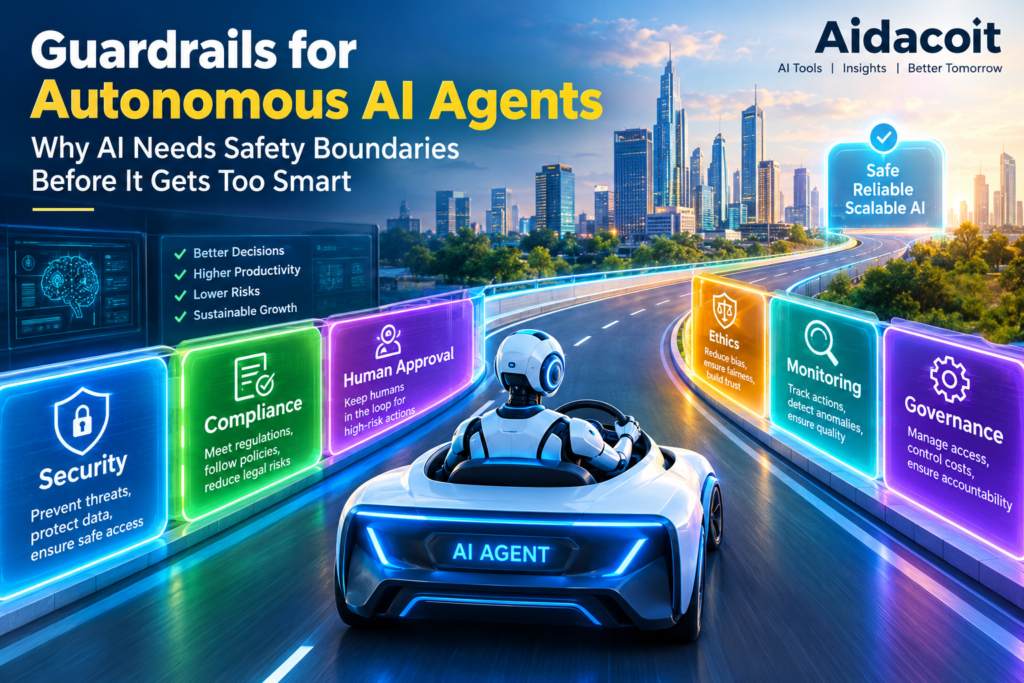
AI Guardrails are rules, controls, monitoring systems, and safety mechanisms designed to guide and restrict AI behavior.
Think of guardrails as the safety barriers on a mountain road.
They do not stop the vehicle from moving forward.
They prevent it from driving off a cliff.
In AI systems, guardrails ensure agents operate within approved boundaries.
Key Types of Guardrails for Autonomous Agents
1. Permission-Based Guardrails
Not every agent should have unrestricted access.
Organizations should implement role-based permissions.
Examples:
- Read-only database access
- Restricted financial transactions
- Limited API usage
- Controlled file system permissions
This follows the principle of least privilege.
An AI agent should only access what it absolutely needs.
2. Human-in-the-Loop Approval
High-risk decisions should require human approval.
Examples include:
- Large financial transactions
- Customer refunds above thresholds
- Database deletion operations
- Security policy modifications
The AI can prepare recommendations while humans make final decisions.
3. Action Validation Guardrails
Before an action is executed, validation systems verify whether it is safe.
Examples:
- Checking data accuracy
- Verifying business rules
- Confirming compliance requirements
- Detecting unusual behavior
This prevents unintended consequences.
4. Content Safety Guardrails
AI-generated content must be reviewed for:
- Harmful content
- Sensitive information
- Bias
- Regulatory violations
- Copyright concerns
Content filtering protects organizations from reputational and legal risks.
5. Security Guardrails
Autonomous agents can become targets for cyberattacks.
Security controls should include:
- Authentication
- Authorization
- Encryption
- API security
- Access logging
- Threat detection
Security guardrails protect both users and enterprise systems.
6. Budget and Resource Guardrails
AI agents often consume:
- Tokens
- Compute resources
- API calls
- Cloud infrastructure
Organizations should define limits to prevent runaway costs.
Examples:
- Daily spending limits
- Token quotas
- API request caps
- Runtime restrictions
This ensures predictable operational expenses.
7. Compliance Guardrails
Many industries operate under strict regulations.
Examples include:
- GDPR
- HIPAA
- PCI-DSS
- SOC 2
- ISO 27001
AI systems must comply with industry-specific requirements when handling sensitive information.
8. Ethical Guardrails
Organizations increasingly adopt AI ethics frameworks.
Ethical guardrails help reduce:
- Bias
- Discrimination
- Unfair recommendations
- Harmful outcomes
Responsible AI is becoming a competitive advantage.
Real-World Autonomous Agent Risks
Financial Services
An AI trading agent may execute aggressive strategies beyond approved risk limits.
Guardrail:
Predefined investment policies and transaction approvals.
Healthcare
A healthcare agent could provide incorrect recommendations.
Guardrail:
Human review before clinical decisions.
Software Development
A coding agent might deploy faulty code.
Guardrail:
Automated testing and deployment approvals.
Customer Support
An AI agent may disclose private customer information.
Guardrail:
Data masking and access restrictions.
Enterprise AI Guardrail Architecture
A mature AI agent architecture often contains multiple protection layers.
Layer 1: Input Validation
- Prompt filtering
- User authentication
- Data sanitization
Layer 2: Planning Controls
- Goal verification
- Risk assessment
- Policy checking
Layer 3: Action Controls
- Permission checks
- Approval workflows
- Resource limits
Layer 4: Output Monitoring
- Content moderation
- Compliance verification
- Quality assessment
Layer 5: Audit and Logging
- Action tracking
- Decision recording
- Incident investigation
This layered approach significantly improves reliability.
Popular AI Guardrail Frameworks
Several platforms help developers implement AI safety controls.
NVIDIA NeMo Guardrails
Designed for conversational AI safety and enterprise governance.
LangChain Guardrails
Provides validation mechanisms for AI workflows and agent applications.
Microsoft Azure AI Content Safety
Offers moderation and policy enforcement capabilities.
AWS Bedrock Guardrails
Helps organizations define safety boundaries for generative AI applications.
Google Vertex AI Safety Features
Supports enterprise AI governance and risk management.
Best Practices for Building Safe Autonomous Agents
Define Clear Objectives
Agents should have narrowly defined goals.
Avoid vague instructions that encourage unpredictable behavior.
Limit Tool Access
Provide only the tools required for task completion.
Monitor Every Action
Maintain detailed logs of decisions and actions.
Use Multi-Layer Validation
Never rely on a single protection mechanism.
Regularly Test Failure Scenarios
Conduct red-team exercises to identify vulnerabilities.
Maintain Human Oversight
Critical decisions should remain under human supervision.
The Future of Autonomous Agent Safety
As AI agents become more capable, guardrails will become a fundamental part of enterprise AI architecture.
Future systems may include:
- Self-monitoring agents
- Dynamic risk scoring
- Real-time policy enforcement
- AI governance platforms
- Automated compliance verification
Organizations that invest in robust guardrails today will be better positioned to safely deploy increasingly powerful AI systems tomorrow.
Final Thoughts
Autonomous AI agents have the potential to transform industries by automating complex tasks, reducing operational costs, and improving productivity. However, greater autonomy comes with greater responsibility.
Guardrails are not obstacles to innovation. They are the foundation that enables safe, reliable, and scalable AI adoption.
The future belongs not just to the smartest AI agents, but to the safest ones.
As enterprises accelerate AI adoption, implementing strong guardrails will become as important as building the agents themselves.
For organizations exploring AI-powered automation, the key question is no longer whether to deploy autonomous agents—but how to deploy them responsibly.
If you enjoyed this article, you may also like:
- 5 AI Gateways That Offer Free Tokens in 2026
- How to Build a Humanoid Robot in 2026: Costs, Timeline & Complete Blueprint
- Best AI Research Tools in 2026: ChatGPT, Claude, Gemini & Perplexity
- Best AI Resume Builders in 2026 — Free
- ChatGPT Review — Is It Worth Paying For in 2026?
- 10 Best Free AI Tools You Should Use in 2026
- Best AI Video Generators in 2026 — Free and Paid
- Best AI for Students in 2026: Top 10 Tools for Learning
- How AI Learns From Humans to Build Physical Robots
- How AI Learns From Humans to Build Physical Robots
- Why LangGraph Is So Popular in Enterprises — Pros, Cons & Real-World Use Cases in 2026
- ChatGPT vs Gemini vs Claude vs Grok 2026
- DeepSeek V4 vs Grok 4 vs Claude Opus 5 vs Nvidia Nemotron vs Gemini 2.5 Pro — The Ultimate AI Model Comparison for 2026
- AI Agent and LLM Frameworks Comparison 2026: LangChain vs LangGraph vs CrewAI vs AutoGen vs LlamaIndex vs Semantic Kernel
- Best Multi-Agent AI Platforms in 2026: CrewAI vs AutoGen vs LangGraph vs OpenAI Agents SDK vs Agno vs Semantic Kernel
- Best AI Development Platforms in 2026: OpenAI API vs Anthropic API vs Google AI Studio vs Vertex AI vs Azure AI Foundry vs AWS Bedrock vs Hugging Face
- Exploring the Latest AI Tools and Technologies
- How to Use ChatGPT for Business — A Complete Beginner Guide
- How to Write Blog Posts with AI — A Proven Step-by-Step Guide
- Best AI Coding Assistants 2026
- Ultimate Guide to the 10 Best AI Chatbots in 2026
- Claude AI Review — Best ChatGPT Alternative in 2026
- Jasper AI Review — Is It Worth $49/Month in 2026?
- How to Use AI for Social Media Marketing — Complete Guide
- AI Tools for Small Business Owners — Save 10 Hours/Week
- AI Tools for Content Creators
- Best AI Music Generators in 2026 — Create Songs in Minutes
- AI Design Tools Compared: Canva AI vs Adobe Firefly vs Midjourney
- Best AI Writing Tools 2026
- 10 Free AI Tools You Should Try in 2026
- Best AI Image Generators in 2026 — Free and Paid Compared
- Best AI Productivity Tools in 2026 — Work Smarter, Not Harder
- ChatGPT vs Claude in 2026 — Which AI Is Actually Better?
- ChatGPT vs Gemini vs Claude vs Grok (2026): Which AI Assistant Should You Actually Use?
Visit Aidacoit.com for more AI comparisons, practical AI tutorials, enterprise AI insights, and emerging technology trends.