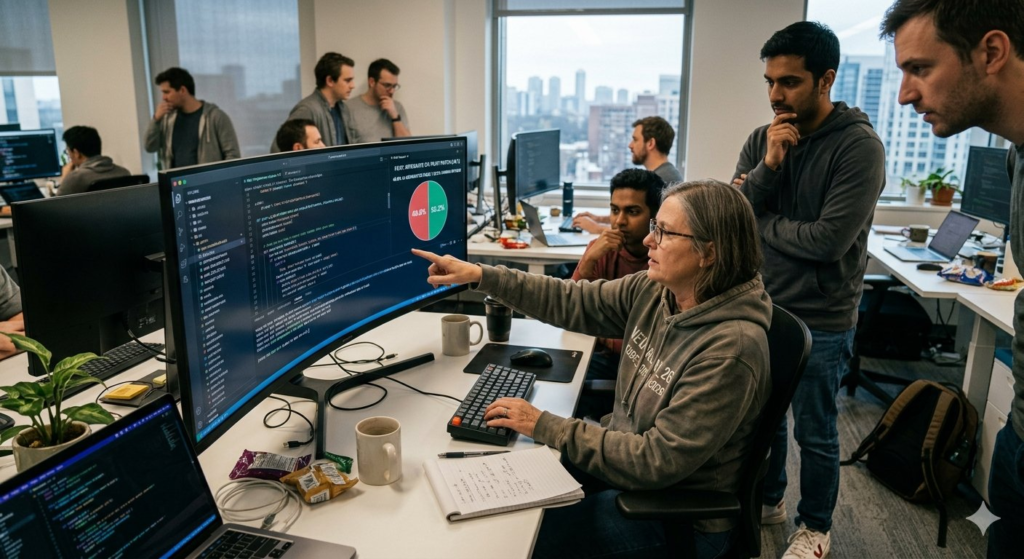
The software industry has crossed a historic milestone.
In 2026, artificial intelligence is no longer just helping developers write code—it is writing a massive portion of the world’s software itself. Multiple industry reports now suggest that AI-generated code accounts for roughly 40% to 50% of new software development, with some organizations reporting even higher numbers. Google has publicly stated that approximately 75% of its new code receives AI assistance, while surveys show many developers rely on AI coding agents daily.
This raises an important question:
If AI is writing half of all code today, what happens when it writes 80%, 90%, or even 99%?
The answer could reshape the future of software engineering, startups, enterprise technology, and millions of jobs worldwide.
The Rise of AI Coding Agents
Only a few years ago, developers used AI mainly for autocomplete suggestions.
Today, advanced coding agents can:
- Generate entire applications
- Write APIs and databases
- Create frontend interfaces
- Debug software automatically
- Generate unit tests
- Refactor legacy systems
- Review pull requests
- Explain complex codebase
Developer surveys in 2026 show that AI coding agents have become mainstream, with around 90% of professional developers using them regularly. Many report that nearly half of their code is now generated by AI systems.
The biggest shift isn’t just code generation.
It’s autonomous software development.
Modern AI agents can accept a task such as:
“Build a customer support portal with login, ticketing, and analytics.”
and generate thousands of lines of production-ready code with minimal human involvement.
Why AI Coding Is Growing So Fast
1. Massive Productivity Gains
A task that once took days can now be completed in hours.
Developers are using AI to:
- Generate boilerplate code instantly
- Build prototypes rapidly
- Automate repetitive tasks
- Reduce debugging time
- Accelerate testing
Companies adopting AI development tools report significant increases in software delivery speed.
2. Lower Development Costs
Startups can now build products with smaller engineering teams.
A company that previously required:
- 10 developers
- 2 QA engineers
- 1 technical architect
may now achieve similar output with a much leaner team augmented by AI.
This is changing startup economics dramatically.
3. Democratization of Software Creation
Non-programmers can now create software using natural language.
Product managers, analysts, marketers, and entrepreneurs increasingly use AI tools to build:
- Internal apps
- Dashboards
- Websites
- Automation workflows
The barrier to software creation has never been lower.
The New Role of Human Developers
Many people assume programmers will disappear.
The reality is more nuanced.
As AI handles more coding work, developers are becoming:
System Architects
Humans define:
- Business requirements
- System design
- Data architecture
- Security standards
AI executes much of the implementation.
AI Supervisors
Future engineers will spend more time:
- Reviewing AI output
- Validating business logic
- Identifying edge cases
- Ensuring reliability
Coding becomes less about typing syntax and more about directing intelligent systems.
Product Thinkers
The highest-value engineers will focus on:
- User experience
- Problem-solving
- Strategic decisions
- Innovation
The competitive advantage shifts from writing code to deciding what should be built.
The Biggest Risks Nobody Is Talking About
The AI coding revolution isn’t entirely positive.
Several challenges are emerging.
Security Vulnerabilities
A major 2026 security study found that roughly 44% of AI-generated coding tasks still contained known vulnerabilities.
This means organizations may ship insecure software faster than ever before.
Speed without security can become dangerous.
Technical Debt Explosion
AI can generate code quickly.
It does not always generate:
- Clean architecture
- Maintainable systems
- Long-term scalability
Experts are warning about a growing “cleanup tax” where teams spend substantial effort fixing AI-generated code later.
Knowledge Erosion
Junior developers traditionally learned by writing code manually.
If AI writes most code:
- Will new developers understand systems deeply?
- Will debugging skills decline?
- Will architecture expertise become rarer?
The industry is still searching for answers.
Will Software Engineers Lose Their Jobs?
This is the question everyone asks.
The answer is:
Some roles will shrink. Others will grow.
Roles Most at Risk
- Junior developers
- Basic coding contractors
- Manual testing teams
- Repetitive maintenance roles
These positions are increasingly automated.
Roles Likely to Grow
- AI Engineers
- AI Agent Architects
- Platform Engineers
- Security Specialists
- Data Engineers
- Product Engineers
- DevOps Experts
The future favors professionals who can work alongside AI rather than compete against it.
Research also suggests experienced developers are currently benefiting more from AI adoption than early-career engineers.
What Enterprises Need to Do Now
Organizations adopting AI coding at scale should focus on:
Governance
Establish clear rules for:
- Code reviews
- Security validation
- Compliance checks
Measurement
Track:
- AI-generated code percentage
- Bug rates
- Security issues
- Productivity gains
Experts warn that unmanaged AI adoption can amplify existing software quality problems.
Training
Developers must learn:
- Prompt engineering
- AI workflow design
- Agent orchestration
- Architecture thinking
The skillets of software engineering is evolving rapidly.
The Future: What Happens by 2030?
Current trends suggest that by 2030:
- AI could generate 80%+ of routine software code
- Small teams may build products that once required hundreds of engineers
- Software development cycles could shrink dramatically
- Autonomous coding agents may handle complete projects
Human engineers will increasingly focus on:
- Creativity
- Strategy
- Governance
- Innovation
- Trust and safety
Programming may evolve from writing code to managing intelligent software factories.
Final Thoughts
The year 2026 may be remembered as the moment software development fundamentally changed.
AI is no longer a coding assistant.
It is becoming a coding partner.
While concerns around security, technical debt, and job disruption remain real, the productivity gains are impossible to ignore. Organizations that learn to combine human expertise with AI-generated code will likely outperform those that resist the shift.
The future of software isn’t human vs AI.
It’s human + AI.
And that future is already being written—line by line.
If you enjoyed this article, you may also like:
- 5 AI Gateways That Offer Free Tokens in 2026
- How to Build a Humanoid Robot in 2026: Costs, Timeline & Complete Blueprint
- Best AI Research Tools in 2026: ChatGPT, Claude, Gemini & Perplexity
- Best AI Resume Builders in 2026 — Free
- ChatGPT Review — Is It Worth Paying For in 2026?
- 10 Best Free AI Tools You Should Use in 2026
- Best AI Video Generators in 2026 — Free and Paid
- Best AI for Students in 2026: Top 10 Tools for Learning
- How AI Learns From Humans to Build Physical Robots
- How AI Learns From Humans to Build Physical Robots
- Why LangGraph Is So Popular in Enterprises — Pros, Cons & Real-World Use Cases in 2026
- ChatGPT vs Gemini vs Claude vs Grok 2026
- DeepSeek V4 vs Grok 4 vs Claude Opus 5 vs Nvidia Nemotron vs Gemini 2.5 Pro — The Ultimate AI Model Comparison for 2026
- AI Agent and LLM Frameworks Comparison 2026: LangChain vs LangGraph vs CrewAI vs AutoGen vs LlamaIndex vs Semantic Kernel
- Best Multi-Agent AI Platforms in 2026: CrewAI vs AutoGen vs LangGraph vs OpenAI Agents SDK vs Agno vs Semantic Kernel
- Best AI Development Platforms in 2026: OpenAI API vs Anthropic API vs Google AI Studio vs Vertex AI vs Azure AI Foundry vs AWS Bedrock vs Hugging Face
- Exploring the Latest AI Tools and Technologies
- How to Use ChatGPT for Business — A Complete Beginner Guide
- How to Write Blog Posts with AI — A Proven Step-by-Step Guide
- Best AI Coding Assistants 2026
- Ultimate Guide to the 10 Best AI Chatbots in 2026
- Claude AI Review — Best ChatGPT Alternative in 2026
- Jasper AI Review — Is It Worth $49/Month in 2026?
- How to Use AI for Social Media Marketing — Complete Guide
- AI Tools for Small Business Owners — Save 10 Hours/Week
- AI Tools for Content Creators
- Best AI Music Generators in 2026 — Create Songs in Minutes
- AI Design Tools Compared: Canva AI vs Adobe Firefly vs Midjourney
- Best AI Writing Tools 2026
- 10 Free AI Tools You Should Try in 2026
- Best AI Image Generators in 2026 — Free and Paid Compared
- Best AI Productivity Tools in 2026 — Work Smarter, Not Harder
- ChatGPT vs Claude in 2026 — Which AI Is Actually Better?
- ChatGPT vs Gemini vs Claude vs Grok (2026): Which AI Assistant Should You Actually Use?
Visit Aidacoit.com for more AI comparisons, practical AI tutorials, enterprise AI insights, and emerging technology trends.