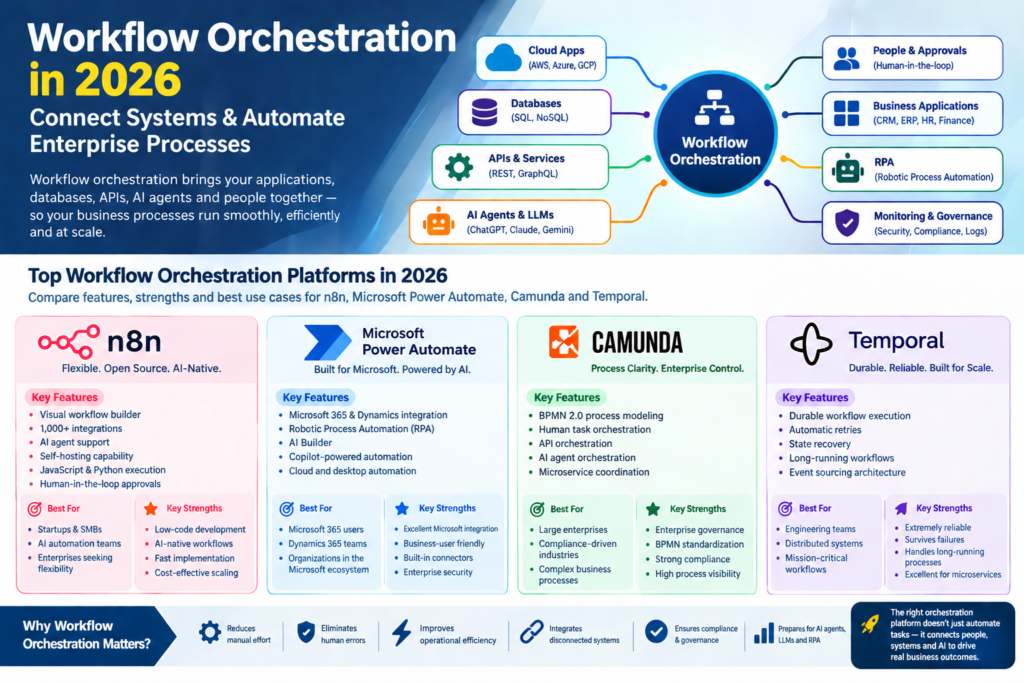
Modern enterprises run hundreds of applications, databases, APIs, cloud services, and AI systems. The challenge is no longer building individual applications—it is making them work together seamlessly.
This is where Workflow Orchestration becomes critical.
Workflow orchestration platforms coordinate multiple systems, automate business processes, manage dependencies, handle failures, and ensure tasks are completed in the correct sequence across the organization. Unlike simple automation tools that execute isolated tasks, orchestration platforms manage complete end-to-end business workflows with visibility, governance, and reliability.
What Is Workflow Orchestration?
Workflow orchestration is the process of coordinating multiple applications, services, APIs, databases, AI agents, and human approvals into a unified workflow.
For example:
Employee Onboarding Workflow
- HR creates employee record
- IT creates email account
- Active Directory provisions access
- Laptop request is submitted
- Manager approves permissions
- Security training is assigned
- Completion notification is sent
Instead of employees manually performing these steps, an orchestration platform manages the entire process automatically.
Why Workflow Orchestration Matters
Organizations use orchestration to:
- Reduce manual effort
- Eliminate human errors
- Improve operational efficiency
- Integrate disconnected systems
- Automate approvals
- Coordinate AI and human tasks
- Track process execution
- Improve compliance and governance
As enterprises adopt AI agents, orchestration platforms are becoming the backbone that connects AI systems with business applications.
Top Workflow Orchestration Platforms in 2026
1. n8n
Best For
Startups, SMBs, AI automation teams, and enterprises seeking flexibility.
Key Features
- Visual workflow builder
- 1,000+ integrations
- AI Agent support
- Self-hosting capability
- JavaScript and Python execution
- Human-in-the-loop approvals
- API orchestration
Strengths
✅ Low-code development
✅ AI-native workflows
✅ Fast implementation
✅ Open-source friendly
✅ Cost-effective scaling
Limitations
❌ Not a full BPMN enterprise process platform
❌ Advanced governance requires enterprise setup
n8n is rapidly becoming one of the most popular orchestration platforms because it combines traditional automation with AI agent workflows in a single visual environment.
2. Microsoft Power Automate
Best For
Organizations using Microsoft 365, Dynamics 365, Azure, and SharePoint.
Key Features
- Microsoft ecosystem integration
- Robotic Process Automation (RPA)
- AI Builder
- Copilot-powered automation
- Cloud and desktop automation
Strengths
✅ Excellent Microsoft integration
✅ Business-user friendly
✅ Built-in connectors
✅ Enterprise security
Limitations
❌ Can become complex for large workflows
❌ Premium connectors increase costs
❌ Less flexibility outside Microsoft ecosystem
If your organization is heavily invested in Microsoft technologies, Power Automate is often the fastest route to enterprise automation.
3. Camunda
Best For
Large enterprises requiring BPMN-based business process management.
Key Features
- BPMN 2.0 process modeling
- Human task orchestration
- API orchestration
- AI agent orchestration
- Microservice coordination
Strengths
✅ Enterprise-grade governance
✅ BPMN standardization
✅ Complex business process support
✅ Strong compliance capabilities
Limitations
❌ Steeper learning curve
❌ Overkill for simple workflows
❌ Higher implementation effort
Camunda excels in industries such as banking, insurance, healthcare, and government where compliance and process visibility are critical.
4. Temporal
Best For
Engineering teams building mission-critical distributed systems.
Key Features
- Durable workflow execution
- Automatic retries
- State recovery
- Long-running workflows
- Event sourcing architecture
Strengths
✅ Extremely reliable
✅ Survives failures automatically
✅ Handles complex distributed workflows
✅ Excellent for microservices
Limitations
❌ Developer-focused
❌ Requires coding expertise
❌ Higher operational complexity
Temporal is ideal when workflows may run for days, weeks, or months and cannot afford failure or data loss.
Feature Comparison
| Feature | n8n | Power Automate | Camunda | Temporal |
|---|---|---|---|---|
| Visual Designer | ✅ | ✅ | ✅ | ❌ |
| AI Agent Support | ✅ | ✅ | ✅ | Limited |
| BPMN Support | ❌ | ❌ | ✅ | ❌ |
| Self Hosting | ✅ | Limited | ✅ | ✅ |
| Low-Code | ✅ | ✅ | Partial | ❌ |
| Long Running Workflows | Moderate | Moderate | High | Excellent |
| Enterprise Governance | Good | Excellent | Excellent | Excellent |
| Developer Friendly | High | Medium | Medium | Very High |
| Reliability | High | High | High | Exceptional |
Sources indicate that n8n focuses on rapid integration and AI workflows, Camunda specializes in BPMN-driven enterprise processes, while Temporal provides durable execution for mission-critical distributed systems.
Enterprise Use Cases
Customer Onboarding
- CRM updates
- Identity verification
- Credit checks
- Compliance approvals
- Welcome communications
AI-Powered Support Automation
- Receive customer request
- Route to AI agent
- Generate response
- Escalate to human if needed
- Update CRM automatically
Financial Process Automation
- Invoice processing
- Approval workflows
- Payment execution
- Audit trail generation
Employee Lifecycle Management
- Recruitment
- Onboarding
- Role changes
- Asset management
- Offboarding
Which Workflow Orchestration Tool Should You Choose?
Choose n8n If
- You need AI workflows quickly
- You want self-hosting
- You need API integrations
- You want low-code flexibility
Choose Power Automate If
- Your company uses Microsoft 365
- Business users build automations
- You need RPA capabilities
Choose Camunda If
- You require BPMN standards
- Compliance is critical
- You manage complex enterprise processes
Choose Temporal If
- Reliability is the highest priority
- You build distributed systems
- Your workflows run for long periods
- You have strong engineering teams
Future of Workflow Orchestration
The next generation of workflow orchestration is moving beyond simple automation. Organizations are increasingly orchestrating:
- AI Agents
- Large Language Models (LLMs)
- Human approvals
- Business applications
- Cloud services
- Robotic Process Automation (RPA)
The winning platforms will be those that can coordinate humans, AI, and enterprise systems within a single workflow engine. Agentic orchestration is already emerging as the next major evolution of enterprise automation.
Conclusion
Workflow orchestration has become a foundational technology for digital transformation. Whether you’re automating business operations, connecting enterprise applications, or deploying AI agents at scale, choosing the right orchestration platform can significantly impact productivity and operational efficiency.
For most organizations in 2026:
- n8n leads in AI-driven automation and flexibility.
- Microsoft Power Automate dominates Microsoft-centric enterprises.
- Camunda remains the enterprise BPM leader.
- Temporal sets the standard for durable execution and reliability.
The best choice depends on your architecture, governance requirements, technical expertise, and long-term automation strategy.
If you enjoyed this article, you may also like:
- 5 AI Gateways That Offer Free Tokens in 2026
- How to Build a Humanoid Robot in 2026: Costs, Timeline & Complete Blueprint
- Best AI Research Tools in 2026: ChatGPT, Claude, Gemini & Perplexity
- Best AI Resume Builders in 2026 — Free
- ChatGPT Review — Is It Worth Paying For in 2026?
- 10 Best Free AI Tools You Should Use in 2026
- Best AI Video Generators in 2026 — Free and Paid
- Best AI for Students in 2026: Top 10 Tools for Learning
- How AI Learns From Humans to Build Physical Robots
- How AI Learns From Humans to Build Physical Robots
- Why LangGraph Is So Popular in Enterprises — Pros, Cons & Real-World Use Cases in 2026
- ChatGPT vs Gemini vs Claude vs Grok 2026
- DeepSeek V4 vs Grok 4 vs Claude Opus 5 vs Nvidia Nemotron vs Gemini 2.5 Pro — The Ultimate AI Model Comparison for 2026
- AI Agent and LLM Frameworks Comparison 2026: LangChain vs LangGraph vs CrewAI vs AutoGen vs LlamaIndex vs Semantic Kernel
- Best Multi-Agent AI Platforms in 2026: CrewAI vs AutoGen vs LangGraph vs OpenAI Agents SDK vs Agno vs Semantic Kernel
- Best AI Development Platforms in 2026: OpenAI API vs Anthropic API vs Google AI Studio vs Vertex AI vs Azure AI Foundry vs AWS Bedrock vs Hugging Face
- Exploring the Latest AI Tools and Technologies
- How to Use ChatGPT for Business — A Complete Beginner Guide
- How to Write Blog Posts with AI — A Proven Step-by-Step Guide
- Best AI Coding Assistants 2026
- Ultimate Guide to the 10 Best AI Chatbots in 2026
- Claude AI Review — Best ChatGPT Alternative in 2026
- Jasper AI Review — Is It Worth $49/Month in 2026?
- How to Use AI for Social Media Marketing — Complete Guide
- AI Tools for Small Business Owners — Save 10 Hours/Week
- AI Tools for Content Creators
- Best AI Music Generators in 2026 — Create Songs in Minutes
- AI Design Tools Compared: Canva AI vs Adobe Firefly vs Midjourney
- Best AI Writing Tools 2026
- 10 Free AI Tools You Should Try in 2026
- Best AI Image Generators in 2026 — Free and Paid Compared
- Best AI Productivity Tools in 2026 — Work Smarter, Not Harder
- ChatGPT vs Claude in 2026 — Which AI Is Actually Better?
- ChatGPT vs Gemini vs Claude vs Grok (2026): Which AI Assistant Should You Actually Use?
Visit Aidacoit.com for more AI comparisons, practical AI tutorials, enterprise AI insights, and emerging technology trends.