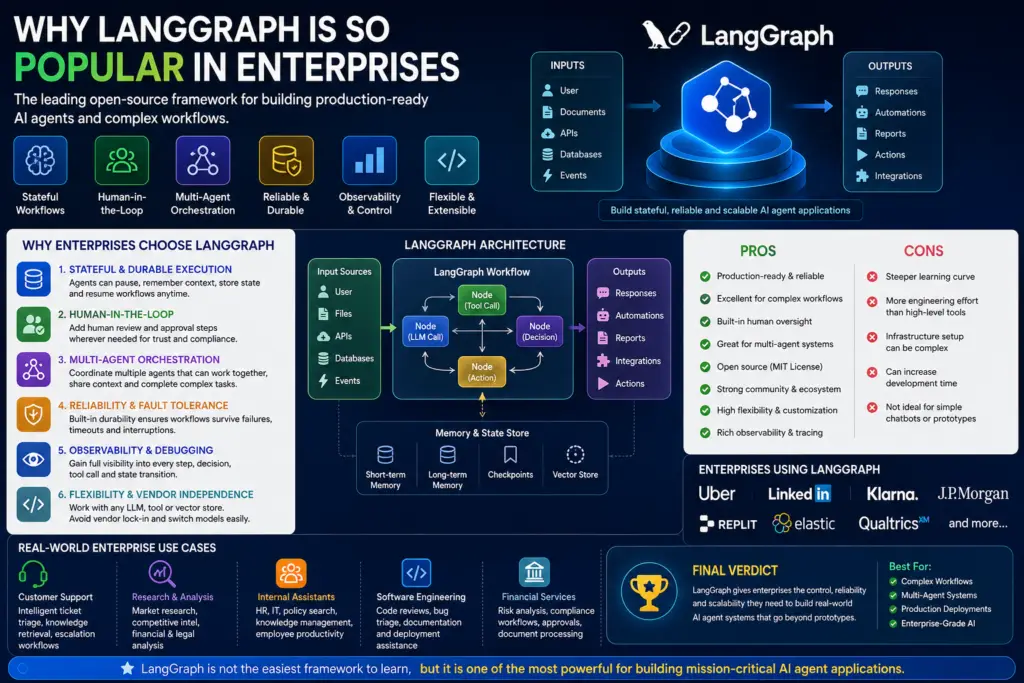
As enterprises move from simple AI chatbots to fully autonomous AI agents, one framework consistently appears in production deployments:
LangGraph.
Companies building AI-powered customer support systems, research agents, coding assistants, workflow automation platforms, and multi-agent applications increasingly choose LangGraph as their orchestration layer.
Organizations such as Uber, LinkedIn, Klarna, J.P. Morgan, Replit, Elastic, and Qualtrics have been highlighted by LangChain as users of LangGraph for agent-based applications.
But why has LangGraph become one of the most popular agent frameworks in enterprise AI?
The answer lies in a combination of:
- Stateful workflows
- Reliability
- Human oversight
- Multi-agent orchestration
- Production-grade deployment capabilities
This article explores why enterprises choose LangGraph, its advantages and disadvantages, and when it is the right framework for your organization.
What Is LangGraph?
LangGraph is an open-source agent orchestration framework created by LangChain.
Unlike traditional chatbot frameworks, LangGraph focuses on building long-running, stateful AI agents that can:
- Remember context
- Handle complex workflows
- Collaborate with humans
- Coordinate multiple agents
- Recover from failures
- Execute tasks over extended periods
LangGraph is intentionally low-level, giving developers control over agent behavior instead of hiding decisions behind black-box abstractions.
Think of LangGraph as:
React for AI agents
or
Kubernetes for agent workflows
It helps developers define how agents think, decide, collaborate, and execute tasks.
Why Enterprises Are Choosing LangGraph
1. Stateful Agents Instead of Stateless Chats
Most chatbot frameworks work like this:
Input → LLM → Response
Once the response is generated, the interaction ends.
Enterprise workflows are different.
A procurement agent may need to:
- Analyze documents
- Request approval
- Wait three days
- Resume processing
- Trigger another workflow
LangGraph was designed specifically for these scenarios.
Its built-in persistence layer allows agents to pause, store state, and continue later without losing context.
Enterprise Benefit
- Better customer service workflows
- Long-running business processes
- Approval chains
- Multi-step automation
2. Human-in-the-Loop Support
One of the biggest concerns enterprises have about AI agents is trust.
Companies rarely want AI making important decisions without oversight.
LangGraph supports human review at any point during execution, allowing users to inspect, modify, approve, or reject actions before an agent continues.
Example
An AI legal assistant might:
- Draft a contract
- Pause execution
- Request lawyer approval
- Continue after approval
This capability is essential for:
- Banking
- Healthcare
- Insurance
- Government
- Legal industries
3. Multi-Agent Architecture
Modern enterprise systems increasingly use multiple specialized agents.
For example:
Customer Support System
Agent 1
Classifies the issue
Agent 2
Searches internal knowledge
Agent 3
Generates the response
Agent 4
Handles escalation
LangGraph provides a graph-based architecture that makes coordinating these agents easier than traditional agent frameworks. It also supports distributed and reusable agent workflows.
4. Reliability and Durable Execution
Enterprise systems cannot simply fail when an API times out.
LangGraph was built around durable execution, allowing workflows to persist through interruptions and resume from where they stopped. This is particularly important for long-running and asynchronous agent tasks.
Why This Matters
Without durability:
- Lost workflows
- Incomplete tasks
- Poor customer experiences
With durability:
- Reliable execution
- Better recovery
- Production readiness
5. Better Observability
One major challenge with AI agents is debugging.
When an agent makes a poor decision, enterprises need to understand:
- What happened?
- Which tool was called?
- What reasoning path was followed?
- Why did it fail?
LangGraph integrates closely with observability and tracing tools that provide visibility into execution paths, state transitions, and runtime behavior.
Enterprise Benefit
- Faster debugging
- Easier optimization
- Improved compliance
- Better governance
6. Flexible Agent Design
Many enterprise workflows are unique.
A healthcare workflow differs significantly from a banking workflow.
LangGraph’s low-level architecture allows teams to build:
- Single agents
- Multi-agent systems
- Hierarchical agents
- Workflow-based agents
without being restricted to predefined patterns.
7. Vendor Independence
Another reason enterprises prefer LangGraph is flexibility.
It works with:
- OpenAI
- Anthropic
- Google Gemini
- Azure OpenAI
- AWS Bedrock
- Mistral
- DeepSeek
- Open-source models
Organizations can switch models without rebuilding the orchestration layer.
This reduces vendor lock-in.
Pros of LangGraph
✅ Production Ready
Designed for real-world deployment rather than demos. Enterprise adoption has grown because it addresses reliability, scalability, and operational concerns.
✅ Excellent for Complex Workflows
Handles:
- Research agents
- Business automation
- Customer support
- Knowledge workers
- Multi-agent systems
more effectively than simple prompt chains.
✅ Durable Execution
Agents can resume after interruptions and continue long-running processes.
✅ Human Oversight
Supports approval workflows and governance requirements.
✅ Open Source
LangGraph is MIT-licensed and free to use.
✅ Multi-Agent Friendly
One of the strongest frameworks available for coordinating multiple AI agents.
✅ Large Community
Benefits from the broader LangChain ecosystem and extensive developer adoption.
Cons of LangGraph
❌ Steeper Learning Curve
LangGraph is intentionally low-level.
Developers must understand:
- State management
- Graph structures
- Agent orchestration
- Workflow design
This makes onboarding harder than higher-level frameworks.
❌ More Engineering Required
For simple chatbot projects, LangGraph can feel excessive.
A basic support bot often doesn’t need:
- Stateful workflows
- Human approvals
- Multi-agent systems
❌ Infrastructure Complexity
Production deployments require attention to:
- Storage
- Persistence
- Monitoring
- Security
- Scaling
While deployment tooling has improved, enterprise-grade setups still require engineering expertise.
❌ Can Increase Development Time
Teams may spend more time designing workflows compared with plug-and-play agent platforms.
LangGraph vs Other Agent Frameworks
| Feature | LangGraph | CrewAI | AutoGen | OpenAI Agents SDK |
|---|---|---|---|---|
| Enterprise Adoption | High | Medium | Medium | High |
| Stateful Workflows | Excellent | Basic | Moderate | Good |
| Human-in-the-Loop | Excellent | Limited | Moderate | Good |
| Multi-Agent Support | Excellent | Excellent | Good | Good |
| Production Readiness | Excellent | Moderate | Moderate | High |
| Flexibility | Excellent | Good | Good | Moderate |
| Learning Curve | High | Low | Medium | Low |
Real Enterprise Use Cases
Customer Support Agents
- Ticket classification
- Knowledge retrieval
- Escalation workflows
- Automated responses
Research Agents
- Market research
- Competitive intelligence
- Financial analysis
- Regulatory monitoring
Internal Enterprise Assistants
- HR copilots
- IT support agents
- Employee knowledge assistants
- Policy search systems
Software Engineering Agents
- Code reviews
- Bug investigations
- Documentation generation
- Deployment assistance
Financial Services
- Risk analysis
- Compliance workflows
- Approval chains
- Document processing
When Should You Use LangGraph?
Choose LangGraph if:
✅ You need production-grade agents
✅ Workflows involve multiple steps
✅ Agents need memory
✅ Human approval is required
✅ You plan to scale enterprise-wide
✅ Multiple agents must collaborate
When Should You Avoid LangGraph?
Avoid LangGraph if:
❌ You’re building a simple chatbot
❌ You need a quick prototype
❌ Your team lacks AI engineering resources
❌ Workflows are straightforward and stateless
In those cases, higher-level tools such as CrewAI or OpenAI Agents SDK may provide faster development.
Final Verdict
LangGraph has become one of the most popular enterprise AI frameworks because it solves problems that appear only after moving from prototype to production.
While many frameworks make it easy to build an AI demo, LangGraph focuses on what enterprises actually need:
- Reliability
- Memory
- State management
- Human oversight
- Multi-agent orchestration
- Observability
- Production deployment
The trade-off is complexity. LangGraph is not the easiest framework to learn, but it is one of the most powerful for organizations building mission-critical AI systems.
For enterprises serious about agentic AI in 2026, LangGraph is increasingly becoming the default choice because it provides the control, scalability, and governance required to move AI agents from experiments into real business operations.
FAQ
Is LangGraph used in production?
Yes. LangChain states that companies including Uber, LinkedIn, Replit, Klarna, J.P. Morgan, and others use LangGraph for agent-based applications and production workflows.
Why is LangGraph better than traditional chatbot frameworks?
LangGraph supports stateful workflows, durable execution, human-in-the-loop approvals, and multi-agent orchestration, making it better suited for enterprise use cases.
Is LangGraph free?
Yes. LangGraph is open source under the MIT license. Enterprise deployment and management services may have commercial offerings, but the framework itself is free.
Is LangGraph difficult to learn?
Compared with higher-level frameworks, LangGraph has a steeper learning curve because it exposes low-level orchestration and state management concepts.
If you enjoyed this article, you may also like:
- 5 AI Gateways That Offer Free Tokens in 2026
- How to Build a Humanoid Robot in 2026: Costs, Timeline & Complete Blueprint
- Best AI Research Tools in 2026: ChatGPT, Claude, Gemini & Perplexity
- Best AI Resume Builders in 2026 — Free
- ChatGPT Review — Is It Worth Paying For in 2026?
- 10 Best Free AI Tools You Should Use in 2026
- Best AI Video Generators in 2026 — Free and Paid
- Best AI for Students in 2026: Top 10 Tools for Learning
- How AI Learns From Humans to Build Physical Robots
- How AI Learns From Humans to Build Physical Robots
- Why LangGraph Is So Popular in Enterprises — Pros, Cons & Real-World Use Cases in 2026
- ChatGPT vs Gemini vs Claude vs Grok 2026
- DeepSeek V4 vs Grok 4 vs Claude Opus 5 vs Nvidia Nemotron vs Gemini 2.5 Pro — The Ultimate AI Model Comparison for 2026
- AI Agent and LLM Frameworks Comparison 2026: LangChain vs LangGraph vs CrewAI vs AutoGen vs LlamaIndex vs Semantic Kernel
- Best Multi-Agent AI Platforms in 2026: CrewAI vs AutoGen vs LangGraph vs OpenAI Agents SDK vs Agno vs Semantic Kernel
- Best AI Development Platforms in 2026: OpenAI API vs Anthropic API vs Google AI Studio vs Vertex AI vs Azure AI Foundry vs AWS Bedrock vs Hugging Face
- Exploring the Latest AI Tools and Technologies
- How to Use ChatGPT for Business — A Complete Beginner Guide
- How to Write Blog Posts with AI — A Proven Step-by-Step Guide
- Best AI Coding Assistants 2026
- Ultimate Guide to the 10 Best AI Chatbots in 2026
- Claude AI Review — Best ChatGPT Alternative in 2026
- Jasper AI Review — Is It Worth $49/Month in 2026?
- How to Use AI for Social Media Marketing — Complete Guide
- AI Tools for Small Business Owners — Save 10 Hours/Week
- AI Tools for Content Creators
- Best AI Music Generators in 2026 — Create Songs in Minutes
- AI Design Tools Compared: Canva AI vs Adobe Firefly vs Midjourney
- Best AI Writing Tools 2026
- 10 Free AI Tools You Should Try in 2026
- Best AI Image Generators in 2026 — Free and Paid Compared
- Best AI Productivity Tools in 2026 — Work Smarter, Not Harder
- ChatGPT vs Claude in 2026 — Which AI Is Actually Better?
Visit Aidacoit.com for more AI comparisons, practical AI tutorials, enterprise AI insights, and emerging technology trends.
Pingback: #post_titleAI Tools for Small Business Owners — Save 10 Hours/Week Aidacoit Aidacoit Aidacoit
Pingback: Aidacoit.com Aidacoit - Aidacoit.com Aidacoit Aidacoit.com
Pingback: 10 AI Tools That Can Replace Hours of Manual Work Every Week (2026)
Pingback: AI Agents & Automation Explained (2026) – Complete Enterprise & Business Guide