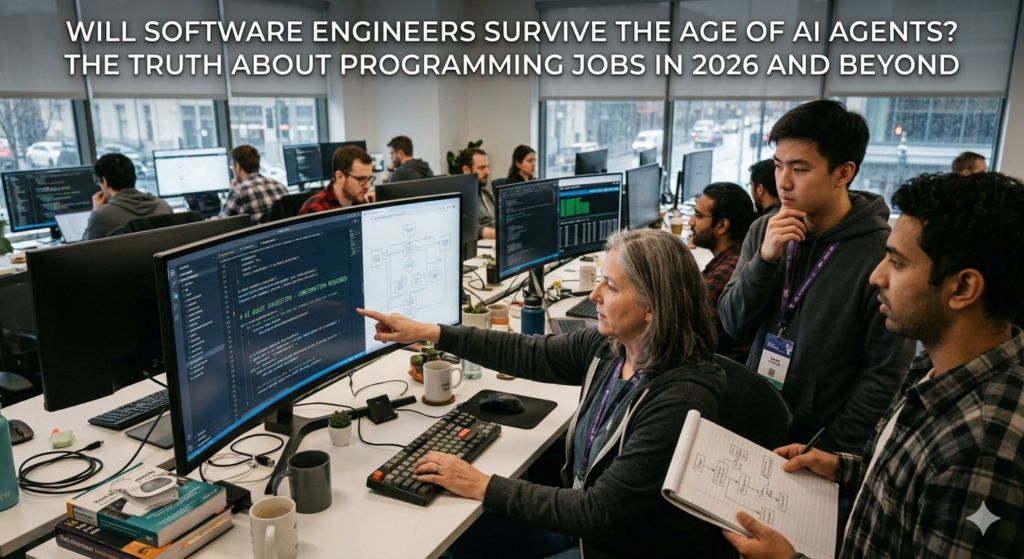
Introduction
The rise of AI agents has sparked one of the biggest debates in the technology industry:
Will software engineers survive, or will AI replace them?
With tools capable of writing code, fixing bugs, generating documentation, creating test cases, and even deploying applications, many developers are wondering whether they are witnessing the beginning of the end of software engineering as a profession.
The fear is understandable.
AI coding assistants have evolved from simple autocomplete tools into autonomous AI agents capable of handling tasks that once required entire engineering teams. Companies are increasingly adopting agentic AI systems to accelerate software development, reduce costs, and improve productivity.
However, history suggests that technological revolutions rarely eliminate professions entirely. Instead, they transform them.
The real question is not whether software engineers will survive. The question is:
What kind of software engineers will thrive in the age of AI agents?
The Rise of AI Coding Agents
Just a few years ago, AI coding tools could only generate snippets of code.
Today, advanced AI agents can:
- Generate complete applications
- Write APIs
- Create test suites
- Review pull requests
- Debug production issues
- Refactor legacy code
- Generate documentation
- Design software architecture
- Automate DevOps workflows
Major AI systems are rapidly moving beyond simple chat interfaces into autonomous agents that can execute long-running tasks independently. Organizations are increasingly delegating complex workflows to these systems.
This shift has created anxiety across the software industry.
Why Many People Believe AI Will Replace Developers
Several factors fuel the fear:
1. AI Writes Code Faster
An AI can generate hundreds of lines of code within seconds.
Tasks that previously required hours can now be completed in minutes.
2. AI Never Gets Tired
Unlike humans, AI agents can work continuously.
They don’t require breaks, vacations, or sleep.
3. AI Is Getting Better Every Month
The quality of AI-generated code has improved dramatically.
Many startups now use AI for significant portions of their software development process.
4. Companies Want Lower Costs
Businesses constantly seek ways to increase productivity while reducing expenses.
AI appears to offer both.
As a result, many people assume software engineering jobs are doomed.
But the reality is far more complex.
Why Software Engineers Are Not Disappearing
Despite rapid AI progress, software engineering remains one of the most resilient professions.
Recent workforce and hiring analyses continue to show demand for software developers, especially experienced engineers, even as AI adoption accelerates.
The reason is simple:
Writing Code Is Only a Small Part of Software Engineering
Many non-engineers assume software development is mostly typing code.
In reality, coding often represents only a fraction of the job.
Engineers also:
- Understand business requirements
- Design systems
- Make architectural decisions
- Balance trade-offs
- Ensure security
- Optimize performance
- Coordinate with stakeholders
- Manage technical debt
- Review quality
- Solve ambiguous problems
AI can assist with coding.
It struggles with organizational context, competing priorities, and business judgment.
The New Role: From Programmer to AI Orchestrator
The software engineer of the future may write less code.
But they will become more valuable.
Industry analysts increasingly describe a shift where engineers supervise, direct, validate, and coordinate AI-generated work rather than manually producing every line themselves.
Future engineers will:
Define Problems
Humans will decide what should be built.
Direct AI Agents
Engineers will instruct multiple AI agents.
Review AI Output
Someone must verify correctness.
Manage Architecture
AI can generate components.
Humans design systems.
Handle Edge Cases
Complex real-world situations require human judgment.
What AI Cannot Easily Replace
Human Creativity
Innovation is more than code generation.
Breakthrough products come from unique ideas.
Business Understanding
Software exists to solve business problems.
Understanding customer needs remains a human strength.
Leadership
Engineering managers and technical leaders align teams and strategy.
Ethical Decision Making
AI cannot be solely responsible for security, privacy, compliance, and ethical choices.
Stakeholder Communication
Explaining technical trade-offs to executives, clients, and users remains a critical human skill.
Jobs Most at Risk
Not every role is equally protected.
Entry-Level Coding Tasks
Routine programming work faces the greatest disruption.
Examples include:
- Simple CRUD applications
- Basic website development
- Template-based coding
- Repetitive testing
Studies and labor-market observations suggest junior and entry-level opportunities are under greater pressure than senior positions as AI handles more routine work.
Low-Skill Development Work
Developers who only know syntax may struggle.
The market increasingly rewards problem-solving ability rather than pure coding speed.
Jobs Likely to Grow
AI Engineers
Organizations need experts who can build AI-powered systems.
AI Agent Architects
Companies require specialists to design agent workflows.
Platform Engineers
Infrastructure becomes more important as AI workloads grow.
Security Engineers
AI-generated software creates new security challenges.
Data Engineers
AI systems need clean, structured, and reliable data.
Cloud Engineers
Cloud adoption continues to expand globally.
DevOps Specialists
Automation requires stronger deployment and monitoring systems.
Skills Software Engineers Must Learn in 2026
To remain competitive, engineers should focus on:
AI Agent Management
Learn how to coordinate multiple AI agents.
System Design
Architecture skills will become more valuable.
Cloud Platforms
Master AWS, Azure, and Google Cloud.
Cybersecurity
Security expertise remains highly demanded.
Product Thinking
Understand why software is built.
Prompt Engineering
Learn how to communicate effectively with AI systems.
Data Engineering
Data remains the foundation of AI.
Leadership and Communication
Human skills become increasingly important as AI handles execution.
The Future: Human + AI Teams
The most likely future is not humans versus AI.
It is humans working alongside AI.
Research and enterprise adoption trends increasingly point toward “human-agent teams” where AI handles execution while humans provide direction, judgment, governance, and accountability.
Think about previous technological shifts:
- Calculators did not eliminate mathematicians.
- Spreadsheets did not eliminate accountants.
- Power tools did not eliminate construction workers.
Instead, professionals became more productive.
AI agents are likely to do the same for software engineers.
What Will Software Engineering Look Like in 2030?
By 2030, developers may spend less time:
- Writing boilerplate code
- Debugging simple issues
- Creating repetitive tests
And more time:
- Designing systems
- Managing AI agents
- Validating outputs
- Solving business problems
- Building innovative products
The software engineer of the future may resemble a conductor directing an orchestra of AI agents rather than a programmer manually writing every note.
Final Verdict: Will Software Engineers Survive?
Yes—but the role is changing dramatically.
Software engineers who rely only on coding may face increasing pressure.
Software engineers who learn AI, system design, architecture, cloud technologies, cybersecurity, and business thinking will remain highly valuable.
The future belongs to developers who can leverage AI rather than compete against it.
AI agents are not the end of software engineering.
They are the beginning of a new era where human creativity, judgment, and leadership become even more important.
The engineers who adapt will not merely survive.
They will become more productive, more influential, and more valuable than ever before.
Key Takeaways
- AI agents are transforming software development, not eliminating it.
- Coding alone is becoming less valuable than problem-solving.
- Entry-level repetitive programming jobs face the greatest disruption.
- Senior engineers remain in high demand.
- AI engineering, cloud, cybersecurity, and architecture skills are growing rapidly.
- Future developers will manage AI agents instead of writing every line of code manually.
- Human creativity, leadership, and judgment remain irreplaceable.
The age of AI agents is not the death of software engineering—it is the evolution of it.
However, the ideal platform depends on your cloud strategy:
- Azure AI Search → Best overall enterprise RAG platform
- Vertex AI Search → Best for Google Cloud users
- Elastic → Best for large-scale search workloads
- Weaviate → Best open-source AI-native solution
The future belongs to organizations that can connect AI models with trusted enterprise knowledge, and the right RAG platform is the foundation of that transformation.
If you enjoyed this article, you may also like:
- 5 AI Gateways That Offer Free Tokens in 2026
- How to Build a Humanoid Robot in 2026: Costs, Timeline & Complete Blueprint
- Best AI Research Tools in 2026: ChatGPT, Claude, Gemini & Perplexity
- Best AI Resume Builders in 2026 — Free
- ChatGPT Review — Is It Worth Paying For in 2026?
- 10 Best Free AI Tools You Should Use in 2026
- Best AI Video Generators in 2026 — Free and Paid
- Best AI for Students in 2026: Top 10 Tools for Learning
- How AI Learns From Humans to Build Physical Robots
- How AI Learns From Humans to Build Physical Robots
- Why LangGraph Is So Popular in Enterprises — Pros, Cons & Real-World Use Cases in 2026
- ChatGPT vs Gemini vs Claude vs Grok 2026
- DeepSeek V4 vs Grok 4 vs Claude Opus 5 vs Nvidia Nemotron vs Gemini 2.5 Pro — The Ultimate AI Model Comparison for 2026
- AI Agent and LLM Frameworks Comparison 2026: LangChain vs LangGraph vs CrewAI vs AutoGen vs LlamaIndex vs Semantic Kernel
- Best Multi-Agent AI Platforms in 2026: CrewAI vs AutoGen vs LangGraph vs OpenAI Agents SDK vs Agno vs Semantic Kernel
- Best AI Development Platforms in 2026: OpenAI API vs Anthropic API vs Google AI Studio vs Vertex AI vs Azure AI Foundry vs AWS Bedrock vs Hugging Face
- Exploring the Latest AI Tools and Technologies
- How to Use ChatGPT for Business — A Complete Beginner Guide
- How to Write Blog Posts with AI — A Proven Step-by-Step Guide
- Best AI Coding Assistants 2026
- Ultimate Guide to the 10 Best AI Chatbots in 2026
- Claude AI Review — Best ChatGPT Alternative in 2026
- Jasper AI Review — Is It Worth $49/Month in 2026?
- How to Use AI for Social Media Marketing — Complete Guide
- AI Tools for Small Business Owners — Save 10 Hours/Week
- AI Tools for Content Creators
- Best AI Music Generators in 2026 — Create Songs in Minutes
- AI Design Tools Compared: Canva AI vs Adobe Firefly vs Midjourney
- Best AI Writing Tools 2026
- 10 Free AI Tools You Should Try in 2026
- Best AI Image Generators in 2026 — Free and Paid Compared
- Best AI Productivity Tools in 2026 — Work Smarter, Not Harder
- ChatGPT vs Claude in 2026 — Which AI Is Actually Better?
- ChatGPT vs Gemini vs Claude vs Grok (2026): Which AI Assistant Should You Actually Use?
Visit Aidacoit.com for more AI comparisons, practical AI tutorials, enterprise AI insights, and emerging technology trends