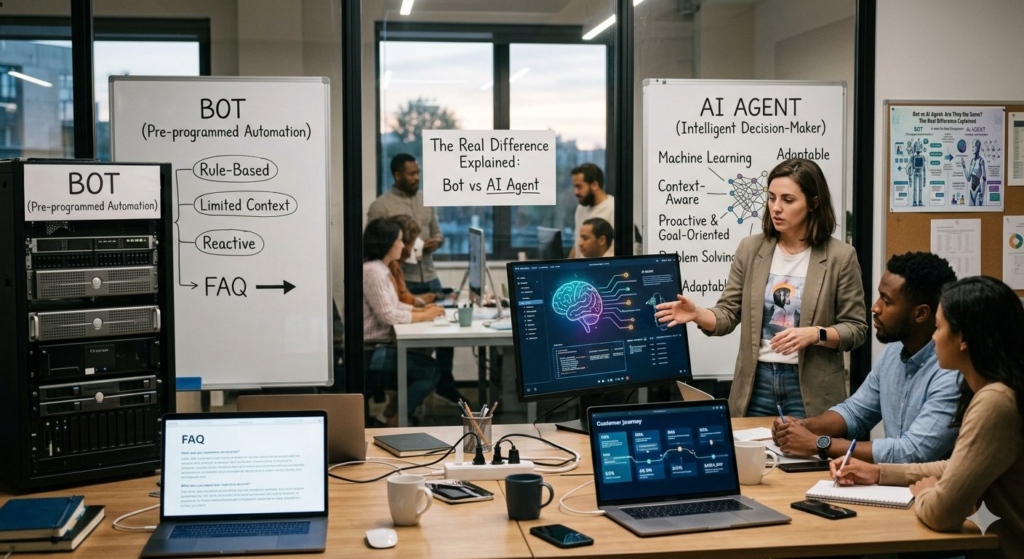
Bot vs AI agent—which one is smarter, and are they actually the same thing?
As artificial intelligence evolves, terms such as bot, chatbot, AI chatbot, AI assistant, AI agent, and agentic AI are increasingly being used interchangeably. But they don’t all mean the same thing.
A traditional bot might follow a fixed set of rules and respond to predefined commands. A chatbot may communicate with users through text or voice. An AI assistant can understand natural language and help with tasks.
An AI agent goes further. It can be designed to understand a goal, plan multiple steps, use tools, make decisions, interact with external systems, and execute tasks with limited human intervention.
Google Cloud describes bots as generally focused on simple, reactive interactions, while AI agents are designed for more complex, goal-oriented and autonomous tasks.
So, is a bot the same as an AI agent?
No—but an AI agent can be a type of bot.
The easiest way to understand the relationship is:
Bot = broad category of automated software
Chatbot = bot designed primarily for conversation
AI chatbot = chatbot powered by AI
AI assistant = AI application designed to assist a user
AI agent = AI system designed to pursue goals and take actions
Let’s break down the difference.
What Is a Bot?
A bot is a software program designed to perform an automated task.
Bots have existed long before modern generative AI.
They can be programmed to:
- Respond to commands
- Collect information
- Send notifications
- Perform repetitive tasks
- Monitor websites
- Process simple requests
- Automate workflows
- Interact with users
A bot does not necessarily need artificial intelligence.
For example, a simple website bot could follow this logic:
If user selects “Track Order” → Ask for order number → Display order status.
There may be no reasoning or large language model involved.
IBM describes traditional chatbots as software applications that communicate through text or voice and notes that many traditional chatbots use predefined rules, decision trees and scripted conversation flows.
What Is a Chatbot?
A chatbot is a type of bot designed primarily for conversation.
It can communicate with users through:
- Websites
- Mobile applications
- Messaging platforms
- Customer-service portals
- Voice interfaces
Traditional chatbots generally rely on predefined flows.
For example:
User: What are your business hours?
Bot: We are open from 9 AM to 6 PM.
User: I want to return my order.
Bot: Please select your order number.
This is useful automation, but the system may be limited to the workflows developers have created.
What Is an AI Chatbot?
An AI chatbot uses artificial intelligence to understand and generate responses.
Modern AI chatbots can use technologies such as:
- Large language models
- Natural language processing
- Retrieval systems
- Knowledge bases
- Speech recognition
- Generative AI
This makes them much more flexible than traditional rule-based bots.
Instead of requiring the user to select an exact menu option, an AI chatbot can understand:
“I bought this product last week but it arrived damaged. Can I get a replacement?”
The AI can understand the meaning of the request and respond naturally.
However, being an AI chatbot does not automatically make something an AI agent.
This is where the confusion begins.
What Is an AI Agent?
An AI agent is a software system designed to pursue a goal and take actions to accomplish it.
Google Cloud defines AI agents as software systems that use AI to pursue goals and complete tasks on behalf of users. It highlights capabilities such as reasoning, planning, memory, decision-making and tool use.
IBM similarly describes AI agents as systems that can autonomously complete tasks by planning workflows and using available tools.
An AI agent can potentially:
- Understand a goal.
- Break the goal into tasks.
- Decide what actions are required.
- Select appropriate tools.
- Execute actions.
- Observe the results.
- Adjust its approach.
- Continue until the goal is completed or human intervention is required.
That is fundamentally different from simply generating a response.
Bot vs AI Agent: The Biggest Difference
The easiest way to understand the difference is how they approach a task.
Traditional Bot
Input → Rule → Action → Response
AI Chatbot
Question → AI model → Answer
AI Agent
Goal → Plan → Reason → Use tools → Act → Check result → Continue
This is why the term agentic AI has become increasingly important.
IBM’s 2026 AI roadmap describes the broader shift from standalone AI models used primarily as chatbots toward multi-agent systems capable of planning, acting and adapting in real time.
Bot vs Chatbot vs AI Agent: Simple Comparison
| Feature | Bot | Chatbot | AI Chatbot | AI Agent |
|---|---|---|---|---|
| Automation | Yes | Yes | Yes | Yes |
| Conversation | Sometimes | Yes | Yes | Usually |
| Uses predefined rules | Often | Often | Sometimes | Not necessarily |
| Uses AI | Not required | Not required | Yes | Usually |
| Understands natural language | Limited | Limited to advanced | Yes | Yes |
| Planning | Usually no | Limited | Limited | Yes |
| Tool use | Sometimes | Sometimes | Sometimes | Yes |
| Multi-step execution | Limited | Limited | Possible | Core capability |
| Memory | Usually limited | Limited | Can have memory | Often designed with memory |
| Decision-making | Rule-based | Rule-based/limited | AI-assisted | Goal-oriented |
| Proactive behavior | Rare | Rare | Sometimes | Common |
| Works across systems | Limited | Limited | Possible | Designed for it |
| Autonomy | Low | Low to moderate | Moderate | Higher |
Important: These are not rigid technical categories. A modern system can combine several characteristics.
1. Bots Follow Instructions; AI Agents Can Pursue Goals
This is probably the most important difference.
A traditional bot is usually given a predefined task.
For example:
“If the customer selects option A, show message B.”
An AI agent can instead receive a broader objective:
“Help this customer resolve their delivery problem.”
The agent may then determine what information it needs, access available systems, check the order, review the applicable policy and determine the next step.
The difference is therefore:
Bot: Execute predefined instructions.
AI agent: Work toward a defined objective.
AI agents still operate within instructions, permissions and guardrails. They are not magically independent. IBM notes that human-defined goals, rules and available tools influence agent behavior.
2. Bots Usually React; AI Agents Can Act Proactively
Traditional bots normally wait for an event or user request.
For example:
User: Check my order.
Bot: Here is your order status.
An AI agent can potentially operate in the background.
For example:
“Monitor all delayed orders and identify customers who may need proactive assistance.”
The agent could continuously monitor information and initiate an approved workflow when conditions are met.
Google Cloud distinguishes reactive bots from agents that can operate proactively toward goals.
This is one reason companies are exploring agents for IT operations, customer service, data analysis and business process automation.
3. AI Agents Can Break Complex Problems Into Steps
Imagine telling a system:
“Find potential customers for our new product, research their companies, identify decision-makers and prepare a sales report.”
A basic chatbot might explain how to perform the research.
An AI agent could potentially coordinate the process:
Step 1: Find companies.
Step 2: Research the companies.
Step 3: Identify relevant information.
Step 4: Organize the data.
Step 5: Analyze prospects.
Step 6: Prepare the report.
This process is known as task decomposition and planning.
IBM describes agent planning as determining a sequence of actions required to achieve a specific goal.
4. AI Agents Can Use Tools
This is another major distinction.
An AI model by itself primarily processes information.
An agent can be connected to tools.
For example:
- Search engines
- APIs
- Databases
- CRM systems
- Calendars
- Spreadsheets
- Code execution
- Enterprise applications
- Internal company systems
The agent can determine which tools are required and use them as part of a workflow.
Google Cloud identifies tools as an important component of AI agents because they allow agents to interact with external systems and environments.
Example
A chatbot might say:
“You should check your company’s CRM for the customer’s previous purchases.”
An appropriately connected AI agent could potentially retrieve that information itself.
5. AI Agents Can Work Across Multiple Applications
Consider an employee onboarding process.
A traditional process might involve:
HR system → IT system → Email → Training platform → Payroll
An AI agent could potentially coordinate actions across these systems.
For example:
- Read the new employee information.
- Create the required records.
- Trigger IT account creation.
- Send onboarding information.
- Enroll the employee in training.
- Update the relevant systems.
This is where AI agents can become more than chat interfaces.
They can act as orchestration layers between software systems.
IBM’s 2026 enterprise AI strategy similarly emphasizes agents interacting with enterprise backend systems and the need for orchestration and governance as agent deployments scale.
6. AI Agents Can Adapt When Something Goes Wrong
Traditional automation is often predictable:
If A happens → perform B.
But what happens if B fails?
A traditional bot may simply return an error.
An AI agent can potentially inspect the failure and determine an alternative path.
For example:
“The primary API is unavailable.”
An agent might:
- Detect the failure.
- Check whether an alternative tool is available.
- Try the alternative.
- Evaluate the result.
- Continue the workflow.
This doesn’t mean an agent will always recover correctly.
AI systems can make mistakes.
But the ability to reason about changing conditions is a key part of agentic systems.
7. AI Agents Can Collaborate With Other Agents
One of the most interesting developments is multi-agent AI.
Instead of one agent doing everything, businesses can use specialized agents.
For example:
Research Agent
Collects information.
Data Agent
Processes data.
Analyst Agent
Interprets findings.
Writing Agent
Creates a report.
Review Agent
Checks the final output.
These agents can potentially coordinate their work.
Google Cloud describes multi-agent systems as systems where multiple specialized agents coordinate to handle more complex workflows.
This could eventually resemble a digital AI workforce.
IBM reported in 2026 that enterprises are increasingly focusing on how to manage, orchestrate and govern large numbers of AI agents.
8. Not Every AI Agent Is a Chatbot
This is an important point.
An AI agent does not have to communicate through a chat window.
Some agents can operate in the background.
For example:
IT monitoring agent
Monitors infrastructure and responds to approved problems.
Data agent
Analyzes databases and generates insights.
Coding agent
Works with a software repository and development tools.
Finance agent
Processes financial documents and prepares workflows.
Security agent
Investigates alerts and supports incident response.
Google Cloud specifically distinguishes conversational agents from background agents that can operate behind the scenes.
So:
Every AI agent does not need to look like ChatGPT.
9. But Some Chatbots Can Also Be AI Agents
This is where the terminology gets complicated.
A chatbot interface can sit on top of an AI agent.
For example:
User → Chat interface → AI agent → Tools → Business systems
The user sees a chatbot.
Behind the scenes, an agent may be:
- Planning the task
- Calling APIs
- Searching databases
- Executing actions
- Checking results
- Updating systems
IBM makes the same distinction: some AI agents include a chatbot interface, but conversation is only one part of what the agent does.
Therefore, saying “AI agent and chatbot are completely different things” is also an oversimplification.
A chatbot can be the interface for an AI agent.
10. What About AI Assistants?
There is another term that frequently gets confused with agents: AI assistant.
An AI assistant generally helps a user accomplish tasks.
For example, an assistant might:
- Draft an email
- Summarize a document
- Schedule a meeting
- Search information
- Create content
- Answer questions
An AI agent generally has a higher degree of autonomy.
It can potentially continue working toward a goal without requiring the user to direct every individual step.
Google Cloud’s comparison places AI assistants between bots and AI agents in terms of autonomy and task complexity.
A simple way to remember it:
Bot → Automates
Chatbot → Converses
AI Assistant → Helps
AI Agent → Acts toward a goal
Bot vs AI Agent: Real-World Example
Let’s take an online shopping company.
Traditional Bot
Customer:
Where is my order?
Bot:
Enter your order number.
Customer enters the number.
Bot:
Your order is out for delivery.
The bot has completed its task.
AI Chatbot
Customer:
My order hasn’t arrived and I need it urgently.
AI chatbot:
I understand. Your order appears to be delayed. Would you like me to explain the available options?
The chatbot provides intelligent conversation.
AI Agent
Customer:
My order hasn’t arrived and I need it urgently.
An appropriately configured agent could potentially:
- Identify the order.
- Check delivery status.
- Review the expected delivery date.
- Check company policy.
- Determine available options.
- Contact the relevant delivery system.
- Initiate an approved resolution.
- Update the customer.
- Record the interaction.
The difference is not simply intelligence.
The difference is agency and execution.
Are AI Agents Better Than Bots?
Not necessarily.
This is another common misconception.
The right technology depends on the problem.
A simple bot can be better when the task is predictable.
For example:
- FAQ responses
- Website navigation
- Simple notifications
- Basic customer queries
- Fixed workflows
Why build an expensive AI agent when a simple rule can solve the problem?
AI agents become more valuable when tasks involve:
- Unstructured information
- Multiple systems
- Complex decisions
- Changing conditions
- Multi-step workflows
- Research
- Planning
- Tool use
Simple rule
Simple problem → Bot
Conversational problem → Chatbot
Knowledge problem → AI chatbot/assistant
Complex goal requiring planning and action → AI agent
AI Agent vs Bot: The Future of Automation
The industry is moving from automation based purely on predefined rules toward systems that can combine AI reasoning with software tools.
IBM’s 2026 roadmap describes this shift as a movement toward AI systems that can plan, act and adapt, while also warning that agent deployments introduce new security and governance challenges.
That last point is extremely important.
More autonomy means more responsibility.
An agent that can access a calendar is one thing.
An agent that can access:
- Banking systems
- Production databases
- Customer information
- Company credentials
- Financial systems
requires significantly stronger security controls.
Are AI Agents Completely Autonomous?
No.
The word “autonomous” can be misleading.
AI agents operate within:
- Instructions
- Permissions
- Tools
- Policies
- Guardrails
- System constraints
They can make decisions within those boundaries, but organizations still need oversight.
This is becoming increasingly important as enterprises deploy agents across critical systems. IBM has highlighted risks including excessive permissions, prompt injection, credential theft, tool manipulation and insufficient monitoring.
The best enterprise AI agent is therefore not the one with unlimited freedom.
It is the one with useful autonomy and controlled permissions.
The Biggest Difference Between a Bot and an AI Agent
If you remember only one thing from this article, remember this:
A bot is built to automate a task. An AI agent is built to pursue a goal.
A bot might follow:
Rule → Action
An AI chatbot might follow:
Question → Answer
An AI agent might follow:
Goal → Plan → Tools → Actions → Results → Adaptation
That difference explains why AI agents are becoming such an important part of the future of enterprise software and automation.
Frequently Asked Questions
Is an AI agent a bot?
Not exactly. A bot is a broad category of automated software. An AI agent is a more advanced type of AI system designed to pursue goals, plan tasks and take actions. Some AI agents can technically be considered bots, but not every bot is an AI agent.
Is ChatGPT a bot or an AI agent?
The answer depends on the specific configuration and capabilities being used. A conversational AI interface can provide chatbot-like behavior, while agentic systems can use tools and execute multi-step tasks.
Can a chatbot become an AI agent?
Yes. A chatbot interface can be connected to an agentic backend that provides planning, memory, tools and the ability to take actions.
Are AI agents replacing chatbots?
Not necessarily. Chatbots remain useful for straightforward customer interactions and information requests. AI agents are better suited to complex, multi-step workflows. Many future systems will combine both.
Is an AI agent the same as agentic AI?
They are closely related but not identical. An AI agent is the system that performs tasks, while agentic AI generally describes the broader approach or capabilities that allow AI systems to operate toward goals with some degree of autonomy.
Do AI agents need humans?
For many important applications, yes. Human oversight is especially important when agents can make high-impact decisions or access sensitive systems.
Final Verdict: Bot vs AI Agent
No, bots and AI agents are not the same.
But the relationship is more nuanced than simply saying:
Bot = basic
AI agent = intelligent
The real difference is how much autonomy, planning, tool use and action the system has.
A bot can automate a predefined task.
A chatbot can have a conversation.
An AI assistant can help a user accomplish tasks.
An AI agent can potentially plan and execute a multi-step goal using tools and external systems.
And the most powerful future systems may combine all of them:
Chat interface + AI assistant + AI agents + tools + automation.
That is where the next generation of AI-powered software is heading.
The One-Line Difference
Bots follow instructions. Chatbots have conversations. AI assistants help users. AI agents pursue goals and take action.
The future of AI may not be about asking machines more questions.
It may be about giving machines goals—and letting them do the work.
If you enjoyed this article, you may also like:
- 5 AI Gateways That Offer Free Tokens in 2026
- How to Build a Humanoid Robot in 2026: Costs, Timeline & Complete Blueprint
- Best AI Research Tools in 2026: ChatGPT, Claude, Gemini & Perplexity
- Best AI Resume Builders in 2026 — Free
- ChatGPT Review — Is It Worth Paying For in 2026?
- 10 Best Free AI Tools You Should Use in 2026
- Best AI Video Generators in 2026 — Free and Paid
- Best AI for Students in 2026: Top 10 Tools for Learning
- How AI Learns From Humans to Build Physical Robots
- How AI Learns From Humans to Build Physical Robots
- Why LangGraph Is So Popular in Enterprises — Pros, Cons & Real-World Use Cases in 2026
- ChatGPT vs Gemini vs Claude vs Grok 2026
- DeepSeek V4 vs Grok 4 vs Claude Opus 5 vs Nvidia Nemotron vs Gemini 2.5 Pro — The Ultimate AI Model Comparison for 2026
- AI Agent and LLM Frameworks Comparison 2026: LangChain vs LangGraph vs CrewAI vs AutoGen vs LlamaIndex vs Semantic Kernel
- Best Multi-Agent AI Platforms in 2026: CrewAI vs AutoGen vs LangGraph vs OpenAI Agents SDK vs Agno vs Semantic Kernel
- Best AI Development Platforms in 2026: OpenAI API vs Anthropic API vs Google AI Studio vs Vertex AI vs Azure AI Foundry vs AWS Bedrock vs Hugging Face
- Exploring the Latest AI Tools and Technologies
- How to Use ChatGPT for Business — A Complete Beginner Guide
- How to Write Blog Posts with AI — A Proven Step-by-Step Guide
- Best AI Coding Assistants 2026
- Ultimate Guide to the 10 Best AI Chatbots in 2026
- Claude AI Review — Best ChatGPT Alternative in 2026
- Jasper AI Review — Is It Worth $49/Month in 2026?
- How to Use AI for Social Media Marketing — Complete Guide
- AI Tools for Small Business Owners — Save 10 Hours/Week
- AI Tools for Content Creators
- Best AI Music Generators in 2026 — Create Songs in Minutes
- AI Design Tools Compared: Canva AI vs Adobe Firefly vs Midjourney
- Best AI Writing Tools 2026
- 10 Free AI Tools You Should Try in 2026
- Best AI Image Generators in 2026 — Free and Paid Compared
- Best AI Productivity Tools in 2026 — Work Smarter, Not Harder
- ChatGPT vs Claude in 2026 — Which AI Is Actually Better?
- ChatGPT vs Gemini vs Claude vs Grok (2026): Which AI Assistant Should You Actually Use?
Visit Aidacoit.com for more AI comparisons, practical AI tutorials, enterprise AI insights, and emerging technology trends.