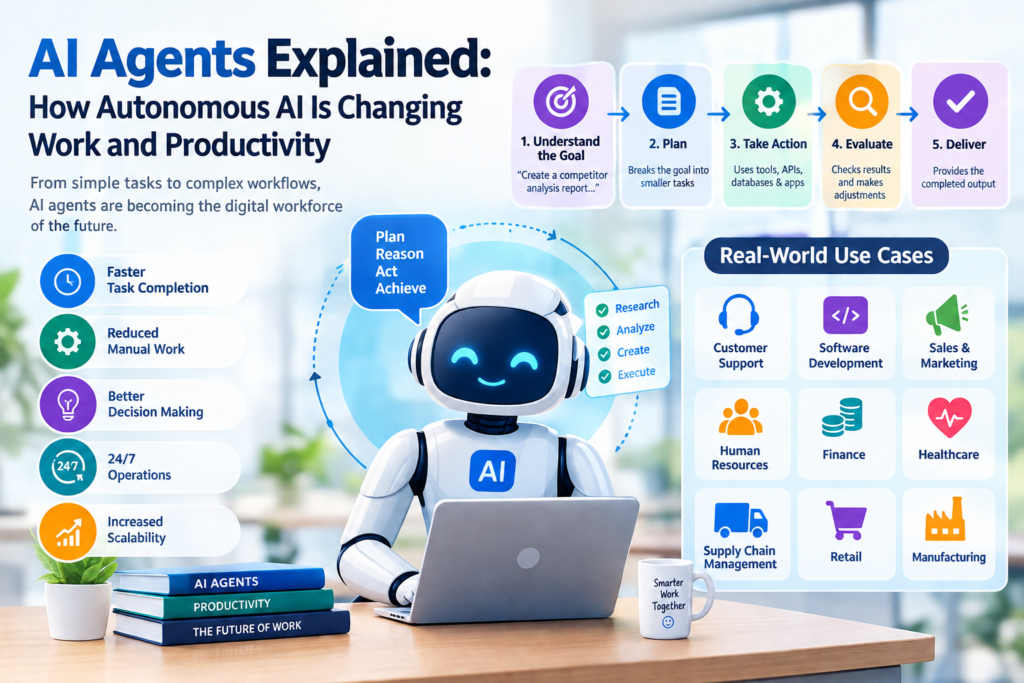
Artificial Intelligence is entering a new era. While chatbots and AI assistants have already transformed how people search, write, and communicate, the next major leap is AI Agents—autonomous systems capable of planning, reasoning, and completing tasks with minimal human intervention.
From automating customer support to managing software development workflows, AI agents are rapidly becoming the digital workforce of the future. Major technology companies including Google, Microsoft, IBM, NVIDIA, and OpenAI are investing heavily in agentic AI because it promises far greater productivity gains than traditional automation.
In this guide, you’ll learn what AI agents are, how they work, their real-world applications, benefits, challenges, and why they are expected to reshape the workplace in the coming years.
What Are AI Agents?
An AI agent is an intelligent software system that can perceive information, reason about a goal, make decisions, and take actions to achieve specific outcomes. Unlike traditional chatbots that simply respond to prompts, AI agents can execute multi-step tasks independently.
For example:
- A chatbot answers: “What is the weather today?”
- An AI agent can check weather forecasts, reschedule meetings, send notifications, and update your calendar automatically.
In simple terms, chatbots provide information, while AI agents perform actions.
How AI Agents Work
Most AI agents operate through a cycle of:
1. Understanding Goals
The agent receives an objective from a user.
Example:
“Create a competitor analysis report for the top five AI companies.”
2. Planning
The agent breaks the objective into smaller tasks.
- Research companies
- Collect market data
- Analyze strengths and weaknesses
- Create a report
3. Executing Actions
The agent uses tools, APIs, databases, browsers, and software applications to complete each task.
4. Evaluating Results
The agent checks whether the outcome meets the original goal and makes adjustments if necessary.
5. Delivering Output
The completed work is presented to the user.
This ability to reason, act, and iterate makes AI agents significantly more powerful than traditional automation systems.
AI Agents vs Traditional Automation
| Feature | Traditional Automation | AI Agents |
|---|---|---|
| Rules-Based | Yes | No |
| Learns from Context | Limited | Yes |
| Multi-Step Tasks | Difficult | Native Capability |
| Decision Making | Predefined | Dynamic |
| Adaptability | Low | High |
| Human Supervision | Constant | Minimal |
Traditional automation follows fixed workflows. AI agents adapt to changing circumstances and can determine the best path toward a goal.
AI Agents vs Generative AI
Many people confuse AI agents with generative AI tools like ChatGPT.
Generative AI
- Creates content
- Answers questions
- Generates text, images, and code
- Waits for instructions
AI Agents
- Take actions
- Use external tools
- Make decisions
- Complete objectives autonomously
Agentic AI builds upon generative AI but extends it into autonomous execution.
Types of AI Agents
Reactive Agents
Respond only to current information without memory.
Example:
- Basic recommendation engines
Goal-Based Agents
Focus on achieving a specific objective.
Example:
- Automated travel booking assistants
Learning Agents
Improve performance through experience and feedback.
Example:
- Fraud detection systems
Multi-Agent Systems
Multiple AI agents collaborate to solve complex problems.
Example:
- Software development teams where separate agents handle coding, testing, documentation, and deployment.
Real-World Applications of AI Agents
Customer Support
AI agents can:
- Answer customer questions
- Process refunds
- Update tickets
- Escalate complex issues
This reduces response times while improving customer satisfaction.
Software Development
Modern AI coding agents can:
- Write code
- Test applications
- Fix bugs
- Review pull requests
Some engineering leaders already manage multiple AI coding agents as part of daily workflows.
Sales and Marketing
AI agents can:
- Generate leads
- Research prospects
- Personalize outreach
- Schedule meetings
- Analyze campaign performance
Human Resources
Recruiting agents can:
- Screen resumes
- Schedule interviews
- Conduct initial candidate assessments
Finance
Financial institutions use AI agents for:
- Report generation
- Risk analysis
- Compliance monitoring
- Fraud detection
Healthcare
Healthcare organizations are exploring AI agents for:
- Administrative automation
- Appointment management
- Clinical documentation support
Supply Chain Management
AI agents can optimize:
- Inventory management
- Demand forecasting
- Logistics planning
- Procurement operations
How AI Agents Improve Productivity
One of the biggest reasons organizations are adopting AI agents is productivity.
Research published in 2026 found autonomous AI systems dramatically reduced task completion times while improving work quality. AI agents were able to automate substantial portions of knowledge work, helping users complete tasks faster and at lower cost.
Key Productivity Benefits
Faster Task Completion
Agents can work continuously without breaks.
Reduced Manual Work
Employees spend less time on repetitive administrative tasks.
Better Decision Making
AI agents can analyze large amounts of information quickly.
24/7 Operations
Unlike humans, AI agents can operate around the clock.
Increased Scalability
Organizations can deploy hundreds of agents simultaneously.
Industries Being Transformed by AI Agents
Banking
Banks use AI for document processing, compliance, customer service, and operational efficiency.
Technology
Software companies are adopting AI agents for coding, testing, deployment, and infrastructure management.
Retail
Retailers use agents for inventory forecasting and personalized customer experiences.
Manufacturing
Factories are leveraging AI-powered systems for predictive maintenance and operational optimization.
Consulting
Consulting firms increasingly use AI agents for research, analysis, and report generation.
Challenges and Risks of Autonomous AI
While AI agents offer significant benefits, organizations must address several challenges.
Security Risks
Agents often access sensitive systems and data.
Strong governance and access controls are essential.
Hallucinations
AI agents can sometimes generate inaccurate information or make incorrect decisions.
Compliance Concerns
Industries with strict regulations require additional oversight.
Lack of Transparency
Complex AI systems may not always clearly explain how decisions were made.
Human Oversight
Experts recommend keeping humans involved in critical business decisions.
The Future of AI Agents
The future points toward a workplace where humans and AI agents collaborate closely.
Instead of replacing workers entirely, AI agents are likely to handle repetitive and time-consuming tasks, allowing employees to focus on creativity, strategy, leadership, and innovation.
Industry experts increasingly describe AI agents as a new digital workforce capable of managing complex workflows across organizations.
Emerging trends include:
- Multi-agent collaboration
- Autonomous business operations
- AI-powered digital employees
- Self-improving agents
- Enterprise-wide agent ecosystems
As agentic AI technology matures, businesses that successfully integrate AI agents may gain substantial advantages in efficiency, speed, and competitiveness.
Conclusion
AI agents represent one of the most important developments in artificial intelligence. Unlike traditional chatbots or automation tools, they can reason, plan, and execute tasks autonomously to achieve meaningful business outcomes.
From software development and customer support to finance and healthcare, AI agents are already transforming how work gets done. Organizations that understand and adopt this technology early will be better positioned to improve productivity, reduce operational costs, and stay competitive in the AI-driven economy.
The age of autonomous AI is no longer a future prediction—it is already reshaping workplaces around the world.
If you enjoyed this article, you may also like:
- 5 AI Gateways That Offer Free Tokens in 2026
- How to Build a Humanoid Robot in 2026: Costs, Timeline & Complete Blueprint
- Best AI Research Tools in 2026: ChatGPT, Claude, Gemini & Perplexity
- Best AI Resume Builders in 2026 — Free
- ChatGPT Review — Is It Worth Paying For in 2026?
- 10 Best Free AI Tools You Should Use in 2026
- Best AI Video Generators in 2026 — Free and Paid
- Best AI for Students in 2026: Top 10 Tools for Learning
- How AI Learns From Humans to Build Physical Robots
- How AI Learns From Humans to Build Physical Robots
- Why LangGraph Is So Popular in Enterprises — Pros, Cons & Real-World Use Cases in 2026
- ChatGPT vs Gemini vs Claude vs Grok 2026
- DeepSeek V4 vs Grok 4 vs Claude Opus 5 vs Nvidia Nemotron vs Gemini 2.5 Pro — The Ultimate AI Model Comparison for 2026
- AI Agent and LLM Frameworks Comparison 2026: LangChain vs LangGraph vs CrewAI vs AutoGen vs LlamaIndex vs Semantic Kernel
- Best Multi-Agent AI Platforms in 2026: CrewAI vs AutoGen vs LangGraph vs OpenAI Agents SDK vs Agno vs Semantic Kernel
- Best AI Development Platforms in 2026: OpenAI API vs Anthropic API vs Google AI Studio vs Vertex AI vs Azure AI Foundry vs AWS Bedrock vs Hugging Face
- Exploring the Latest AI Tools and Technologies
- How to Use ChatGPT for Business — A Complete Beginner Guide
- How to Write Blog Posts with AI — A Proven Step-by-Step Guide
- Best AI Coding Assistants 2026
- Ultimate Guide to the 10 Best AI Chatbots in 2026
- Claude AI Review — Best ChatGPT Alternative in 2026
- Jasper AI Review — Is It Worth $49/Month in 2026?
- How to Use AI for Social Media Marketing — Complete Guide
- AI Tools for Small Business Owners — Save 10 Hours/Week
- AI Tools for Content Creators
- Best AI Music Generators in 2026 — Create Songs in Minutes
- AI Design Tools Compared: Canva AI vs Adobe Firefly vs Midjourney
- Best AI Writing Tools 2026
- 10 Free AI Tools You Should Try in 2026
- Best AI Image Generators in 2026 — Free and Paid Compared
- Best AI Productivity Tools in 2026 — Work Smarter, Not Harder
- ChatGPT vs Claude in 2026 — Which AI Is Actually Better?
- ChatGPT vs Gemini vs Claude vs Grok (2026): Which AI Assistant Should You Actually Use?
Visit Aidacoit.com for more AI comparisons, practical AI tutorials, enterprise AI insights, and emerging technology trends.