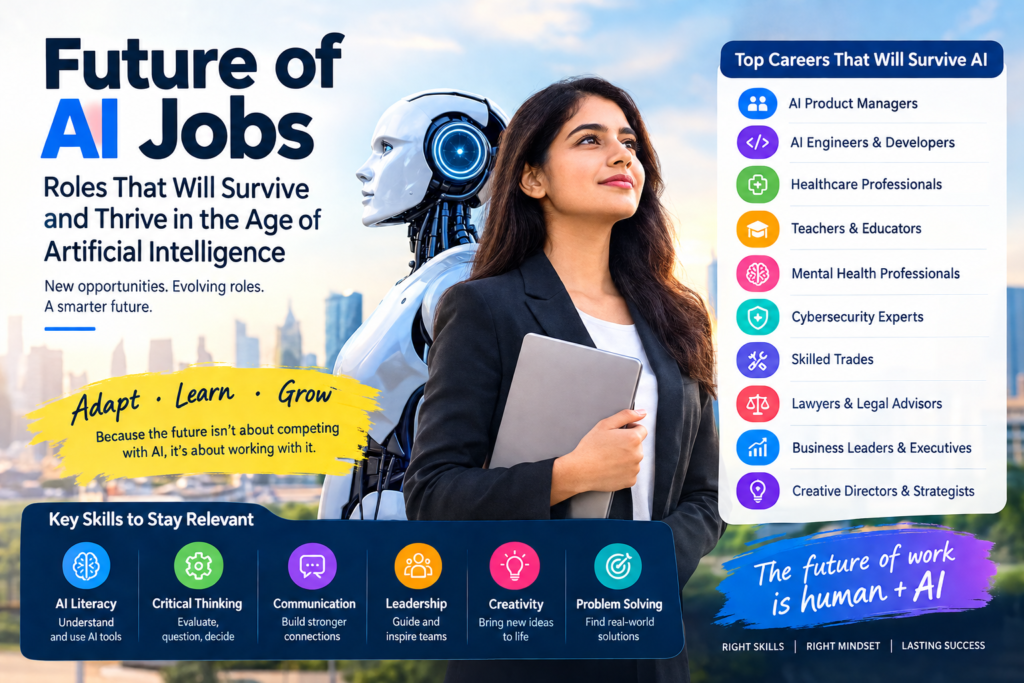
Artificial Intelligence is transforming industries faster than any technology in modern history. From content creation and software development to customer support and financial analysis, AI is automating tasks that once required human effort.
This rapid advancement has created an important question for professionals worldwide:
Which jobs will survive AI?
While some roles are becoming increasingly automated, many careers remain highly resilient because they require human judgment, creativity, emotional intelligence, leadership, accountability, and real-world problem-solving. In fact, research suggests that AI will not simply eliminate jobs—it will reshape them and create entirely new career opportunities.
In this article, we’ll explore the future of AI jobs, careers likely to thrive in the coming decade, and the skills professionals should develop to remain valuable in an AI-driven economy.
Will AI Replace Human Jobs?
The short answer is: Some jobs will change dramatically, but many will evolve rather than disappear.
According to workforce studies, AI is more likely to automate repetitive and rule-based tasks than jobs requiring complex judgment, accountability, leadership, creativity, or human interaction. Companies are increasingly using AI as a productivity tool that augments workers rather than replacing entire professions.
The future belongs to professionals who can effectively work alongside AI rather than compete against it.
Characteristics of AI-Proof Jobs
Jobs most resistant to automation generally possess one or more of these characteristics:
Human Trust and Relationships
Roles that require empathy, negotiation, coaching, mentoring, or emotional support remain difficult for AI to replicate.
Complex Decision-Making
Jobs involving accountability, strategic thinking, and high-stakes decisions continue to require human oversight.
Creativity and Innovation
AI can generate content, but defining vision, strategy, and original ideas remains a human strength.
Physical Dexterity
Many hands-on professions involve unpredictable real-world environments that robots and AI struggle to navigate effectively.
Leadership
Organizations still require humans to motivate teams, resolve conflicts, and make business-critical decisions.
Research indicates that judgment, creativity, leadership, and human interaction are becoming increasingly valuable in the AI era.
Top Jobs That Will Survive AI
1. AI Product Managers
AI Product Managers bridge the gap between technology and business.
Responsibilities include:
- Defining AI product strategy
- Prioritizing business requirements
- Managing stakeholders
- Evaluating AI performance
- Ensuring customer value
As companies deploy AI across operations, demand for professionals who understand both business and AI will continue to grow.
2. AI Engineers and Agentic AI Developers
Ironically, one of the safest careers in the AI era is building AI itself.
High-demand roles include:
- AI Engineers
- GenAI Engineers
- Agentic AI Developers
- AI Architects
- RAG Engineers
- AI Platform Engineers
Recent hiring data from India shows explosive growth in these specialized AI implementation roles.
3. Healthcare Professionals
Healthcare requires:
- Human judgment
- Patient trust
- Ethical decision-making
- Physical examination
- Emotional support
While AI can assist with diagnosis and administrative work, doctors, nurses, therapists, and healthcare specialists remain essential.
4. Teachers and Educators
AI can provide information, but education extends far beyond knowledge delivery.
Great teachers:
- Inspire students
- Build confidence
- Adapt to individual needs
- Provide mentorship
- Develop critical thinking
The human relationship between educators and learners remains difficult to automate.
5. Psychologists and Mental Health Professionals
Emotional intelligence remains one of humanity’s strongest advantages.
Mental health professionals provide:
- Empathy
- Human connection
- Counseling
- Trust-based relationships
- Personalized care
These capabilities are unlikely to be fully replaced by AI.
6. Cybersecurity Experts
As AI becomes more powerful, cyber threats are becoming more sophisticated.
Organizations increasingly need professionals who can:
- Investigate threats
- Design security strategies
- Manage risk
- Respond to incidents
- Govern AI systems
Cybersecurity is expected to remain a critical growth sector.
7. Skilled Trades
Many people underestimate the resilience of hands-on professions.
Examples include:
- Electricians
- Plumbers
- Carpenters
- HVAC Technicians
- Construction Specialists
These jobs involve physical environments and unpredictable conditions that remain difficult for automation.
8. Lawyers and Legal Advisors
AI can review documents and summarize cases.
However, legal professionals still provide:
- Legal interpretation
- Strategic advice
- Negotiation
- Court representation
- Accountability
Routine legal work may be automated, but complex legal judgment remains highly valuable.
9. Business Leaders and Executives
Executives make decisions involving:
- Risk management
- Company strategy
- Resource allocation
- Leadership
- Crisis response
AI can assist with analysis, but ultimate responsibility remains with human leaders.
10. Creative Directors and Brand Strategists
AI can generate content rapidly.
However, companies still require professionals who can:
- Create brand vision
- Understand culture
- Develop marketing strategies
- Build emotional connections
Creative leadership remains highly human-centric.
New AI Careers Emerging in 2026 and Beyond
The AI revolution is creating entirely new jobs.
Examples include:
AI Agent Developer
Builds autonomous AI agents capable of completing business workflows.
Prompt Engineer
Designs and optimizes prompts for AI systems.
AI Governance Specialist
Ensures ethical, legal, and regulatory compliance.
AI Operations Manager
Manages enterprise AI deployments.
AI Trainer
Improves AI outputs through human feedback and evaluation.
AI Workflow Architect
Designs AI-powered business processes.
Many of these roles barely existed a few years ago but are now among the fastest-growing technology careers.
Jobs Most Vulnerable to AI
Roles involving repetitive digital tasks face the highest automation risk.
Examples include:
- Data Entry Clerks
- Telemarketers
- Basic Administrative Support
- Routine Bookkeeping
- Typists
- Order Processing Roles
These occupations are already experiencing automation pressure.
Skills You Need to Stay Relevant
Instead of focusing solely on job titles, professionals should develop skills that complement AI.
AI Literacy
Understand how AI systems work and how to use them effectively.
Critical Thinking
Evaluate AI-generated outputs rather than accepting them blindly.
Communication
Clear communication remains essential in every profession.
Leadership
Organizations increasingly value professionals who can guide teams.
Creativity
Original thinking becomes more valuable as AI automates routine content generation.
Problem Solving
Businesses pay for solutions, not routine tasks.
Studies show that jobs demanding judgment, creativity, leadership, and human interaction are becoming increasingly valuable in AI-driven organizations.
How Professionals Should Prepare for the AI Era
The most successful workers will not be those who avoid AI.
They will be those who:
- Learn AI tools.
- Automate repetitive work.
- Focus on strategic thinking.
- Build domain expertise.
- Strengthen communication skills.
- Develop leadership abilities.
- Continuously learn and adapt.
The future workplace will likely reward professionals who combine human expertise with AI capabilities.
Conclusion
Artificial Intelligence will undoubtedly change the employment landscape, but it is unlikely to eliminate the need for human talent.
Jobs centered around leadership, judgment, creativity, trust, empathy, accountability, and complex problem-solving remain highly resilient. At the same time, entirely new AI-powered careers are emerging across industries.
The future belongs neither to humans alone nor to AI alone.
It belongs to professionals who know how to leverage AI as a powerful partner while strengthening the uniquely human skills that machines cannot easily replicate.
Those who adapt, learn, and evolve will find tremendous opportunities in the AI-powered economy of the future.
If you enjoyed this article, you may also like:
- 5 AI Gateways That Offer Free Tokens in 2026
- How to Build a Humanoid Robot in 2026: Costs, Timeline & Complete Blueprint
- Best AI Research Tools in 2026: ChatGPT, Claude, Gemini & Perplexity
- Best AI Resume Builders in 2026 — Free
- ChatGPT Review — Is It Worth Paying For in 2026?
- 10 Best Free AI Tools You Should Use in 2026
- Best AI Video Generators in 2026 — Free and Paid
- Best AI for Students in 2026: Top 10 Tools for Learning
- How AI Learns From Humans to Build Physical Robots
- How AI Learns From Humans to Build Physical Robots
- Why LangGraph Is So Popular in Enterprises — Pros, Cons & Real-World Use Cases in 2026
- ChatGPT vs Gemini vs Claude vs Grok 2026
- DeepSeek V4 vs Grok 4 vs Claude Opus 5 vs Nvidia Nemotron vs Gemini 2.5 Pro — The Ultimate AI Model Comparison for 2026
- AI Agent and LLM Frameworks Comparison 2026: LangChain vs LangGraph vs CrewAI vs AutoGen vs LlamaIndex vs Semantic Kernel
- Best Multi-Agent AI Platforms in 2026: CrewAI vs AutoGen vs LangGraph vs OpenAI Agents SDK vs Agno vs Semantic Kernel
- Best AI Development Platforms in 2026: OpenAI API vs Anthropic API vs Google AI Studio vs Vertex AI vs Azure AI Foundry vs AWS Bedrock vs Hugging Face
- Exploring the Latest AI Tools and Technologies
- How to Use ChatGPT for Business — A Complete Beginner Guide
- How to Write Blog Posts with AI — A Proven Step-by-Step Guide
- Best AI Coding Assistants 2026
- Ultimate Guide to the 10 Best AI Chatbots in 2026
- Claude AI Review — Best ChatGPT Alternative in 2026
- Jasper AI Review — Is It Worth $49/Month in 2026?
- How to Use AI for Social Media Marketing — Complete Guide
- AI Tools for Small Business Owners — Save 10 Hours/Week
- AI Tools for Content Creators
- Best AI Music Generators in 2026 — Create Songs in Minutes
- AI Design Tools Compared: Canva AI vs Adobe Firefly vs Midjourney
- Best AI Writing Tools 2026
- 10 Free AI Tools You Should Try in 2026
- Best AI Image Generators in 2026 — Free and Paid Compared
- Best AI Productivity Tools in 2026 — Work Smarter, Not Harder
- ChatGPT vs Claude in 2026 — Which AI Is Actually Better?
- ChatGPT vs Gemini vs Claude vs Grok (2026): Which AI Assistant Should You Actually Use?
Visit Aidacoit.com for more AI comparisons, practical AI tutorials, enterprise AI insights, and emerging technology trends.