Introduction
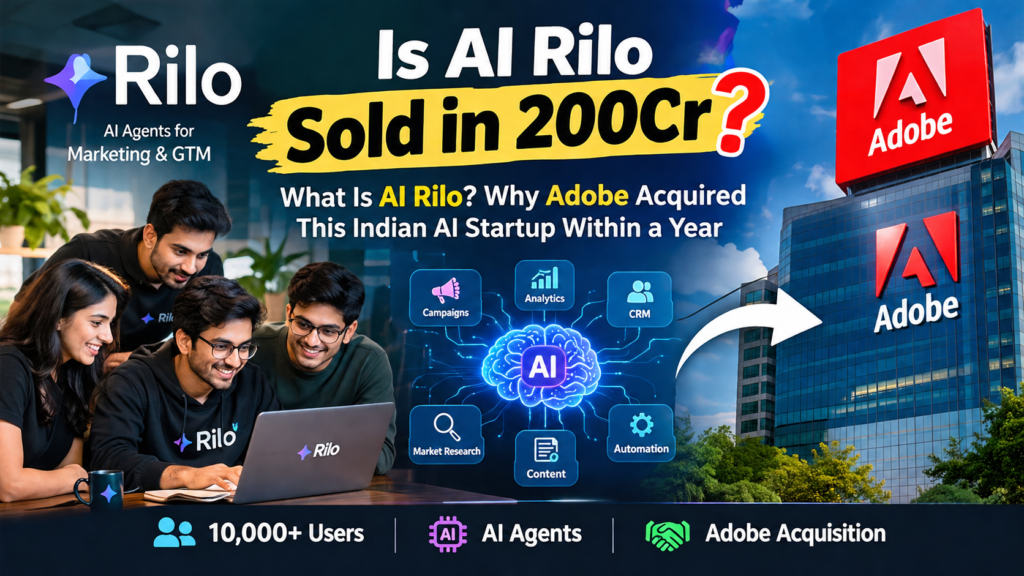
In one of the most talked-about AI startup acquisitions of 2026, Adobe acquired Indian AI startup Rilo less than a year after its launch. The deal surprised many in the startup ecosystem because Rilo was founded only in 2025, had a team of just six people, and had raised approximately $1 million in funding.
The acquisition has sparked a common question:
What exactly is Rilo, and why would a global software giant like Adobe acquire it so quickly?
The answer reveals an important trend shaping the future of artificial intelligence: companies are no longer buying software alone—they are buying AI agents, automation workflows, and specialized talent.
In this article, we will explore what Rilo is, how it works, why Adobe acquired it, and what this acquisition means for the future of AI-powered marketing.
What Is Rilo?
Rilo is an AI-powered workflow automation platform designed for marketing and go-to-market (GTM) teams.
Founded in 2025 by IIT Bombay alumni Dhruv Jaglan and Georgi Boby, Rilo aimed to make AI useful for non-technical professionals rather than just software developers. The platform allowed users to describe a task in plain English and have AI agents build and execute workflows automatically.
Instead of manually connecting dozens of tools, users could simply describe an outcome such as:
- Track competitors
- Monitor market trends
- Generate sales outreach campaigns
- Analyze sales calls
- Repurpose content
- Research prospects
- Manage marketing workflows
The AI agents would then perform these tasks with minimal human intervention.
The Problem Rilo Solved
Modern marketing teams use multiple tools:
- CRM platforms
- Social media tools
- Analytics dashboards
- Email automation systems
- AI writing assistants
- Customer data platforms
Managing these tools often creates workflow complexity.
Rilo attempted to solve this problem by acting as an “AI employee” that could coordinate activities across multiple platforms using natural language instructions.
This reduced:
- Manual work
- Tool switching
- Repetitive processes
- Operational overhead
For businesses, that translates directly into improved productivity and lower costs.
How Rilo’s AI Agents Worked
Unlike traditional automation software that requires users to create flowcharts and rules manually, Rilo focused on outcome-based automation.
A user could type:
“Monitor my top five competitors and notify me when they launch a new product.”
The AI system would:
- Gather competitor data
- Monitor websites and channels
- Detect significant changes
- Generate insights
- Send alerts automatically
The same approach worked for:
Sales Prospecting
AI agents could identify prospects and prepare outreach campaigns.
Content Distribution
AI could repurpose content and publish it across multiple channels.
Competitive Intelligence
Businesses could continuously track competitors without manual research.
Campaign Research
Marketing teams could gather insights and recommendations faster than traditional methods.
Why Did Rilo Grow So Fast?
Several factors contributed to Rilo’s rapid growth.
1. AI Agents Became Mainstream
2025 and 2026 saw explosive growth in AI agents.
Businesses began looking beyond chatbots and wanted systems that could actually perform tasks rather than just answer questions.
Rilo aligned perfectly with this shift.
2. Easy for Non-Technical Users
Most workflow automation platforms require technical expertise.
Rilo allowed users to interact using natural language.
This significantly reduced adoption barriers.
3. Strong Founding Team
The founders came from highly technical backgrounds and understood both AI infrastructure and enterprise workflow challenges.
Adobe specifically highlighted the value of the technical team after the acquisition.
4. Early Market Validation
Within months of launch, Rilo reportedly attracted over 10,000 users. This demonstrated strong product-market fit despite the company’s young age.
Why Adobe Acquired Rilo
Many people assume Adobe acquired Rilo because of revenue.
However, acquisitions in AI are often driven by strategic advantages rather than immediate revenue generation.
Adobe acquired Rilo primarily for three reasons.
1. Agentic AI Is the Future of Marketing
The marketing industry is rapidly moving toward agentic AI.
Instead of marketers manually creating campaigns, AI agents can:
- Create content
- Analyze competitors
- Monitor customer behavior
- Generate insights
- Optimize campaigns
Rilo’s technology directly supports this vision.
2. Strengthening Adobe Experience Cloud
Adobe has been aggressively investing in AI-powered marketing solutions.
Rilo’s workflow automation capabilities can enhance:
- Adobe Experience Cloud
- Customer Experience products
- Marketing automation tools
- Enterprise AI offerings
This makes Adobe more competitive against rivals such as Canva, OpenAI, Anthropic, Google, and Meta.
3. Acquiring Talent
In AI, talent is often more valuable than products.
Rilo’s six-person team had already built sophisticated workflow automation technology in less than a year.
Adobe gained:
- Experienced AI engineers
- Proven founders
- Proprietary intellectual property
- Existing workflow architecture
This significantly accelerates Adobe’s AI roadmap.
Was Rilo Really Sold for ₹200 Crore?
Adobe has not officially disclosed the acquisition amount. Multiple reports confirm that the financial terms remain undisclosed.
However, industry observers have speculated that the acquisition could be valued in the tens of millions of dollars because:
- Rilo had a reported valuation of around $10 million during fundraising.
- The startup demonstrated rapid user growth.
- Adobe acquired both technology and talent.
- AI acquisition premiums are currently very high.
If the deal were worth approximately $20 million, it would translate to roughly ₹190–₹200 crore, but this remains speculation rather than confirmed information.
Lessons Entrepreneurs Can Learn from Rilo
The Rilo story offers important lessons for founders.
Build for a Massive Trend
Rilo entered the market at exactly the right time when AI agents were becoming mainstream.
Focus on a Specific Problem
Instead of building a generic AI chatbot, Rilo solved workflow automation for marketers.
Prioritize User Outcomes
Users care about results, not technology.
Rilo focused on outcomes rather than complicated workflow diagrams.
Move Fast
The company went from launch to acquisition in less than a year.
Speed matters in AI.
What This Means for the Future of AI
The acquisition signals a broader industry trend.
Future AI platforms will increasingly move beyond conversation and become action-oriented systems.
Instead of asking AI for information, users will ask AI to complete tasks.
Examples include:
- Running marketing campaigns
- Conducting research
- Monitoring competitors
- Generating sales leads
- Managing customer interactions
Companies that successfully build these AI agents may become highly attractive acquisition targets.
Final Thoughts
Rilo’s acquisition by Adobe demonstrates how quickly value can be created in the AI era.
In less than a year, a small Indian startup built technology compelling enough for one of the world’s largest software companies to acquire it.
The reason was not simply revenue or funding. It was Rilo’s ability to solve a growing enterprise challenge: turning AI from a chatbot into a workforce.
As businesses increasingly adopt AI agents, acquisitions like Rilo may become more common. The companies that can automate real-world work, not just generate text, are likely to define the next wave of AI innovation.
For entrepreneurs, marketers, and AI enthusiasts, Rilo serves as a powerful example of how identifying the right problem at the right time can create extraordinary opportunities.
If you enjoyed this article, you may also like:
- 5 AI Gateways That Offer Free Tokens in 2026
- How to Build a Humanoid Robot in 2026: Costs, Timeline & Complete Blueprint
- Best AI Research Tools in 2026: ChatGPT, Claude, Gemini & Perplexity
- Best AI Resume Builders in 2026 — Free
- ChatGPT Review — Is It Worth Paying For in 2026?
- 10 Best Free AI Tools You Should Use in 2026
- Best AI Video Generators in 2026 — Free and Paid
- Best AI for Students in 2026: Top 10 Tools for Learning
- How AI Learns From Humans to Build Physical Robots
- How AI Learns From Humans to Build Physical Robots
- Why LangGraph Is So Popular in Enterprises — Pros, Cons & Real-World Use Cases in 2026
- ChatGPT vs Gemini vs Claude vs Grok 2026
- DeepSeek V4 vs Grok 4 vs Claude Opus 5 vs Nvidia Nemotron vs Gemini 2.5 Pro — The Ultimate AI Model Comparison for 2026
- AI Agent and LLM Frameworks Comparison 2026: LangChain vs LangGraph vs CrewAI vs AutoGen vs LlamaIndex vs Semantic Kernel
- Best Multi-Agent AI Platforms in 2026: CrewAI vs AutoGen vs LangGraph vs OpenAI Agents SDK vs Agno vs Semantic Kernel
- Best AI Development Platforms in 2026: OpenAI API vs Anthropic API vs Google AI Studio vs Vertex AI vs Azure AI Foundry vs AWS Bedrock vs Hugging Face
- Exploring the Latest AI Tools and Technologies
- How to Use ChatGPT for Business — A Complete Beginner Guide
- How to Write Blog Posts with AI — A Proven Step-by-Step Guide
- Best AI Coding Assistants 2026
- Ultimate Guide to the 10 Best AI Chatbots in 2026
- Claude AI Review — Best ChatGPT Alternative in 2026
- Jasper AI Review — Is It Worth $49/Month in 2026?
- How to Use AI for Social Media Marketing — Complete Guide
- AI Tools for Small Business Owners — Save 10 Hours/Week
- AI Tools for Content Creators
- Best AI Music Generators in 2026 — Create Songs in Minutes
- AI Design Tools Compared: Canva AI vs Adobe Firefly vs Midjourney
- Best AI Writing Tools 2026
- 10 Free AI Tools You Should Try in 2026
- Best AI Image Generators in 2026 — Free and Paid Compared
- Best AI Productivity Tools in 2026 — Work Smarter, Not Harder
- ChatGPT vs Claude in 2026 — Which AI Is Actually Better?
- ChatGPT vs Gemini vs Claude vs Grok (2026): Which AI Assistant Should You Actually Use?
Visit Aidacoit.com for more AI comparisons, practical AI tutorials, enterprise AI insights, and emerging technology trends.