Artificial Intelligence is evolving rapidly, and terms like AI Agents, Chatbots, and Bots are often used interchangeably. However, while they may appear similar on the surface, AI agents and bots are fundamentally different in terms of intelligence, autonomy, decision-making, and business impact.
Many organizations are moving from traditional bots to AI agents because agents can reason, plan, take actions, and complete complex tasks with minimal human intervention.
In this article, we’ll explore the differences between AI agents and bots, understand when to use each, and see why AI agents are becoming the future of enterprise automation.
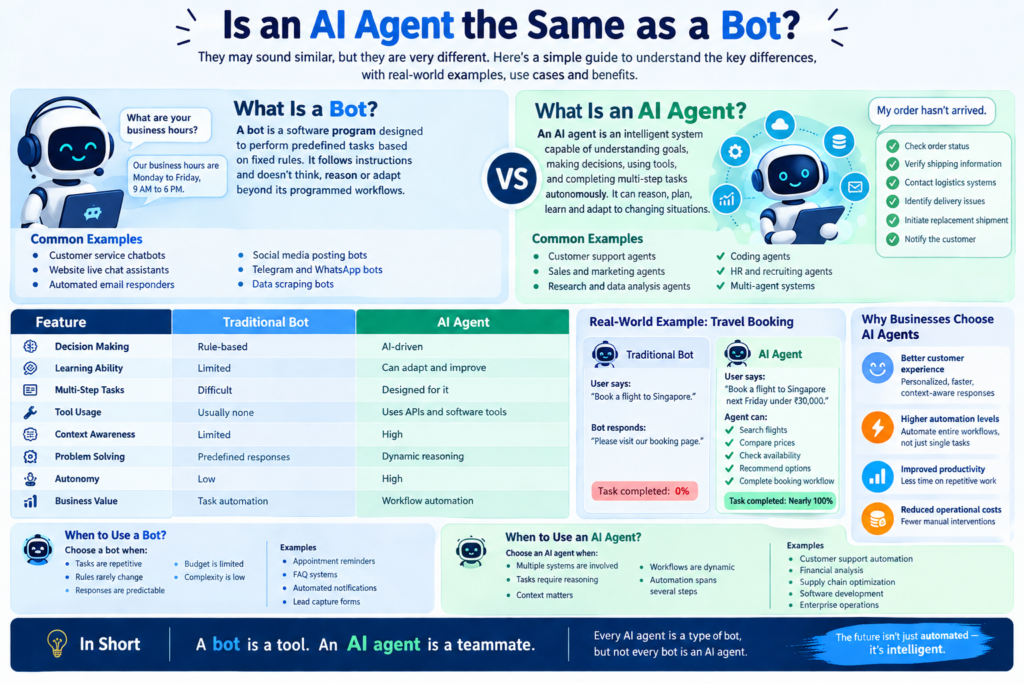
What Is a Bot?
A bot is a software program designed to perform predefined tasks based on fixed rules.
Bots follow instructions that developers explicitly program into them. They typically cannot think, reason, or adapt beyond their predefined workflows.
Common Examples of Bots
- Customer service chatbots
- Website live chat assistants
- Automated email responders
- Social media posting bots
- Telegram and WhatsApp bots
- Data scraping bots
Example
A customer asks:
“What are your business hours?”
A chatbot searches its predefined responses and returns:
“Our business hours are Monday to Friday, 9 AM to 6 PM.”
The bot simply matches the query to an existing response.
What Is an AI Agent?
An AI agent is an intelligent system capable of understanding goals, making decisions, using tools, and completing multi-step tasks autonomously.
Unlike bots, AI agents are not limited to predefined scripts.
They can:
- Understand context
- Reason through problems
- Plan actions
- Access external tools
- Learn from feedback
- Adapt to changing situations
Example
A customer says:
“My order hasn’t arrived.”
An AI agent can:
- Check the order database
- Verify shipping information
- Contact logistics systems
- Identify delivery issues
- Initiate replacement shipment
- Notify the customer
The customer gives one request, but the agent completes multiple actions independently.
AI Agent vs Bot: Quick Comparison
| Feature | Traditional Bot | AI Agent |
|---|---|---|
| Decision Making | Rule-based | AI-driven |
| Learning Ability | Limited | Can adapt and improve |
| Multi-Step Tasks | Difficult | Designed for it |
| Tool Usage | Usually none | Uses APIs and software tools |
| Context Awareness | Limited | High |
| Problem Solving | Predefined responses | Dynamic reasoning |
| Autonomy | Low | High |
| Business Value | Task automation | Workflow automation |
How Traditional Bots Work
Bots typically operate using predefined workflows.
Basic Workflow
Step 1: Receive Input
User sends a message.
Step 2: Match Pattern
Bot compares input against predefined rules.
Step 3: Return Response
Bot provides a predefined answer.
Example
If user says:
“Reset my password”
The bot follows a fixed workflow.
If the question changes slightly, the bot may fail to understand.
How AI Agents Work
AI agents use large language models (LLMs), reasoning frameworks, memory systems, and external tools.
AI Agent Workflow
Step 1: Understand Intent
Agent analyzes user goals.
Step 2: Plan Actions
Agent determines necessary steps.
Step 3: Use Tools
Agent interacts with:
- CRM systems
- Databases
- APIs
- Applications
- Search systems
Step 4: Execute Tasks
Agent performs required actions.
Step 5: Evaluate Results
Agent verifies whether the objective was achieved.
This makes agents significantly more capable than traditional bots.
Why AI Agents Are Replacing Traditional Bots
Businesses are increasingly adopting AI agents because customers expect more than scripted responses.
Better Customer Experience
AI agents provide:
- Personalized responses
- Faster resolutions
- Context-aware interactions
Higher Automation Levels
Agents automate entire workflows instead of individual tasks.
Improved Productivity
Employees spend less time on repetitive work.
Reduced Operational Costs
Organizations require fewer manual interventions.
Real-World Example: Bot vs AI Agent
Scenario: Travel Booking
Traditional Bot
User asks:
“Book a flight to Singapore.”
Bot responds:
“Please visit our booking page.”
Task completed: 0%
AI Agent
User asks:
“Book a flight to Singapore next Friday under ₹30,000.”
Agent can:
- Search flights
- Compare prices
- Check availability
- Recommend options
- Complete booking workflow
Task completed: Nearly 100%
This illustrates the major difference between automation and intelligence.
Types of Bots
Rule-Based Bots
Operate using predefined logic.
Examples
- FAQ chatbots
- Interactive menus
- Auto-reply systems
Workflow Bots
Execute specific business processes.
Examples
- Ticket routing
- Form processing
- Lead assignment
Social Media Bots
Manage repetitive online activities.
Examples
- Post scheduling
- Comment moderation
- Content publishing
Types of AI Agents
Customer Service Agents
Handle support interactions and issue resolution.
Sales Agents
Research leads, draft outreach emails, and update CRM systems.
Coding Agents
Generate code, review pull requests, and create documentation.
Research Agents
Collect information, analyze data, and generate reports.
Multi-Agent Systems
Multiple agents collaborate to complete complex business objectives.
When Should You Use a Bot?
Bots are still useful in many situations.
Choose a bot when:
- Tasks are repetitive
- Rules rarely change
- Responses are predictable
- Budget is limited
- Complexity is low
Examples
- Appointment reminders
- FAQ systems
- Automated notifications
- Lead capture forms
When Should You Use an AI Agent?
AI agents are better when tasks require intelligence and decision-making.
Choose an AI agent when:
- Multiple systems are involved
- Tasks require reasoning
- Context matters
- Workflows are dynamic
- Automation spans several steps
Examples
- Customer support automation
- Financial analysis
- Supply chain optimization
- Software development
- Enterprise operations
Can an AI Agent Be a Bot?
Technically, yes.
Every AI agent can be considered a type of bot because it is software performing tasks automatically.
However:
Not every bot is an AI agent.
Think of it like this:
Vehicle Analogy
- A bicycle is a vehicle.
- A sports car is also a vehicle.
But they offer vastly different capabilities.
Similarly:
- A chatbot is a bot.
- An AI agent is a much more advanced form of automated software.
Future of AI Agents and Bots
The future of automation is moving toward agentic systems.
Experts predict that organizations will increasingly deploy:
Autonomous AI Agents
Agents capable of completing business processes end-to-end.
Multi-Agent Teams
Groups of specialized AI agents working together.
Human-AI Collaboration
Employees managing and supervising AI agent ecosystems.
Traditional bots will continue to exist, but AI agents are expected to handle a growing share of enterprise operations.
Common Myths About AI Agents
Myth 1: AI Agents Are Just Chatbots
Reality:
AI agents can take actions, not just hold conversations.
Myth 2: Bots and Agents Are Identical
Reality:
Agents possess reasoning and decision-making capabilities that bots typically lack.
Myth 3: AI Agents Replace Humans Completely
Reality:
Most successful deployments involve humans supervising AI systems.
Conclusion
AI agents and bots are related but not the same.
A bot follows predefined rules and performs specific tasks. An AI agent goes much further by understanding goals, making decisions, using tools, and completing complex workflows autonomously.
For simple automation needs, bots remain effective and cost-efficient. However, organizations looking to automate sophisticated business processes, improve productivity, and create intelligent workflows are increasingly turning to AI agents.
As AI technology advances, the distinction between bots and agents will become even more important, making AI agents a key component of the future digital workforce.
If you enjoyed this article, you may also like:
- 5 AI Gateways That Offer Free Tokens in 2026
- How to Build a Humanoid Robot in 2026: Costs, Timeline & Complete Blueprint
- Best AI Research Tools in 2026: ChatGPT, Claude, Gemini & Perplexity
- Best AI Resume Builders in 2026 — Free
- ChatGPT Review — Is It Worth Paying For in 2026?
- 10 Best Free AI Tools You Should Use in 2026
- Best AI Video Generators in 2026 — Free and Paid
- Best AI for Students in 2026: Top 10 Tools for Learning
- How AI Learns From Humans to Build Physical Robots
- How AI Learns From Humans to Build Physical Robots
- Why LangGraph Is So Popular in Enterprises — Pros, Cons & Real-World Use Cases in 2026
- ChatGPT vs Gemini vs Claude vs Grok 2026
- DeepSeek V4 vs Grok 4 vs Claude Opus 5 vs Nvidia Nemotron vs Gemini 2.5 Pro — The Ultimate AI Model Comparison for 2026
- AI Agent and LLM Frameworks Comparison 2026: LangChain vs LangGraph vs CrewAI vs AutoGen vs LlamaIndex vs Semantic Kernel
- Best Multi-Agent AI Platforms in 2026: CrewAI vs AutoGen vs LangGraph vs OpenAI Agents SDK vs Agno vs Semantic Kernel
- Best AI Development Platforms in 2026: OpenAI API vs Anthropic API vs Google AI Studio vs Vertex AI vs Azure AI Foundry vs AWS Bedrock vs Hugging Face
- Exploring the Latest AI Tools and Technologies
- How to Use ChatGPT for Business — A Complete Beginner Guide
- How to Write Blog Posts with AI — A Proven Step-by-Step Guide
- Best AI Coding Assistants 2026
- Ultimate Guide to the 10 Best AI Chatbots in 2026
- Claude AI Review — Best ChatGPT Alternative in 2026
- Jasper AI Review — Is It Worth $49/Month in 2026?
- How to Use AI for Social Media Marketing — Complete Guide
- AI Tools for Small Business Owners — Save 10 Hours/Week
- AI Tools for Content Creators
- Best AI Music Generators in 2026 — Create Songs in Minutes
- AI Design Tools Compared: Canva AI vs Adobe Firefly vs Midjourney
- Best AI Writing Tools 2026
- 10 Free AI Tools You Should Try in 2026
- Best AI Image Generators in 2026 — Free and Paid Compared
- Best AI Productivity Tools in 2026 — Work Smarter, Not Harder
- ChatGPT vs Claude in 2026 — Which AI Is Actually Better?
- ChatGPT vs Gemini vs Claude vs Grok (2026): Which AI Assistant Should You Actually Use?
Visit Aidacoit.com for more AI comparisons, practical AI tutorials, enterprise AI insights, and emerging technology trends.