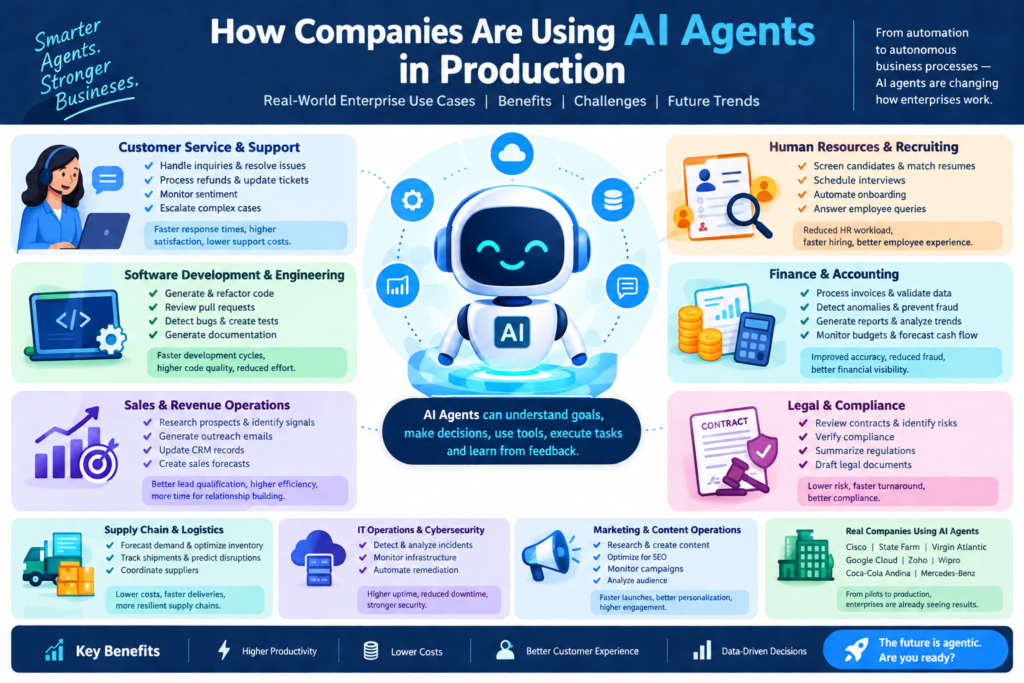
Artificial Intelligence has moved far beyond chatbots and content generation. In 2026, companies are deploying AI agents in production environments to automate complex workflows, improve customer experiences, reduce operational costs, and accelerate business decisions.
Unlike traditional AI systems that simply answer questions, AI agents can reason, plan, take actions, interact with applications, and complete multi-step tasks autonomously. This shift is transforming how enterprises operate across customer service, software engineering, finance, HR, legal, supply chain, and sales.
In this article, we’ll explore how organizations are successfully using AI agents in production, the benefits they are seeing, and the challenges they face when scaling agentic AI.
What Are AI Agents?
An AI agent is an intelligent software system capable of:
- Understanding goals
- Making decisions
- Using tools and APIs
- Executing tasks
- Learning from feedback
- Collaborating with humans and other agents
Unlike a chatbot that simply responds to prompts, an AI agent can complete end-to-end workflows.
Example
A customer asks:
“My package hasn’t arrived.”
A chatbot may provide tracking information.
An AI agent can:
- Check order status
- Verify shipping partner
- Contact logistics systems
- Initiate replacement shipment
- Notify the customer
- Update CRM records
All without human intervention.
Why Enterprises Are Investing in AI Agents
Enterprise adoption is accelerating rapidly.
Recent industry research shows:
- 72% of enterprises are using or testing AI agents.
- 84% plan to increase AI agent investments.
- More than half of surveyed organizations already have agents running in production.
- Gartner projects that 40% of enterprise applications will include task-specific AI agents by the end of 2026.
Organizations are moving from AI-assisted work toward AI-executed work.
1. Customer Service and Support Automation
Customer support remains one of the most mature AI agent use cases.
How AI Agents Help
Agents can:
- Handle customer inquiries
- Troubleshoot issues
- Process refunds
- Update tickets
- Escalate complex cases
- Monitor sentiment
Business Impact
Companies report:
- Faster response times
- Higher customer satisfaction
- Reduced support costs
- 24/7 service availability
Many organizations now deploy AI agents that resolve issues without human intervention while escalating only high-value interactions.
2. Software Development and Engineering
Engineering teams were among the earliest adopters of AI agents.
Production Use Cases
AI coding agents can:
- Generate code
- Refactor legacy applications
- Review pull requests
- Detect bugs
- Create test cases
- Generate documentation
Enterprise Example
Organizations are using coding agents to dramatically reduce development effort. OpenAI reports rapid growth in enterprise agent adoption within engineering teams, while companies such as Virgin Atlantic have used AI-assisted development to refactor legacy systems significantly faster than traditional approaches.
3. Sales and Revenue Operations
Sales organizations are increasingly deploying AI agents to improve productivity.
Common Tasks
AI agents can:
- Research prospects
- Analyze buying signals
- Generate outreach emails
- Update CRM records
- Create sales forecasts
- Prepare meeting briefings
Benefits
- Better lead qualification
- Increased sales efficiency
- Improved forecast accuracy
- More time for relationship building
Cisco’s internal AI deployment allows employees to perform tasks such as market analysis and sales forecasting through personalized AI agents.
4. Human Resources and Recruiting
HR departments are using AI agents to automate administrative work.
HR Agent Capabilities
- Candidate screening
- Resume matching
- Interview scheduling
- Employee onboarding
- Policy assistance
- Training recommendations
Real-World Results
Large enterprises are deploying HR agents that provide instant answers to employee questions and automate repetitive HR workflows, reducing workload on HR teams.
5. Finance and Accounting
Finance teams are embracing AI agents for data-intensive processes.
Key Applications
Invoice Processing
Agents can:
- Extract invoice information
- Validate data
- Detect anomalies
- Route approvals
Financial Analysis
AI agents help:
- Generate reports
- Monitor budgets
- Analyze spending trends
- Predict cash flow
Fraud Detection
Agents continuously monitor transactions and identify suspicious activity for review.
6. Legal and Compliance Operations
Legal departments are finding significant value in agentic AI.
What Legal Agents Do
- Review contracts
- Identify risks
- Verify compliance
- Summarize regulations
- Draft legal documents
Enterprise Adoption
Google Cloud recently introduced industry-specific AI agents designed to automate legal workflows including contract review and compliance management.
Legal teams are among the fastest-growing adopters of AI agents in enterprise environments.
7. Supply Chain and Logistics
Supply chains generate massive amounts of operational data.
AI agents help organizations:
- Forecast demand
- Optimize inventory
- Track shipments
- Predict disruptions
- Coordinate suppliers
Business Outcomes
Companies benefit from:
- Lower inventory costs
- Faster deliveries
- Better demand planning
- Improved resilience
Production-grade AI agents are increasingly being used to automate logistics coordination and operational planning.
8. IT Operations and Cybersecurity
IT teams are adopting AI agents to manage growing infrastructure complexity.
Common Use Cases
Incident Management
Agents can:
- Detect anomalies
- Analyze logs
- Identify root causes
- Trigger remediation workflows
Infrastructure Monitoring
AI agents continuously monitor:
- Cloud resources
- Servers
- Applications
- Network performance
Organizations are using agentic AI to create self-healing systems that automatically resolve operational issues before users are impacted.
9. Marketing and Content Operations
Marketing teams are using AI agents to streamline campaign execution.
Agent Responsibilities
- Competitive research
- Content creation
- SEO optimization
- Campaign monitoring
- Audience analysis
- Performance reporting
Benefits
- Faster campaign launches
- Improved personalization
- Reduced manual effort
- Better customer engagement
OpenAI reports strong growth in marketing adoption of AI agents as organizations automate research and content workflows.
Real Companies Using AI Agents in Production
Several well-known enterprises have already moved beyond pilot projects.
| Company | AI Agent Use Case |
|---|---|
| Cisco | Personalized employee AI agents for productivity, forecasting, and research |
| State Farm | Thousands of internal AI agents supporting business operations |
| Virgin Atlantic | Software development and strategic research |
| Google Cloud Customers | Industry-specific legal and financial workflow automation |
| Zoho | AI-assisted application development and agentic workflows |
| Wipro | Enterprise-scale Gemini and agentic AI adoption |
| Coca-Cola Andina | HR process automation |
| Mercedes-Benz Tech Innovation | Enterprise AI agent ecosystem development |
Challenges Companies Face
While AI agents offer tremendous value, deployment is not without challenges.
Governance
Organizations need:
- Clear approval workflows
- Human oversight
- Audit trails
Security
Agents often access sensitive systems and data.
Enterprises must implement:
- Permission controls
- Data protection
- Compliance monitoring
Reliability
AI hallucinations can create operational risks.
Production deployments require:
- Testing
- Monitoring
- Validation mechanisms
Industry analysts warn that weak governance remains one of the biggest reasons AI agent projects fail.
Best Practices for Deploying AI Agents
Successful enterprises typically follow these principles:
Start Small
Begin with a single workflow.
Measure ROI
Track:
- Cost savings
- Productivity gains
- Time reductions
Keep Humans in the Loop
Critical decisions should still involve human review.
Establish Guardrails
Define:
- Permissions
- Escalation paths
- Security policies
Build for Scale
Use orchestration and monitoring tools from the beginning.
The Future of AI Agents
The next wave of enterprise AI will be driven by multi-agent systems, where specialized agents collaborate to achieve business goals.
Future capabilities will include:
- Autonomous business processes
- Self-healing IT environments
- Intelligent supply chains
- AI-powered decision-making
- Fully automated knowledge work
Industry experts increasingly view AI agents as a foundational component of the modern enterprise rather than an experimental technology.
Conclusion
AI agents are rapidly becoming a core part of enterprise operations. Organizations are already using them to automate customer support, accelerate software development, optimize supply chains, improve HR processes, streamline legal work, and enhance business decision-making.
The companies achieving the greatest success are not treating AI agents as standalone tools. Instead, they integrate them into business workflows, establish strong governance, and focus on measurable outcomes.
As AI technology continues to evolve, enterprises that effectively deploy AI agents today will be better positioned to compete in an increasingly automated and intelligent future.
If you enjoyed this article, you may also like:
- 5 AI Gateways That Offer Free Tokens in 2026
- How to Build a Humanoid Robot in 2026: Costs, Timeline & Complete Blueprint
- Best AI Research Tools in 2026: ChatGPT, Claude, Gemini & Perplexity
- Best AI Resume Builders in 2026 — Free
- ChatGPT Review — Is It Worth Paying For in 2026?
- 10 Best Free AI Tools You Should Use in 2026
- Best AI Video Generators in 2026 — Free and Paid
- Best AI for Students in 2026: Top 10 Tools for Learning
- How AI Learns From Humans to Build Physical Robots
- How AI Learns From Humans to Build Physical Robots
- Why LangGraph Is So Popular in Enterprises — Pros, Cons & Real-World Use Cases in 2026
- ChatGPT vs Gemini vs Claude vs Grok 2026
- DeepSeek V4 vs Grok 4 vs Claude Opus 5 vs Nvidia Nemotron vs Gemini 2.5 Pro — The Ultimate AI Model Comparison for 2026
- AI Agent and LLM Frameworks Comparison 2026: LangChain vs LangGraph vs CrewAI vs AutoGen vs LlamaIndex vs Semantic Kernel
- Best Multi-Agent AI Platforms in 2026: CrewAI vs AutoGen vs LangGraph vs OpenAI Agents SDK vs Agno vs Semantic Kernel
- Best AI Development Platforms in 2026: OpenAI API vs Anthropic API vs Google AI Studio vs Vertex AI vs Azure AI Foundry vs AWS Bedrock vs Hugging Face
- Exploring the Latest AI Tools and Technologies
- How to Use ChatGPT for Business — A Complete Beginner Guide
- How to Write Blog Posts with AI — A Proven Step-by-Step Guide
- Best AI Coding Assistants 2026
- Ultimate Guide to the 10 Best AI Chatbots in 2026
- Claude AI Review — Best ChatGPT Alternative in 2026
- Jasper AI Review — Is It Worth $49/Month in 2026?
- How to Use AI for Social Media Marketing — Complete Guide
- AI Tools for Small Business Owners — Save 10 Hours/Week
- AI Tools for Content Creators
- Best AI Music Generators in 2026 — Create Songs in Minutes
- AI Design Tools Compared: Canva AI vs Adobe Firefly vs Midjourney
- Best AI Writing Tools 2026
- 10 Free AI Tools You Should Try in 2026
- Best AI Image Generators in 2026 — Free and Paid Compared
- Best AI Productivity Tools in 2026 — Work Smarter, Not Harder
- ChatGPT vs Claude in 2026 — Which AI Is Actually Better?
- ChatGPT vs Gemini vs Claude vs Grok (2026): Which AI Assistant Should You Actually Use?
Visit Aidacoit.com for more AI comparisons, practical AI tutorials, enterprise AI insights, and emerging technology trends.