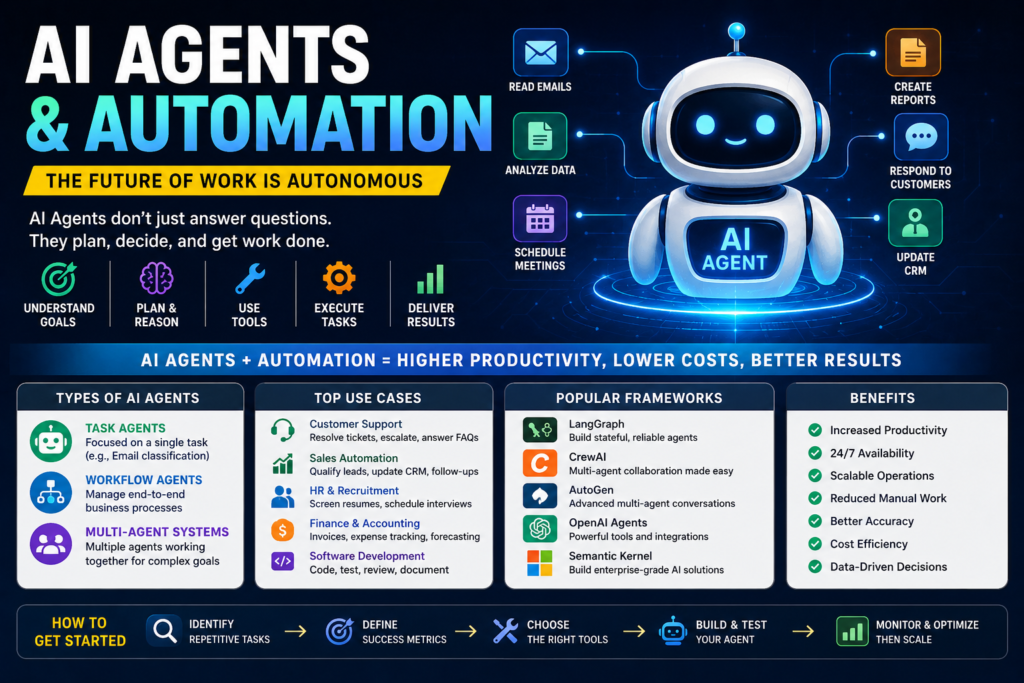
AI Agents & Automation: The Technology Transforming Businesses in 2026
Artificial Intelligence is no longer limited to answering questions.
The next evolution of AI is already here—and it’s called AI Agents.
Unlike traditional chatbots that wait for instructions, AI agents can plan, reason, make decisions, interact with tools, and execute tasks autonomously.
Imagine having a digital employee that:
- Reads emails
- Analyzes documents
- Updates CRM records
- Creates reports
- Schedules meetings
- Responds to customers
- Executes workflows
—all without constant human intervention.
This shift from AI assistance to AI execution is becoming one of the most important technology trends in business. Enterprise adoption of AI agents is accelerating rapidly as organizations move from simple chatbots toward systems that can complete multi-step work autonomously.
In this comprehensive guide, you’ll learn:
- What AI agents are
- How AI automation works
- Single-Agent vs Multi-Agent systems
- Enterprise use cases
- Best AI agent frameworks
- Security and governance
- Implementation roadmap
- Future of AI agents
What Are AI Agents?
An AI agent is an intelligent software system capable of:
- Understanding goals
- Planning actions
- Using tools
- Executing tasks
- Learning from outcomes
- Taking follow-up actions
Traditional AI:
User → Question → Answer
Agentic AI:
User → Goal → Plan → Execute → Deliver Results
Example
Instead of asking:
“Write a customer report.”
You tell an AI Agent:
“Analyze last month’s customer data and create an executive summary.”
The agent can:
- Access databases
- Collect data
- Analyze trends
- Generate charts
- Create reports
- Email stakeholders
without requiring step-by-step instructions.
AI Assistant vs AI Agent
| AI Assistant | AI Agent |
|---|---|
| Responds to prompts | Acts on goals |
| Requires human guidance | Can operate autonomously |
| Single interaction | Multi-step execution |
| Generates content | Completes tasks |
| Limited memory | Maintains workflow context |
This transition from assistance to delegation is one of the defining trends in enterprise AI. Organizations are increasingly using agents to perform work rather than simply provide information.
Why AI Agents Are Exploding in 2026
Industry surveys show rapid growth in production deployments across enterprises, with many organizations already running AI agents in customer service, operations, software development, and business workflows.
Key Drivers
1. Better AI Models
Modern models can:
- Reason effectively
- Handle complex instructions
- Use tools
- Maintain context
2. Workflow Automation Demand
Businesses want:
- Lower costs
- Faster operations
- Better customer experiences
- Increased productivity
3. Enterprise Adoption
Large enterprises are increasingly scaling agentic AI initiatives and coding agents as part of broader digital transformation efforts.
AI Agents Market Growth
The AI agents market is projected to grow dramatically over the coming years, driven by demand for automation, productivity gains, and enterprise adoption.
Types of AI Agents
1. Task Agents
Focused on a single task.
Examples:
- Email classification
- Data extraction
- Report generation
2. Workflow Agents
Manage complete business processes.
Examples:
- Customer onboarding
- Invoice processing
- Recruitment screening
3. Multi-Agent Systems
Multiple specialized agents collaborate together.
Example:
Research Agent →
Analysis Agent →
Writer Agent →
Reviewer Agent →
Publisher Agent
Research suggests multi-agent systems can process significantly more tasks than comparable single-agent approaches when designed correctly.
Top Business Use Cases
Customer Support
AI agents can:
- Resolve tickets
- Escalate issues
- Access knowledge bases
- Generate responses
Organizations report meaningful cost reductions in customer service implementations.
Sales Automation
Agents can:
- Qualify leads
- Update CRM systems
- Generate proposals
- Schedule meetings
- Draft follow-ups
HR & Recruitment
AI agents can:
- Screen resumes
- Schedule interviews
- Generate assessments
- Create offer letters
Finance
Automation opportunities include:
- Expense validation
- Invoice processing
- Forecasting
- Compliance monitoring
Software Development
AI coding agents are among the fastest-growing enterprise use cases.
They can:
- Generate code
- Review pull requests
- Test applications
- Fix bugs
- Create documentation
Many organizations are already scaling coding agents and even replacing some purchased software by building solutions internally.
Best AI Agent Frameworks in 2026
LangGraph
Best for:
- Enterprise workflows
- Stateful agents
- Complex orchestration
Pros
- Production-ready
- Flexible architecture
- Strong ecosystem
CrewAI
Best for:
- Multi-agent collaboration
- Role-based agents
- Team automation
OpenAI Agents
Best for:
- Fast deployment
- Tool calling
- Enterprise integrations
AutoGen
Best for:
- Research workflows
- Multi-agent communication
Semantic Kernel
Best for:
- Microsoft ecosystem
- Enterprise development
AI Automation Tools You Should Know
No-Code Platforms
- n8n
- Zapier
- Make
- Pipedream
Enterprise Platforms
- Microsoft Copilot Studio
- Salesforce Agentforce
- Google Vertex AI
- Azure AI Foundry
- AWS Bedrock
Enterprise vendors are increasingly building products around AI agents, reflecting strong demand for automation across departments.
Security Risks of AI Agents
AI agents are powerful.
But they also introduce risks.
Common Risks
- Prompt injection attacks
- Data leakage
- Unauthorized actions
- Hallucinations
- Excessive autonomy
Security researchers and enterprises are paying growing attention to governance, oversight, and containment of autonomous systems as adoption increases.
Enterprise AI Agent Governance Framework
Before deploying AI agents, establish:
Identity Controls
- Authentication
- Authorization
- Role-based access
Human Approval Gates
Critical actions should require review.
Many production deployments already include mandatory human oversight checkpoints.
Monitoring
Track:
- Decisions
- Tool usage
- Costs
- Outcomes
Auditability
Maintain:
- Logs
- Action history
- Decision records
How to Build Your First AI Agent
Step 1: Identify Repetitive Work
Examples:
- Report generation
- Lead qualification
- Ticket triage
Step 2: Define Success Criteria
Examples:
- Reduce manual effort by 50%
- Cut response times by 70%
Step 3: Select Tools
Choose:
- LLM
- Database
- Automation platform
- Monitoring system
Step 4: Start Small
Build one agent.
Measure results.
Optimize.
Scale later.
Step 5: Add Human Review
Keep humans in the loop until performance is proven.
Future of AI Agents
The future isn’t one giant AI.
It’s a digital workforce of specialized agents.
Experts expect agent adoption to continue expanding across business functions, software development, operations, and customer engagement. At the same time, governance and architecture will determine which projects succeed and which fail.
Coming trends include:
- Agent-to-agent collaboration
- Autonomous business processes
- Agent marketplaces
- AI-driven commerce
- Digital employees
- Self-improving workflows
Even payment systems and enterprise infrastructure are beginning to evolve around autonomous agents.
Final Thoughts
AI Agents are not just another technology trend.
They represent the biggest shift in automation since cloud computing.
Organizations that successfully combine:
- AI models
- Automation platforms
- Governance controls
- Human oversight
will unlock massive gains in productivity, efficiency, and innovation.
The question is no longer whether AI agents will transform business.
The question is how quickly your organization will adopt them.
Start with one workflow. Build one agent. Measure the results. Then scale.
That is how modern enterprises are turning AI from a tool into a digital workforce.
If you enjoyed this article, you may also like:
- 5 AI Gateways That Offer Free Tokens in 2026
- How to Build a Humanoid Robot in 2026: Costs, Timeline & Complete Blueprint
- Best AI Research Tools in 2026: ChatGPT, Claude, Gemini & Perplexity
- Best AI Resume Builders in 2026 — Free
- ChatGPT Review — Is It Worth Paying For in 2026?
- 10 Best Free AI Tools You Should Use in 2026
- Best AI Video Generators in 2026 — Free and Paid
- Best AI for Students in 2026: Top 10 Tools for Learning
- How AI Learns From Humans to Build Physical Robots
- How AI Learns From Humans to Build Physical Robots
- Why LangGraph Is So Popular in Enterprises — Pros, Cons & Real-World Use Cases in 2026
- ChatGPT vs Gemini vs Claude vs Grok 2026
- DeepSeek V4 vs Grok 4 vs Claude Opus 5 vs Nvidia Nemotron vs Gemini 2.5 Pro — The Ultimate AI Model Comparison for 2026
- AI Agent and LLM Frameworks Comparison 2026: LangChain vs LangGraph vs CrewAI vs AutoGen vs LlamaIndex vs Semantic Kernel
- Best Multi-Agent AI Platforms in 2026: CrewAI vs AutoGen vs LangGraph vs OpenAI Agents SDK vs Agno vs Semantic Kernel
- Best AI Development Platforms in 2026: OpenAI API vs Anthropic API vs Google AI Studio vs Vertex AI vs Azure AI Foundry vs AWS Bedrock vs Hugging Face
- Exploring the Latest AI Tools and Technologies
- How to Use ChatGPT for Business — A Complete Beginner Guide
- How to Write Blog Posts with AI — A Proven Step-by-Step Guide
- Best AI Coding Assistants 2026
- Ultimate Guide to the 10 Best AI Chatbots in 2026
- Claude AI Review — Best ChatGPT Alternative in 2026
- Jasper AI Review — Is It Worth $49/Month in 2026?
- How to Use AI for Social Media Marketing — Complete Guide
- AI Tools for Small Business Owners — Save 10 Hours/Week
- AI Tools for Content Creators
- Best AI Music Generators in 2026 — Create Songs in Minutes
- AI Design Tools Compared: Canva AI vs Adobe Firefly vs Midjourney
- Best AI Writing Tools 2026
- 10 Free AI Tools You Should Try in 2026
- Best AI Image Generators in 2026 — Free and Paid Compared
- Best AI Productivity Tools in 2026 — Work Smarter, Not Harder
- ChatGPT vs Claude in 2026 — Which AI Is Actually Better?
- ChatGPT vs Gemini vs Claude vs Grok (2026): Which AI Assistant Should You Actually Use?
Visit Aidacoit.com for more AI comparisons, practical AI tutorials, enterprise AI insights, and emerging technology trends.