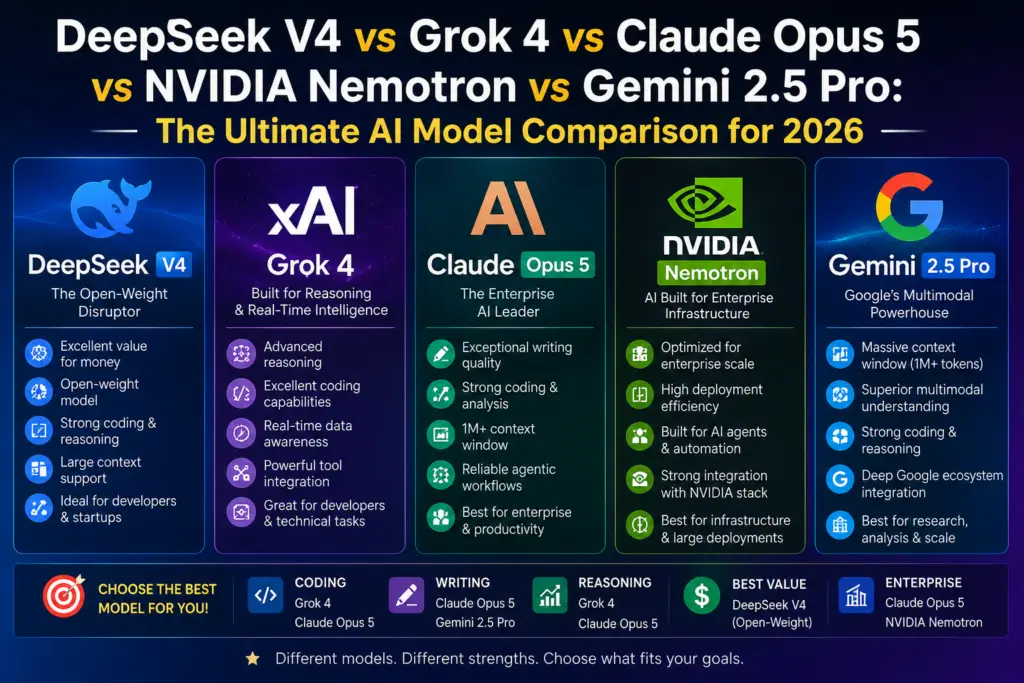
Artificial Intelligence is evolving at an unprecedented pace. What started as simple chatbots has transformed into highly capable AI systems that can write code, analyze large datasets, automate workflows, generate content, and even act as autonomous agents.
In 2026, five AI models stand out as the most influential in the market:
- DeepSeek V4
- Grok 4
- Claude Opus 5
- NVIDIA Nemotron
- Gemini 2.5 Pro
Each model targets a slightly different audience, from developers and enterprises to researchers and content creators. Choosing the right AI model depends on your goals, budget, and workload requirements.
This comprehensive comparison explores the strengths, weaknesses, and ideal use cases of each model.
Quick Comparison Table
| Model | Best For | Key Strength |
|---|---|---|
| DeepSeek V4 | Affordable AI deployment | Open-weight model with excellent value |
| Grok 4 | Advanced reasoning and coding | Strong problem-solving capabilities |
| Claude Opus 5 | Enterprise productivity and writing | High-quality reasoning and agent workflows |
| NVIDIA Nemotron | AI infrastructure and agents | Enterprise-scale deployment |
| Gemini 2.5 Pro | Multimodal analysis and research | Massive context window |
DeepSeek V4: The Open-Weight Disruptor
DeepSeek has become one of the most important names in AI due to its ability to deliver frontier-level performance at significantly lower costs than many proprietary competitors.
DeepSeek V4 introduced major improvements in reasoning, coding, agentic workflows, and long-context processing. The company also emphasized affordable million-token context windows, making large-scale document analysis accessible to more organizations.
Advantages
- Lower operating costs
- Open-weight availability
- Strong coding performance
- Excellent reasoning capabilities
- Large context support
Limitations
- Smaller ecosystem than Google or Anthropic
- Enterprise integrations still evolving
- Fewer consumer-focused features
Best Use Cases
DeepSeek V4 is ideal for:
- Startups
- Independent developers
- AI research projects
- Self-hosted deployments
- Cost-sensitive enterprises
For organizations seeking maximum value per dollar, DeepSeek V4 is among the strongest options available today.
Grok 4: Built for Reasoning and Real-Time Intelligence
xAI’s Grok 4 has rapidly gained attention for its advanced reasoning capabilities and strong performance in coding and technical problem-solving.
Unlike traditional AI assistants, Grok places significant emphasis on reasoning before responding. This allows it to tackle complex mathematical, scientific, and programming tasks with greater accuracy.
Many developers appreciate Grok’s ability to handle difficult coding workflows while maintaining conversational flexibility.
Advantages
- Strong reasoning performance
- Excellent coding capabilities
- Good support for technical workflows
- Powerful tool integration
Limitations
- Higher operational costs than some open models
- Smaller enterprise ecosystem
- Less mature business tooling compared to established enterprise platforms
Best Use Cases
Grok 4 is particularly effective for:
- Software engineering
- AI agent development
- Data analysis
- Technical research
- Problem-solving applications
For users prioritizing raw intelligence and reasoning, Grok 4 remains one of the strongest competitors in the market.
Claude Opus 5: The Enterprise AI Leader
Anthropic has established Claude as one of the most trusted AI families for businesses and professional users.
The release of Claude Opus 5 introduced major improvements in coding, professional knowledge work, and long-running agentic tasks. Anthropic describes Opus 5 as a significant step forward for enterprise-grade AI systems. Claude Opus 5 supports a 1 million token context window and is optimized for complex workflows requiring advanced reasoning and reliability.
Alongside Opus 5, Anthropic also introduced Claude Sonnet 5, which delivers near-flagship performance while maintaining lower costs and faster response times. Anthropic reports substantial improvements in reasoning, coding, tool use, and autonomous workflows compared with earlier Sonnet versions.
Advantages
- Exceptional writing quality
- Strong coding performance
- Excellent reasoning capabilities
- Enterprise security features
- Large context window
- Reliable agent workflows
Limitations
- Premium pricing
- Closed ecosystem
- More expensive than open-weight alternatives
Best Use Cases
Claude Opus 5 excels at:
- Content creation
- Research and analysis
- Enterprise automation
- Knowledge management
- Technical documentation
- Business workflows
For many enterprises, Claude remains the benchmark for high-quality AI-generated content and professional productivity.
NVIDIA Nemotron: AI Built for Enterprise Infrastructure
NVIDIA approaches AI differently from most competitors.
Instead of focusing primarily on consumer-facing chat experiences, the Nemotron family is designed for organizations building AI systems at scale.
Nemotron models are optimized for enterprise deployments, AI agents, large-scale inference workloads, and infrastructure efficiency.
This makes NVIDIA particularly attractive to companies already investing heavily in AI infrastructure and GPU ecosystems.
Advantages
- Enterprise-focused architecture
- Optimized for agentic AI
- High deployment efficiency
- Strong integration with NVIDIA ecosystem
Limitations
- Less consumer-friendly
- Primarily designed for enterprises
- Smaller public adoption compared with major chatbot brands
Best Use Cases
Nemotron is particularly valuable for:
- Large enterprises
- AI infrastructure providers
- Agentic AI systems
- Cloud deployments
- Autonomous workflow automation
Organizations building large-scale AI solutions often consider NVIDIA a foundational technology provider rather than simply another chatbot vendor.
Gemini 2.5 Pro: Google’s Multimodal Powerhouse
Gemini 2.5 Pro remains one of Google’s most advanced AI models and continues to be a leader in multimodal understanding.
One of Gemini’s biggest advantages is its ability to process text, images, video, audio, documents, and code within a unified system. Google also provides a context window exceeding one million tokens, making Gemini exceptionally useful for analyzing large repositories, research datasets, and lengthy business documents.
Google highlights Gemini 2.5 Pro’s strengths in reasoning, coding, web application development, and long-context analysis. The model consistently performs well across industry benchmarks and developer evaluations.
Advantages
- Massive context window
- Excellent multimodal capabilities
- Strong coding performance
- Google ecosystem integration
- Advanced reasoning
Limitations
- Premium pricing for advanced workloads
- Can be overwhelming for smaller projects
- Best experience often tied to Google’s ecosystem
Best Use Cases
Gemini 2.5 Pro is ideal for:
- Research projects
- Long-document analysis
- Multimodal applications
- Enterprise knowledge systems
- Large codebase analysis
For users working with enormous datasets and diverse content types, Gemini remains one of the most capable AI systems available.
Which AI Model Should You Choose?
The answer depends entirely on your priorities.
Choose DeepSeek V4 if:
- You want maximum value for money.
- You prefer open-weight models.
- You plan to self-host AI systems.
Choose Grok 4 if:
- Advanced reasoning is your priority.
- You need strong coding performance.
- You are building technical AI workflows.
Choose Claude Opus 5 if:
- Writing quality matters most.
- You need enterprise-grade reliability.
- Your team works with research, documentation, and business automation.
Choose NVIDIA Nemotron if:
- You’re deploying AI at scale.
- Infrastructure optimization is important.
- You are building autonomous AI agents.
Choose Gemini 2.5 Pro if:
- You work with massive documents.
- Multimodal AI is essential.
- You rely heavily on Google’s ecosystem.
Final Verdict
The AI industry in 2026 is no longer defined by a single dominant model. Instead, each leading model excels in different areas.
DeepSeek V4 offers unmatched value and openness. Grok 4 stands out for advanced reasoning and technical problem-solving. Claude Opus 5 remains a top choice for enterprise productivity and content generation. NVIDIA Nemotron powers large-scale AI infrastructure and autonomous systems, while Gemini 2.5 Pro continues to lead in multimodal understanding and long-context analysis.
The best AI model is not necessarily the most powerful one—it is the one that aligns most closely with your business goals, technical requirements, and budget.
As AI continues to advance, organizations that understand the unique strengths of each model will be better positioned to gain a competitive advantage in the years ahead.
If you enjoyed this article, you may also like:
- 5 AI Gateways That Offer Free Tokens in 2026
- How to Build a Humanoid Robot in 2026: Costs, Timeline & Complete Blueprint
- Best AI Research Tools in 2026: ChatGPT, Claude, Gemini & Perplexity
- Best AI Resume Builders in 2026 — Free
- ChatGPT Review — Is It Worth Paying For in 2026?
- 10 Best Free AI Tools You Should Use in 2026
- Best AI Video Generators in 2026 — Free and Paid
- Best AI for Students in 2026: Top 10 Tools for Learning
- How AI Learns From Humans to Build Physical Robots
- How AI Learns From Humans to Build Physical Robots
- Why LangGraph Is So Popular in Enterprises — Pros, Cons & Real-World Use Cases in 2026
- ChatGPT vs Gemini vs Claude vs Grok 2026
- DeepSeek V4 vs Grok 4 vs Claude Opus 5 vs Nvidia Nemotron vs Gemini 2.5 Pro — The Ultimate AI Model Comparison for 2026
- AI Agent and LLM Frameworks Comparison 2026: LangChain vs LangGraph vs CrewAI vs AutoGen vs LlamaIndex vs Semantic Kernel
- Best Multi-Agent AI Platforms in 2026: CrewAI vs AutoGen vs LangGraph vs OpenAI Agents SDK vs Agno vs Semantic Kernel
- Best AI Development Platforms in 2026: OpenAI API vs Anthropic API vs Google AI Studio vs Vertex AI vs Azure AI Foundry vs AWS Bedrock vs Hugging Face
- Exploring the Latest AI Tools and Technologies
- How to Use ChatGPT for Business — A Complete Beginner Guide
- How to Write Blog Posts with AI — A Proven Step-by-Step Guide
- Best AI Coding Assistants 2026
- Ultimate Guide to the 10 Best AI Chatbots in 2026
- Claude AI Review — Best ChatGPT Alternative in 2026
- Jasper AI Review — Is It Worth $49/Month in 2026?
- How to Use AI for Social Media Marketing — Complete Guide
- AI Tools for Small Business Owners — Save 10 Hours/Week
- AI Tools for Content Creators
- Best AI Music Generators in 2026 — Create Songs in Minutes
- AI Design Tools Compared: Canva AI vs Adobe Firefly vs Midjourney
- Best AI Writing Tools 2026
- 10 Free AI Tools You Should Try in 2026
- Best AI Image Generators in 2026 — Free and Paid Compared
- Best AI Productivity Tools in 2026 — Work Smarter, Not Harder
- ChatGPT vs Claude in 2026 — Which AI Is Actually Better?
Visit Aidacoit.com for more AI comparisons, practical AI tutorials, enterprise AI insights, and emerging technology trends.
Pingback: AI for Content Creators — 8 Tools That Actually Work - Aidacoit
Pingback: AI Design Tools Compared — Canva AI vs Adobe Firefly vs Midjourney - Aidacoit
Pingback: 10 Best AI Chatbots in 2026: Your Complete Guide to Options
Pingback: Why LangGraph Is So Popular in Enterprises: Pros, Cons, and Real-World Use Cases in 2026 - Aidacoit
Pingback: AI Agent and LLM Frameworks Comparison 2026 - Aidacoit
Pingback: ChatGPT vs Gemini vs Claude vs Grok (2026) – Ultimate AI Comparison Guide
Pingback: Is AI Rilo Sold in 200 Cr.? What Is AI Rilo? Why Adobe Acquired This Indian AI Startup Within a Year of Launch - Aidacoit