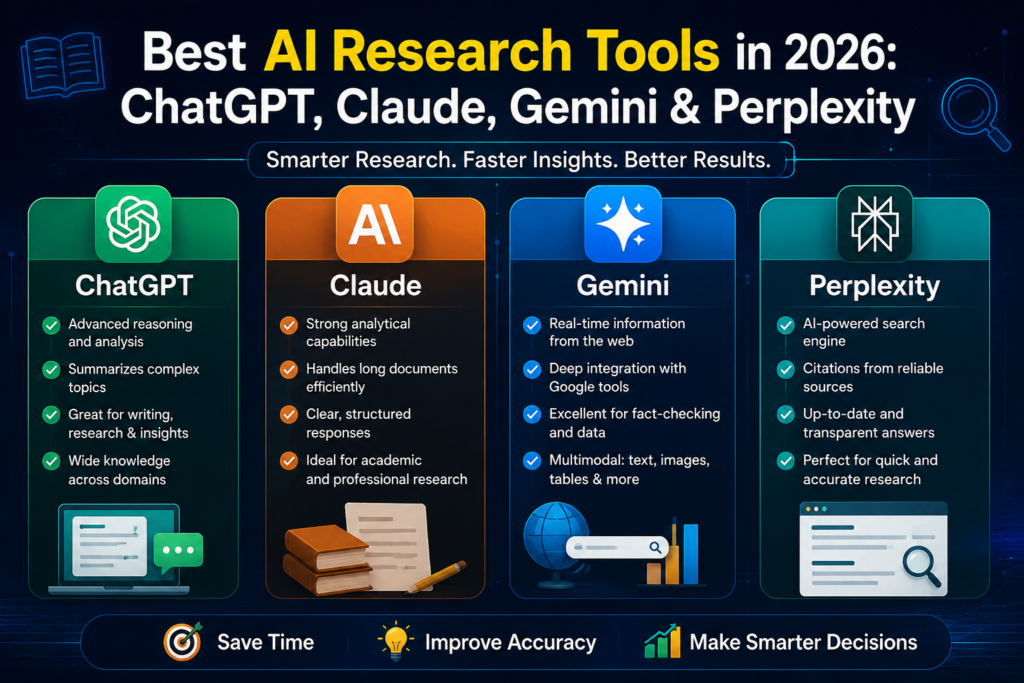
Artificial Intelligence has transformed how we research information, analyze data, summarize documents, and generate insights. In 2026, best AI Research Tools are ChatGPT, Claude, Gemini & Perplexity AI research tools which are more powerful than ever, offering deep web search, source citations, academic analysis, and long-form report generation.
But a common question remains:
Which AI is actually the best for research?
The answer depends on your research goals. Some AI tools excel at finding real-time information with citations, while others are better at analyzing lengthy documents or generating detailed reports.
In this guide, we’ll compare ChatGPT, Claude, Gemini, and Perplexity, the four most popular AI research tools in 2026, and help you decide which one fits your workflow best. Research comparisons across industry evaluations consistently show that each platform has different strengths for research tasks.
Why AI Research Tools Matter in 2026
Traditional search engines require users to:
- Open multiple websites
- Read dozens of articles
- Compare conflicting information
- Create summaries manually
Modern AI research assistants can:
- Search hundreds of sources automatically
- Summarize information instantly
- Generate structured reports
- Provide citations and references
- Analyze PDFs and documents
- Compare viewpoints from multiple sources
This can save hours of work for students, researchers, marketers, consultants, and business professionals.
Quick Comparison Table
| AI Tool | Best For | Web Research | Citations | Document Analysis | Overall Research Score |
|---|---|---|---|---|---|
| Perplexity | Fast fact-finding | Excellent | Excellent | Good | ⭐⭐⭐⭐⭐ |
| ChatGPT Deep Research | Comprehensive reports | Excellent | Good | Very Good | ⭐⭐⭐⭐⭐ |
| Claude | Document analysis | Good | Good | Excellent | ⭐⭐⭐⭐⭐ |
| Gemini | Google-powered research | Excellent | Good | Very Good | ⭐⭐⭐⭐ |
| NotebookLM | Personal documents | Limited | Excellent | Excellent | ⭐⭐⭐⭐⭐ |
Industry reviews consistently rank Perplexity highly for citation-focused research, ChatGPT for comprehensive reports, Claude for document understanding, and Gemini for Google ecosystem integration.
1. Perplexity AI – Best for Everyday Research
What Makes Perplexity Different?
Perplexity was designed specifically for research.
Unlike traditional chatbots, every answer includes source citations and links, making it easier to verify information.
Key Features
✅ Real-time web search
✅ Inline citations
✅ Source transparency
✅ Fast responses
✅ Research-focused interface
Pros
- Excellent citation quality
- Fast research results
- Easy fact-checking
- Strong for current events
- Great free version
Cons
- Less creative than ChatGPT
- Limited customization
- Deep analysis can be shorter
Best For
- Journalists
- Students
- Bloggers
- Market researchers
- Fact-checkers
Many independent comparisons identify Perplexity as one of the strongest options for daily research and source-backed answers because of its citation-first approach.
2. ChatGPT Deep Research – Best for Detailed Reports
OpenAI’s Deep Research feature has become one of the most powerful AI research capabilities available today.
Instead of answering instantly, ChatGPT can spend several minutes analyzing sources and creating a comprehensive report.
Key Features
✅ Multi-step research
✅ Long-form reports
✅ Advanced reasoning
✅ Data synthesis
✅ Follow-up analysis
Pros
- Extremely detailed outputs
- Excellent reasoning
- Strong report structure
- Handles complex topics well
- Great for business analysis
Cons
- Research can take longer
- Citations still require verification
- Premium features may require subscription
Best For
- Consultants
- Analysts
- Researchers
- Business leaders
- Enterprise users
Industry comparisons frequently highlight ChatGPT Deep Research for exhaustive multi-source reports and complex analytical work.
3. Claude – Best for Document Research
Anthropic’s Claude has built a reputation for exceptional document understanding and long-context analysis.
If your research involves PDFs, reports, contracts, academic papers, or lengthy documents, Claude is often the strongest option.
Key Features
✅ Large context window
✅ PDF analysis
✅ Research paper summaries
✅ Long-document reasoning
✅ Strong writing quality
Pros
- Outstanding document analysis
- Excellent summaries
- Strong logical reasoning
- Natural writing style
- Handles large files effectively
Cons
- Web research capabilities vary
- Research speed can be slower
- Citations should still be verified
Best For
- Academic researchers
- Lawyers
- Analysts
- Students
- Technical professionals
Research reviews commonly recommend Claude when the task involves understanding and synthesizing large documents rather than searching the live web.
4. Gemini – Best for Google Ecosystem Users
Google Gemini has evolved into a powerful research platform thanks to Deep Research capabilities and integration with Google’s ecosystem.
Key Features
✅ Google Search integration
✅ Google Workspace support
✅ Large context window
✅ Research planning
✅ Structured reports
Pros
- Strong web grounding
- Excellent Google integration
- Helpful research workflows
- Strong multimodal capabilities
- Useful for students
Cons
- Research quality varies by topic
- Some reports need verification
- Best experience often requires Google services
Best For
- Students
- Google Workspace users
- Educators
- Business teams
- Researchers using Google tools
Google continues to expand Gemini’s research capabilities, including dedicated research and study-focused features.
Which AI Is Best for Different Research Tasks?
Academic Research
Winner: Claude + Elicit
Claude excels at understanding research papers, while academic-focused tools help locate peer-reviewed studies.
Market Research
Winner: ChatGPT Deep Research
Best for competitor analysis, industry trends, and strategic reports.
Fact Checking
Winner: Perplexity
Fast answers with transparent citations make verification easier.
Document Analysis
Winner: Claude
Ideal for lengthy PDFs, reports, and research papers.
Google-Based Research
Winner: Gemini
Strong integration with Google’s search ecosystem and productivity tools.
Best AI Research Workflow in 2026
The most effective researchers don’t rely on a single AI.
A professional workflow often looks like this:
Step 1: Discover Information
Use Perplexity for fast source collection.
Step 2: Deep Analysis
Use ChatGPT Deep Research for comprehensive reports.
Step 3: Document Review
Use Claude to analyze PDFs and source material.
Step 4: Cross-Verification
Use Gemini to validate findings through Google’s ecosystem.
Several industry analyses recommend combining tools rather than relying exclusively on one assistant for high-stakes research.
Common Mistakes When Using AI for Research
1. Trusting Every Citation
Always verify sources manually.
2. Using Only One Tool
Cross-check important findings.
3. Ignoring Primary Sources
AI summaries are useful, but original documents remain essential.
4. Skipping Fact Verification
AI systems can still make mistakes.
5. Treating AI as an Expert
Think of AI as a research assistant, not the final authority.
Research experts consistently caution that all AI research tools can occasionally produce inaccurate or fabricated references, making verification essential.
Final Verdict: Which AI Is Best for Research?
If you need one recommendation for most people in 2026:
🥇 Perplexity — Best overall for daily research and citations.
🥈 ChatGPT Deep Research — Best for detailed reports and complex analysis.
🥉 Claude — Best for document-heavy research.
🏅 Gemini — Best for Google-centric workflows.
The reality is that no single AI dominates every research task. The best researchers combine multiple tools, verify sources, and use AI to accelerate their workflow rather than replace critical thinking.
Conclusion
AI research tools have reached a point where they can save hours of manual work, uncover insights faster, and help users process vast amounts of information. Whether you’re a student writing a thesis, a marketer conducting competitor analysis, or a business professional preparing strategic reports, the right AI research assistant can significantly boost productivity.
For most users, Perplexity and ChatGPT offer the strongest balance of research capability, while Claude shines in document analysis and Gemini excels within the Google ecosystem. Choosing the right tool depends on your goals, budget, and preferred workflow.
Pingback: Best AI Gateways in 2026: Access Multiple AI Models for Free
Pingback: How to Write Blog Posts with AI: A Step-by-Step Guide
Pingback: Claude AI Review — Best ChatGPT Alternative in 2026? - Aidacoit
Pingback: Jasper AI Review — Is It Worth $49/Month in 2026? - Aidacoit
Pingback: AI Design Tools Compared — Canva AI vs Adobe Firefly vs Midjourney - Aidacoit
Pingback: ChatGPT vs Claude in 2026 — Which AI Is Actually Better?
Pingback: The Ultimate AI Model Comparison for 2026 - Aidacoit
Pingback: Why LangGraph Is So Popular in Enterprises: Pros, Cons, and Real-World Use Cases in 2026 - Aidacoit
Pingback: Best AI Development Platforms in 2026 - Aidacoit
Pingback: Best Multi-Agent AI Platforms in 2026 - Aidacoit
Pingback: AI Agent and LLM Frameworks Comparison 2026 - Aidacoit
Pingback: 10 AI Tools That Can Replace Hours of Manual Work Every Week (2026)
Pingback: ChatGPT vs Gemini vs Claude vs Grok (2026) – Ultimate AI Comparison Guide
Pingback: Is AI Rilo Sold in 200 Cr.? What Is AI Rilo? Why Adobe Acquired This Indian AI Startup Within a Year of Launch - Aidacoit
Pingback: Is an AI Agent the Same as a Bot? Understanding the Key Differences in 2026 - Aidacoit